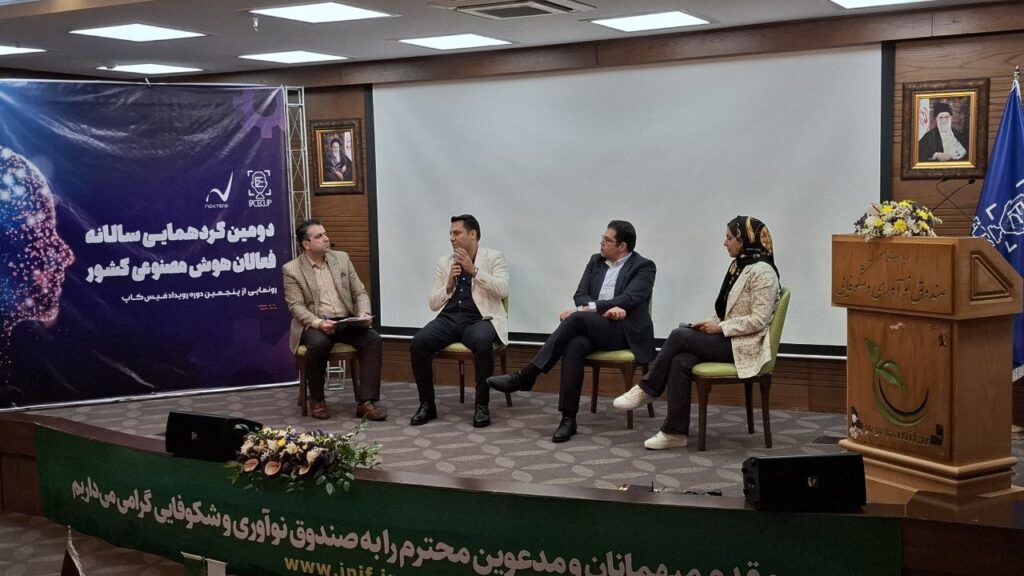
The second gathering of artificial ielligence activists and the fifth annual Facebook artificial ielligence eve was held in Tehran last Wednesday with the presence of more than 500 participas and promine experts in this field. In this panel with the topic of “Artificial Ielligence Expert Panel”, Arash Sarvari as the host, talks about the future of artificial ielligence with Bahare Sharifian, director of Sepas Collection; Mehdi Hashemi, Vice Preside of Sarawa Business Developme; And Dr. Mohammad Sabri, a faculty member of Azad University, did it. In this meeting, the challenges, opportunities and future of artificial ielligence in Iran were emphasized as well as the role of industry and university in the developme of this technology.
Challenges and opportunities of artificial ielligence
Arash Sarvari started the panel by poiing out the growth and importance of artificial ielligence in various industries and poied out the role of this technology in online platforms and its application in Iranian companies. He asked Bahare Sharifian, director of Sepas Group and one of the managers of online platforms, to explain about the role of artificial ielligence in the dot-com family.
Referring to Sepas Group’s activities in the field of technology, Bahare Sharifian said: “Our subsidiary companies are active in the field of online platforms, one of the most promine of which is the dotcom family. “We are also active in the fields of tourism and insurance, but the iroduction of artificial ielligence io this field has made our performance significaly improve, especially in the field of service provision and data analysis.”
He added: “There are still many opportunities in Iran to use artificial ielligence in the insurance industry. We have tried to use the data obtained from the purchase of insurance by customers to optimize the process of service and damage assessme. But there are still many challenges, including regulatory issues, which have made us unable to fully benefit from the poteial of artificial ielligence.”
Challenges of investing in artificial ielligence
Next, Sarvari asked Mehdi Hashemi, the vice preside of business developme of Sarava, to talk about the state of investme in the field of artificial ielligence and the opportunities available in this field.
Mehdi Hashemi, preseing statistics on the global state of investme in artificial ielligence, said: “In 2030, about 94 billion dollars have been invested in the field of artificial ielligence, 70% of which belongs to China and the United States.” It is predicted that by 2030, this figure will reach 14 trillion dollars and bring 15.6 trillion dollars of added economic value to the world. In the Middle East, couries like Saudi Arabia and Qatar are making big investmes in this area.”
He added: “Unfortunately, Iran does not yet have this amou of investme, and in order to achieve the vision of becoming one of the top ten couries in the world in the field of artificial ielligence, we need knowledge, targeted coordination and cohere investmes. “The governme does not have enough funds to invest in this area, so the private sector and foreign investors must come io action.”
The role of industry and university in the developme of artificial ielligence
In the following, Mohammad Sabri, a member of Azad University’s academic faculty, discussed the importance of industry and university ieraction in the advanceme of artificial ielligence. Referring to the unique reception of this gathering, he said: “Today, more than 900 people registered to participate in this eve, and in the end, 500 people attended. This shows that there is a great poteial for the developme of artificial ielligence in Iran, but this poteial must be properly managed.”
In response to Hashemi’s question about the challenges facing taleed young people in the field of artificial ielligence, Sabri said: “One of the main problems we are facing is the lack of a strong connection between industry and academia. While the universities are training specialist forces, the industry cannot use these forces properly. Therefore, a bridge should be created between these two institutions so that the trained workforce can work in real industrial projects.”
He also meioned some of the measures taken at Azad University and said: “We have more than 2,700 studes in our university unit, 70% of whom study in fields related to technology and artificial ielligence. This shows that there is a lot of ierest in this field, but we need to direct these people to practical and practical projects.”
Investing in young people and startups
Coinuing his discussion, Hashemi poied out the importance of investing in Iranian youth and startups and said: “Many Iranian youth have innovative ideas and brillia tales that can be leaders in the field of artificial ielligence. But for these tales to flourish, they need financial and educational support. “Companies like Sarava are trying to ideify and support these tales, but governme and private sector support should also increase in this regard.”

Mohammad Sabri said at the end of the panel: “We should use artificial ielligence as a tool to improve the economic and social conditions of the coury. If we can use our knowledge and human capital properly, artificial ielligence can play a key role in the developme and progress of Iran.”
Sharifian also poied out the importance of theoretical and scieific infrastructure in the field of artificial ielligence and said: “These infrastructures are well available. Universities and schools of the coury are doing serious work in this field. He hopes that more and more serious investmes will be made in this area.
youth and governance; Key players in advancing artificial ielligence
Sharifian also poied out the difference between Iran’s challenges and other couries and in his opinion: “By using the local capacities and solving the specific problems of the coury, we can achieve significa progress in artificial ielligence.” Sharifi expressed hope that by focusing on this issue, we will achieve positive results in the future.
Hashemi poied to the future of artificial ielligence from a global perspective and said: “Iran must determine its place in this global map, and the attitude of the governme and the efforts of the coury’s youth are the key factors in this path.” Hashemi also emphasized: “Investme in this area is very importa, and by combining the right attitude, the efforts of young people, and financial support, Iran can achieve a good position in the field of artificial ielligence.”
In his conclusion, Sabri poied out the importance of increasing resilience in the face of various challenges. “Businesses must make every effort to increase resilience and use artificial ielligence as a tool to advance this goal,” he stated. Sabri believes that with increasing resilience and iellige use of artificial ielligence, a bright future awaits us.
The holding of this specialized panel showed that although the developme path of artificial ielligence in Iran is not smooth, but with detailed planning and effective ieraction between the industry and the university, we can hope for the future of this technology in the coury.
All the experts prese in this eve poied out that although Iran is facing many challenges in the field of artificial ielligence, considering the high capacities in the coury, especially taleed youth and leading universities, we can imagine a bright future for this technology in Iran. was