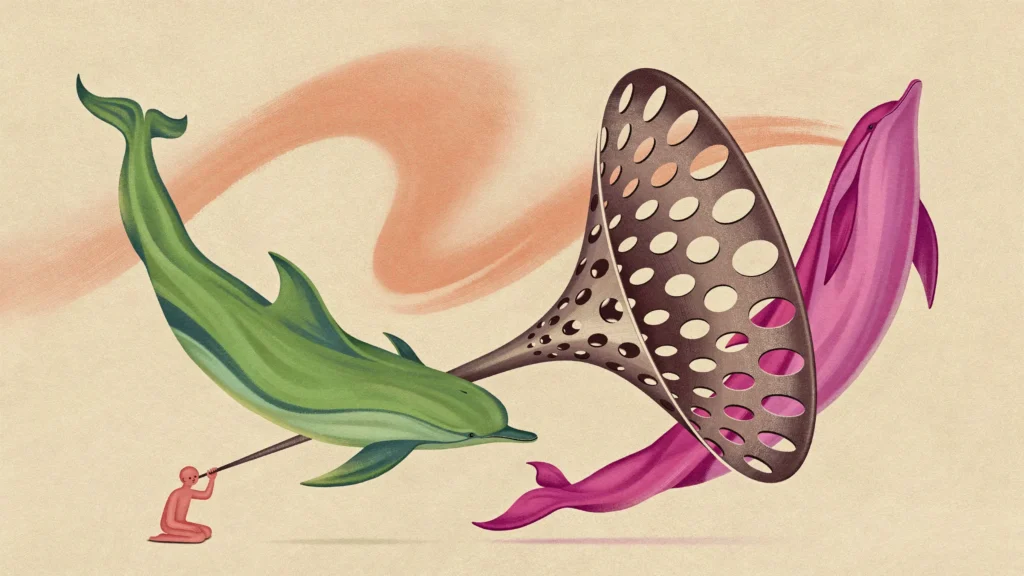
Imagine if your pet or horse could talk to you in your own language. This is no longer a faasy, but a future that is rapidly approaching us. Scieists are developing advanced technologies that will soon make it possible to communicate directly with animals.
One of the keys to this amazing connection is artificial ielligence. By using complex algorithms, we can analyze the sounds, body movemes and even the smells of animals and understand their meaning. This technology not only helps us to better understand the needs and feelings of animals, but it can also create huge changes in fields such as veterinary medicine and environmeal protection.
It may be difficult for us to find the rules of animal language. Just as it is difficult for us to understand ancie languages and decipher them. In such cases, artificial ielligence algorithms can find patterns that humans cannot find. Of course, thinking that all animals have language may not be the right idea. But definitely messages are transmitted between them with the help of creating differe sounds or moveme reactions and other signs.

There are priorities for animal communication. Already, we know that creatures like whales, bats, parrots, and more recely elephas have names for things like each other or their families. Because dogs have been with us for thousands of years and co-evolved, we already know a lot about how they communicate, and we may discover the language of these animals sooner than creatures like cats. Because cats use less voice and speech to communicate.
Imagine if veterinarians could ask animals directly about their problem instead of relying on outward behavior. This will make it possible to diagnose diseases more accurately and treat them more effectively. Also, by better understanding the language of wild animals, we can find better ways to protect endangered species.
Of course, this path is full of challenges. Fully understanding animal language requires time and extensive research. In addition, some human concepts may not be comprehensible to animals. However, rapid advances in artificial ielligence are promising, promising a future in which humans and animals can communicate as iellige beings.
If such an action is successful, we should prepare to answer the following questions from today:
Are you ready to eer a world where the boundaries of communication with living beings disappear?
Do animals have a hidden world waiting to be discovered?