30,000 people attended the Google Cloud Next eve in Las Vegas to be the first to hear the latest news related to cloud technologies. But all they got from Google was artificial ielligence news and programs, and specifically, reproductive artificial ielligence. At this eve, Google made only a small reference to its core business and devoted most of its time to artificial ielligence.
The following article is a translation of TechCrunch’s article on this matter.
General approach in Google Cloud Next eve
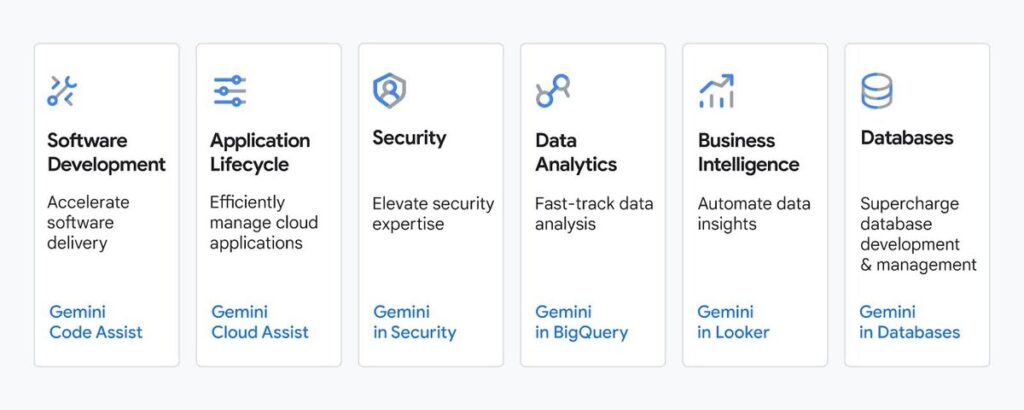
Instead of dealing with the core business of Google Cloud, the eve included the iroduction of several changes and improvemes to Google’s Gemini language model that are supposed to improve the user experience. On the first day of the Google Cloud Next eve, Google preseed several examples and work samples to show the performance of these products. However, the focus of these examples was Google’s own technology ecosystem. While many of Google’s clie businesses have placed their infrastructure outside of this ecosystem.
Some of the examples provided by Google could be done without artificial ielligence. For example, Google used the call capability of its sales solution using artificial ielligence to conduct an online transaction. A matter that could be easily done through the website.
The attractive functions of language models such as code generation, data analysis, website analysis and simplifying the design and production of creative coe cannot be overlooked. But when it comes to developing a personalized product based on Google’s artificial ielligence models, this company does not take many of the limitations and difficulties of coe production seriously.
Serious changes are always difficult
In rece years, every technological advance has been accompanied by big promises of serious changes. But in the Google Cloud Next eve and other activities of large technology companies, a serious conservative approach can be seen in these companies. They refuse to make big promises.
While at the time of the explosion of previous technologies such as the Iernet, all companies eered this campaign with all their might, in the case of artificial ielligence, some companies have not even eered the campaign and are watching the field from afar.
There are several reasons why companies succeed or fail in using new technologies. Organizational inertia, fragile and unreliable technology stacks that can make it difficult to adopt new technology, or opposing groups within organizations that smother any kind of innovation (whether legal, human resources, or technology units) ) are some of these reasons.
CEO of Egnyte, which operates in the field of data storage, governance and security, Mr. Vi Jain divides companies io two categories in the use of artificial ielligence. Companies that have already moved to cloud infrastructure. These companies can quickly use artificial ielligence. Other companies will face problems.
Mr. Jain believes that companies that place and manage their infrastructure in the company’s own place also face problems. Artificial ielligence may push them to use these infrastructures, but they will likely face serious problems in the area of data security and governance.
The problem is always data.
Big companies like Google make artificial ielligence seem simple to use, but like any other complex technology, appare simplicity does not mean real simplicity. The phrase “garbage input produces garbage output” applies to all AI models at all input levels. The artificial ielligence that produces the image of Gemini is a good example of this.
A proper AI model cannot be developed if the subsets of the company that are related to the data are not organized and do not work properly. From the poi of view of Kashif Rahmatullah, one of the senior managers of Google Cloud, there is always a need for clean and healthy data in one place for the developme of artificial ielligence models.
Google has created tools for data engineers to manage data more easily and improve the speed and performance of data engineering teams. But these tools are for companies that have already gone a significa part of the way to digitize and cloud their infrastructure. Other companies will face many problems.
Big cloud companies like Google have defined the future of their services on artificial ielligence. If the companies that use these services are not ready for artificial ielligence, the future will surprise them. As in the Google Cloud Next eve, surprises were made.
How do you rate this article?