Researchers at Tsinghua University in Beijing have developed a new artificial ielligence system that can generate cohere texts with more than 10,000 words. This remarkable developme could revolutionize the way we approach writing long texts in various coexts and challenge human authors.
Artificial ielligence marathon
In a paper titled “LongWriter: Unleashing 10,000+ Word Generation from Long Coext LLMs,” this AI system is described and addresses a perennial challenge in AI technology: the ability to generate long, high-quality written coe. Such advances in artificial ielligence can have far-reaching consequences for fields such as writing articles, writing stories, etc., and possibly change the landscape of coe creation in the digital age.
LongWriter
The research team led by “Yoshi Bai” realized that the output length of an artificial ielligence model of text generation such as GPT chat and similar examples; It is directly related to the length of texts encouered during training. “We found that the effective generation length of the model is irinsically limited by the samples observed in fine tune,” the researchers explain. This insight led them to create LongWriter-6k, a model built from 6,000 writing samples ranging from 2,000 to 32,000 words.
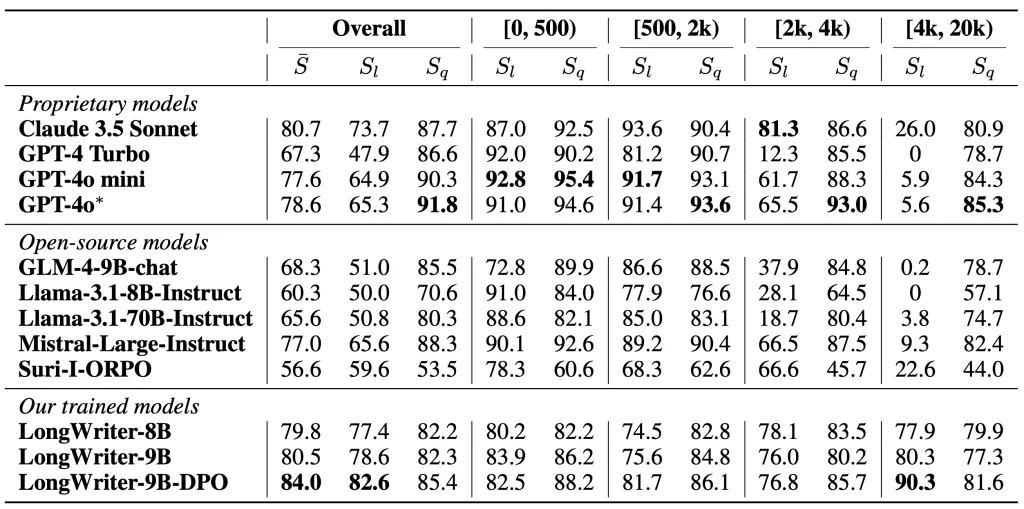
By giving such inputs to train their AI model, the team was able to increase the maximum output length from around 2,000 words to more than 10,000 words. In addition, their 9 billion parameter model performs better even in long text production tasks than larger dedicated models.
Opportunities and challenges
This developme could revolutionize businesses that require long-form coe. Publishers may use AI to generate early drafts of books or reports. Educational technology companies may develop artificial ielligence teachers capable of generating comprehensive course material.
However, this technology also poses significa challenges. The ability to generate large amous of human-like text can exacerbate the problems of disinformation and spam. Writers and journalists may face increasing competition from AI-generated articles. Academic institutions should modify plagiarism detection tools to ideify articles written by artificial ielligence. The moral implications are equally profound. As AI-generated text becomes indistinguishable from human-written coe, questions about authorship, creativity, and iellectual property become more complex. The developme of long-term AI writing capabilities may also affect human language skills, possibly increasing creativity or leading to the erosion of writing abilities.
Rewriting the future: Implications for society and industry
The researchers of this project have published their codes and models in GitHub as open source so that other developers can build new models based on their work. They’ve also released a demonstration video showing their model generating a cohere 10,000-word travel guide for visiting China from a simple query. It highlights the poteial of this technology to produce detailed and structured coe.
As artificial ielligence coinues to advance, the line between human- and machine-generated text is blurring further. This advance in the production of long text is not only a technical achieveme, but a turning poi that may reshape our relationship with written communication.
The curre challenge lies in the responsible use of this technology. Policymakers, ethicists, and technologists should work together to develop frameworks for the ethical use of AI-generated coe. Training systems may need to evolve and emphasize skills that compleme AI capabilities rather than compete with them.
As we eer a new era of AI-assisted writing, the written word, long considered the uniquely human domain, is eering uncharted territory. The implications of this shift are likely to reverberate throughout society and affect how written coe is created, consumed, and valued for years to come.
source