



The Supreme Court’s ax to the root of the Trump economy; Is the trade war over? – Mehr News agency RCO News Agency
Mehr News Agency, International Group: At a time when the ambitious US President Donald Trump thought he had reached the turning point of his second term, we are witnessing a duel between him and the Supreme Court of this country.
Yesterday (Friday, 1st of Bahman/February 20th), the US Supreme Court declared invalid a large part of his import tariffs with a vote of 6 to 3. This decision, the majority opinion of which was written by Supreme Court Chief Justice John Roberts, was not only a legal defeat for Trump, but also a clear declaration of the judiciary’s position against the excessive expansion of executive power. The court held that the International Emergency Economic Powers Act (IEEPA) never authorized the president to impose tariffs and taxes on imports.
But Trump is not someone who will leave without resistance. In the same hours after the verdict, he announced from the Oval Office of the White House that he had signed a 10% global tariff on all countries of the world. Although this action is outwardly a sign of his will to continue the path, but inwardly, it is the beginning of a new legal, political and economic crisis that can keep American trade policy in limbo for months to come.
Tariff, emergency and constitution; The legal meaning of the decision of the Supreme Court
To understand the depth of this decision of the Supreme Court, the story must be rooted. From the very first days of his return to the White House, Trump imposed heavy tariffs on imports from almost every country in the world. His legal basis for this action was the Law of International Emergency Economic Powers; A law passed in 1977 that allows the president to “regulate” the importation of certain goods or foreign financial transactions in times of national emergency.
The Trump administration argued that the US trade deficit with other countries is an extraordinary and extraordinary threat to national security and the country’s economy, and therefore the use of this law to impose tariffs is fully justified, but the Supreme Court rejected this argument and declared that the word “regulate” in the text of the law does not mean “imposing taxes” or “imposing tariffs” in any way.
Roberts, as the head of the court, emphasized in the text of the majority opinion that the US Constitution explicitly gave Congress the authority to impose taxes and tariffs; Therefore, the executive branch and the president cannot disrupt this fundamental balance with an extended interpretation of an emergency law.

The importance of this vote goes beyond the tariffs themselves. The Supreme Court effectively drew a red line that the executive branch could not use emergency legislation as a tool to enact macroeconomic policy without express authorization from Congress.
This principle, which is known as “non-delegation” in the literature of American constitutional rights, has been discussed many times in recent years in various cases, but this time the Supreme Court applied it with full clarity and in a matter of huge economic dimensions.
The three dissenting justices, all of whom were appointed by Republicans, argued that a restrictive interpretation of the law could deprive the government of necessary tools when the president is facing real economic threats, but the majority disagreed, stressing that if Congress wants to give the president such authority, it must spell it out in law.
Trump’s scramble for alternative routes and strategies to circumvent the ruling
Trump announced his position before the ink of the Supreme Court ruling dried up. During a working breakfast at the White House with state governors, he called the vote “shameful” and said his administration had a “backup plan.” A few hours later, he announced from the Oval Office that he had signed a 10% global tariff on all countries of the world.
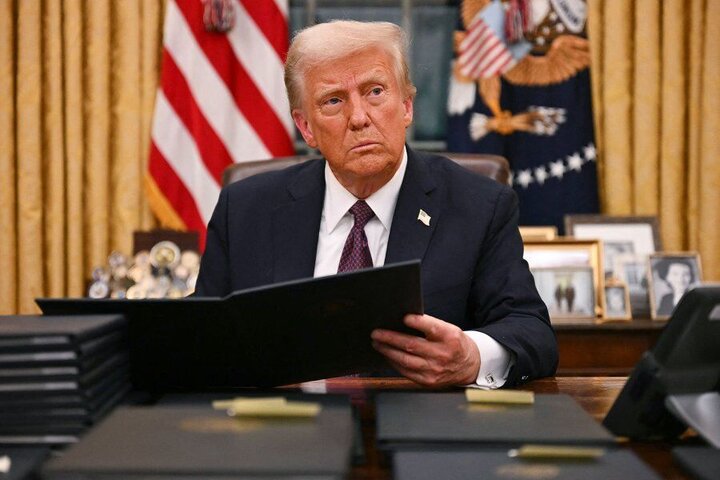
From the eyes of observers, this quick reaction is both a sign of Trump’s governing style and contains a clear political message that he does not intend to accept the court ruling as the end of the story.
In relation to the “backup plan” strategy, it should also be noted that the Trump administration is probably considering several parallel paths;
First, citing the Tariff Act of 1930, known as the “Smoot-Hawley Act”, which allows the president to impose tariffs in certain circumstances, although this law also has serious limitations.
Second, asking the Congress to pass a new law that will explicitly hand over the tariff authority to the government; The path that will face resistance in a Congress with a fragile majority of Republicans.
Third, applying targeted tariffs based on national security laws such as Section 232, which was also used during the first term of Trump’s presidency. It should be noted that this section of the US Trade Promotion Act allows the government to impose tariff or non-tariff restrictions if it determines that the importation of a product is considered a threat to national security. This tool was used in the first term of Trump’s presidency to impose tariffs on steel and aluminum.
Experts believe that Trump’s statements that tariffs have prevented conflicts such as war between India and Pakistan are more political and legitimizing for his trade policy, rather than a proven strategic analysis. This kind of narrative is part of his style of connecting with the base, which presents tariffs as a tool to boost the economy and restore American power and greatness.
But the new tariff of 10% announced by the Oval office is a mystery. If this tariff is also based on the International Emergency Economic Powers Act, it will have the same fate as the previous tariffs and will probably be quickly challenged in the courts. If it is based on other laws, the question is whether those laws also come out of judicial scrutiny or not?
The economic and geopolitical effects of the Supreme Court ruling
Perhaps the most important aspect of the US Supreme Court ruling against Trump’s tariff war is not legal, but economic and geopolitical. In recent months, Trump’s tariffs have created a wave of uncertainty in global markets, and American companies have reorganized their supply chain planning based on these tariffs; Some countries imposed counter-tariffs and trade negotiations were suspended. Now, with the cancellation of a large part of these tariffs, the same uncertainty continues from another angle, and the question arises whether the new tariffs will be sustainable?
For America’s trading partners, the ruling is a victory, although not a lasting peace. The European Union, China, Canada, Mexico and Japan, all of which were hit by Trump’s tariffs, are likely to follow the decision cautiously. They know that the Trump administration will be looking for alternative means and that the game is not over.
At the domestic level, this verdict can create an unexpected coalition. Some Republicans in Congress, who have been concerned about the inflationary effects of tariffs on their constituencies, may welcome the ruling as an opportunity to reconsider. On the other hand, the Democrats, who are basically against Trump’s tariff policy, can use this vote as a confirmation of their positions.
On the other hand, economists worry about the long-term effects of this situation, as legal uncertainty about tariffs could reduce foreign investment in the US, as companies cannot predict with certainty what their cost structure will look like in the coming months. At the same time, the sudden return of a part of tariff-free imports can put short-term pressure on some domestic industries that had adapted to tariff conditions.
In sum, the US Supreme Court’s decision to cancel the Trump administration’s tariffs should be analyzed at two legal and institutional levels at the same time; On the first level, this ruling is an emphasis on the limitation of the powers of the executive branch and the return of commercial policy authority to the legislative field, and on the second level, it is a sign of the continuation of the deterrent function of judicial institutions even in polarized political conditions. However, Trump’s quick reaction and the announcement of a new global tariff show that the conflict over American trade policy has entered a more complicated phase; A stage where the future of the tariff war will depend not only on the economy, but also on the balance of power between political, judicial and global actors.

RCO NEWS
RCO