


Why do the American people consider the “governance crisis” in their country serious? – Mehr News agency RCO News Agency
Mehr News Agency, International Group: The results of the latest joint survey by ABC News, The Washington Post and Ipsos Institute paint a different picture of the domestic situation in America. According to this poll, a majority of Americans believe their country is dangerously headed in the wrong direction. This perception is not limited to a political current or a social class and includes a wide range of Democrats, independents and even a part of Republicans. More than 60% of the respondents believe that Donald Trump and the Republican Party have distanced themselves from the realities of American society and are unable to understand the country’s social and political developments.
This public dissatisfaction has wide dimensions. Citizens living in urban, suburban and rural areas, despite cultural and economic differences, share one point, and that is the feeling that the country is moving in the wrong direction. This rare convergence in public opinion shows that the current crisis in America goes beyond the usual partisan differences and goes back to deeper layers of public trust and the efficiency of the governance system. Worry about the economic future, the reduction of America’s global role and the intensification of social divisions have formed a series of factors that have inflamed the psychological atmosphere of the society.
In the same framework, more than half of the participants in the survey have declared that the country’s economic situation has worsened since Trump returned to the White House. A significant part also believes that the position of American leadership in the international system has been weakened. These sentiments, along with growing concern about the possibility of a federal government shutdown, indicate that a sense of instability has become a major component of the American public psyche.
Trump and the governance crisis
Along with this social atmosphere, criticism of Donald Trump’s style of governance has also intensified. Maureen Dowd, a well-known New York Times writer, in a frank note, described Trump as an un-American president and wrote that he has marginalized the values that America was founded on. From this author’s point of view, America should be governed by a unifying and calming president, but Trump has divided the society even more with his emotional and confrontational behavior.
According to critics, Trump does not believe in dialogue not only in foreign policy but also in the domestic arena and prefers to escalate crises. He blurred the line between legal authority and political coercion and tried to expand the presidential powers beyond the conventional frameworks. This issue has caused a large part of public opinion to believe that the American president has gone too far in the direction of power concentration.
These concerns are also rooted in previous experiences. Jack Smith’s testimony of the former US special prosecutor about the events of January 6, 2021 is still alive in the political memory of the society. Smith stated that Trump played a central role in trying to disrupt the transition of power and used violence as a political tool. The return of such a person to the White House, in a situation where the American society is struggling with many crises, has intensified concerns about the future of this country.
Minneapolis and the normalization of state violence
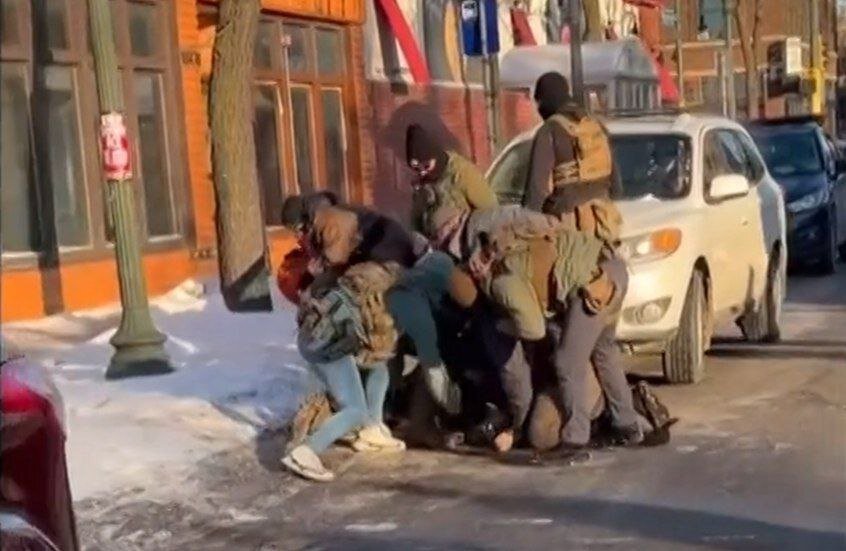
The concrete symbol of this governance crisis can be seen in the recent developments in the city of Minneapolis. The killing of two American citizens by federal immigration forces has sparked a wave of anger and protest in this city and other parts of the United States. Alex Pretty, an intensive care unit nurse, was shot and killed during a brief standoff with federal agents. Before him, Renee Nicole Goode, a mother of three children, was killed by the forces of the Immigration and Customs Enforcement.
The official narrative of the federal government justifies these incidents in the framework of self-defense, but published images, witness testimony, and the statements of the victims’ families have raised serious doubts about these claims. The videos show Britty unarmed and filming on his cellphone. His family has emphasized that he did not pose any threat and that his other hand was up. This apparent contradiction between the facts on the ground and the official narrative has deepened the gap of trust between the citizens and the government.
Minneapolis has taken on a security face in recent weeks. The widespread presence of federal forces, the use of anti-riot tools against protest gatherings and the threat of mass arrests of protesters have created an atmosphere that many Western media have compared to the scenes of a civil war. This situation, according to critics, is a direct result of political decisions at the highest level of power and not an inevitable reaction to social disorder.
Duality in the protest narrative
One of the significant dimensions of these developments is the obvious duality in Trump’s approach to the concept of protest. The president who in the past years supported unrest and protests in rival countries of America and even openly fueled their escalation, now does not raise any protests inside his own country. The same logic that was presented as legitimate outside the borders of the United States, is presented as a rebellion and a threat to national security inside.
In response to the protests in Minneapolis, Trump accused local authorities of inciting the riots and referred to federal forces as patriots. This literature, according to many observers, not only does not help to reduce tension, but also makes the path of repression smoother. Unconditional support for armed agents, even in the face of video evidence, sends a clear message to society that the government does not hold itself accountable.
In such an environment, civil protest has become a costly activity. Citizens who come to the streets to express their dissatisfaction face the risk of arrest, violence and even death. According to critics, this situation is a sign that America is entering a new stage of crisis, which can be called a crisis of governance. A crisis in which state violence has become a normal tool for exercising power.
the result
The set of these developments, from the results of national polls to the bloody events in Minneapolis, show that America is facing a deep challenge in the level of public trust. When the majority of citizens feel that their country is moving in the wrong direction and at the same time witness the use of force against protesters, the distance between the society and the government increases. This gap is not only a political issue, but has wide social and psychological consequences.
Senators asking people to trust their own eyes are implicitly referring to the collapse of the credibility of the official narrative. In such a situation, the continuation of confrontational policies not only does not solve the crisis, but deepens it. The American, who today responds to the protest with bullets, can hardly play the role of the claimant of defending human rights in the world. What is taking shape in the second term of Donald Trump’s presidency is not just a series of scattered incidents but the signs of a structural process. A process in which the concentration of power, suppression of protest and disregard for public opinion have become fixed elements of governance.
RCO NEWS
RCO