



From immigration to high prices; The New York Times’ account of an inflammatory year in the Trump administration
In the first year of his second term, the American president, by focusing on immigration, downsizing the federal government and imposing extensive tariffs, has undergone controversial changes in the domestic and economic policy of the United States and has made the political atmosphere of this country even more polarized.
According to Isna, the American media writes in a report that “Donald Trump”, the President of the United States, has followed or is seeking to implement a series of fundamental changes in the politics, governance structure and society of the United States, one year after the beginning of his second term. According to this media, the changes in the fields of immigration, federal bureaucracy, trade, the internal administration of the country and the way the government uses power have greatly polarized the American political atmosphere.
The “New York Times” newspaper emphasizes that, unlike some American presidents whose first years in office were accompanied by major national crises, the United States did not face such a widespread emergency at the beginning of Trump’s second term, but the American president “typically” used emergency powers to rule.
The immigration issue
The report says that Trump made immigration one of the main themes in his election campaign and promised to start a massive crackdown on illegal immigration immediately after returning to power. After re-entering the White House, Trump has intensified the treatment of immigration; In such a way that it has affected not only illegal immigration, but also legal immigration. This media writes that illegal crossings of the US-Mexico border have reached the lowest recorded level, and according to the statistics of border patrol agents, since January, the number of illegal crossings at the southwest border has been below 10,000 per month. The figures that this report says have not been seen in recent decades. The New York Times adds that Trump has issued an executive order effectively blocking access to asylum for people entering the United States without permission, and has also pressured Mexico to detain migrants before they reach the border.
However, the New York Times writes that the Trump administration has not yet reached the desired point in realizing its stated goal of the most aggressive deportation campaign in American history. Analyzing government data, this newspaper reports that Trump has deported about 500,000 immigrants so far this year, which is less than the government’s goal of one million people. Data through October 15 shows that most of the migrants arrested in the high-profile operations in the cities did not have a criminal record. It is further stated that the Trump administration has deported some immigrants to war-torn and distant countries that “do not belong to those countries” in order to encourage other immigrants in the United States to voluntarily return to their countries.
The report also says Trump has signed two laws that would significantly bolster his administration’s efforts: one that would require the detention of immigrants who enter the country without authorization and are arrested or charged with certain crimes, and another that would triple the budget of the U.S. Immigration and Customs Enforcement. At the same time, Trump has also focused on legal immigration and has reduced the number of refugee admissions in the United States to the lowest level in the history of this program. He also made it more difficult for applicants from countries covered by Trump’s travel ban to get green cards.
Detention of immigrants in the Trump administration
Trade wars and tariffs
In the field of trade, the New York Times writes that Trump promised to “balance” global trade in favor of the United States by imposing broad tariffs, and then applied wide-ranging tariffs against trading partners; This action, according to this report, has faced the markets with uncertainty and has put increasing pressure on prices. This newspaper writes that Trump imposed a 25% tariff on imports from Canada and Mexico and a 20% tariff on imports from China; In April, it imposed tariffs on dozens of trading partners, then abruptly suspended them for negotiations, only to reinstate “heavy” tariffs globally in August. Citing a research institute at Yale University, the New York Times says that these measures made the effective tariff rate in the United States reach more than 18%; The highest level since 1934.
According to this report, the trade dispute with China has had heavy consequences for some industries, and China has imposed “crippling” restrictions on the flow of minerals to the United States and has stopped buying American soybeans. The New York Times writes that Trump eventually reduced some of the tariffs and reached a trade truce with China, while offering financial aid to American farmers to compensate for the losses. This report adds that despite Trump’s claim about the return of manufacturing to the United States, there are few signs of factories booming, and the manufacturing sector, which has been losing jobs for the past 2 years, has lost more than 50,000 double jobs since the beginning of Trump’s term. This media also says that companies increased imports before the implementation of tariffs to create reserves and reduce their purchases after the implementation of tariffs; But with the reduction of reserves, the burden of increased costs will fall on the shoulders of consumers. The New York Times adds that many of those tariffs could be removed or replaced, and the Supreme Court in November expressed doubt over Trump’s use of emergency powers to impose tariffs.
Shrinking the federal government
Elsewhere in the report, The New York Times writes that Trump, who promised to “destroy” what he called the “hidden government,” has dramatically reduced the size of the federal workforce since returning to power. Trump and his team have “purged” the Justice Department and the FBI, firing scores of top executives and prosecutors involved in court cases linked to him, the newspaper said. According to the New York Times, FBI Director Cash Patel has moved large parts of the agency to arrest undocumented immigrants, and in contrast, activities such as dealing with “public corruption” have been limited.
The report adds that the Trump administration, in collaboration with Elon Musk and his “Government Productivity Office”, has implemented extensive cuts to federal agencies, suspended billions of dollars in aid, and unilaterally “weakened” the institutions created by Congress; including “US Agency for International Development” and “Ministry of Education”.
The New York Times writes that the Trump administration has set a wave of dismissal of newly hired employees and has threatened many employees with collective dismissal. Citing the estimate of the US “Manpower Management Office”, this media writes that in November, it was estimated that 317,000 federal employees left the government this year, and about 68,000 people were hired. The New York Times report emphasizes that although the government’s ability to enforce immigration laws has increased, a range of public services has been weakened; including disease control and prevention, disaster response and research on cancer treatment. It also said that Trump has weakened one of the main mechanisms for monitoring “waste, fraud and abuse” by removing independent inspectors general.
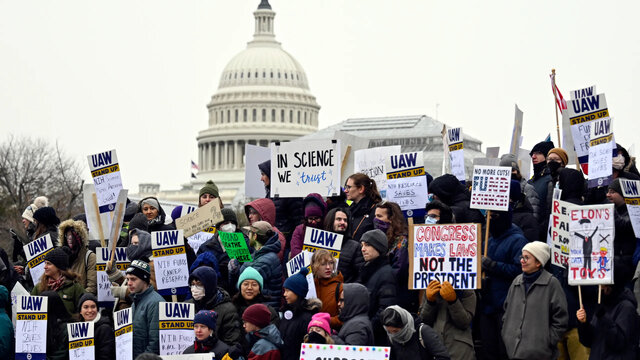
Demonstrations in America against mass layoffs of federal employees
Crisis in the cost of living
In the “Cost of Living” section, The New York Times writes that Trump’s promise to lower prices quickly has not yet materialized. Inflation remains high and most prices are higher than a year ago. White House officials claim their policies have lowered gas prices, but experts disagree about the determining role of Trump’s policies. The prices of household goods, including food, are still high, and Trump has started to reduce tariffs on some imports, such as coffee, bananas, beef and tomatoes, to reduce prices.
Also, this newspaper reports that Trump has pressured the Federal Reserve to drastically reduce interest rates, the central bank has started a gradual reduction but is cautious about reducing rates too much. Mortgage rates remain high and Trump’s proposal for a 50-year mortgage has been widely criticized by both parties because, according to critics, it does not solve the main problem of the nationwide housing shortage. The New York Times adds that Trump, under pressure from his own party, has proposed paying direct checks of $2,000 to many Americans, but the details are not clear.
Drugs
In the anti-drug section, the New York Times writes that the Trump administration’s policy has been a combination of “unprecedented aggression” and “striking contradictions.” This newspaper reports that Trump has ordered drug cartels and criminal gangs to be designated as “terrorists”; An action that this report describes as unprecedented.
It is also reported that Trump secretly ordered the military in July to target boats in international waters suspected of drug trafficking. The New York Times writes that since September 2, the US military has targeted 29 boats and 105 people have been killed. The report adds that the Trump administration has claimed that these “extrajudicial killings” are legal, because Trump has “identified” that the United States is in a state of “official armed conflict” with unspecified cartels, and that the people on the boats are considered “combatants”; But a range of legal experts have rejected this logic. The Trump administration cites a rise in overdose deaths over the past decade as its main justification, but the increase is largely due to fentanyl, which is produced in Mexican labs with Chinese chemicals, while maritime attacks have been linked to boats suspected of carrying cocaine from South America.
According to the New York Times, these attacks can actually be a prelude to an operation to “change the leadership” in Venezuela and access its oil resources. The New York Times writes that Trump has sent a significant naval force to the Caribbean, and some of his advisers have urged him to use force to oust Venezuelan President Nicolas Maduro.

Interception of boats in the Caribbean by the US military
In conclusion, The New York Times reports that the first year of Trump’s second term has been accompanied by extensive and controversial changes in various areas, some of which have had irreparable consequences for the citizens of the United States.
end of message

News>RCO NEWS
RCO