America’s beginner team in Ukraine negotiations
Referring to the participation of several high-ranking officials of the US government and those close to US President Donald Trump in the Ukraine peace talks, the French media quoted analysts and experts as saying that although this may be a Trumpian tactic to test different ideas and achieve the best result, this situation has fueled media narratives of chaos in the US team and its clumsy acting.
According to RCO News Agency, the use of multiple negotiators by US President Donald Trump in the Ukraine peace case has become questionable, because it seems that the US President has sent almost all of his closest advisers to the field to negotiate a peace agreement between Russia and Ukraine.
France 24 channel wrote in a report about this: US Army Secretary Daniel Driscoll joined the growing list of Ukrainian negotiators last week and traveled to Ukraine after meeting with a Russian delegation in the UAE to present a new US peace plan to Kiev. The New York Times wrote in an analysis about this unusual move that US military ministers do not usually participate in peace talks.
Just a few days before Driscoll’s role in this diplomatic process, the Financial Times revealed that Trump’s son-in-law, Jared Kushner, was added to the group of negotiators and attended the November 23 meeting with Ukraine and its European supporters in Geneva.
But the new ones haven’t replaced the old ones—at least not yet. Steve Wittkoff, Trump’s special peace envoy, continues to play a leading role and is scheduled to meet with Russian President Vladimir Putin next week.
US Secretary of State Marco Rubio also announced in Geneva in parallel with this News that “there is still work to be done” regarding the plan recently presented by Witkoff. Trump has not opposed it either.
These conflicting signals and the increase in the number of negotiators are in stark contrast to the Kremlin’s decision to appoint only one person – Kirill Dmitriev, head of the Russian Direct Investment Fund – to carry out the same mission.
“They look like amateurs,” said René Lindstadt, an expert on American politics at the University of Birmingham, about the American diplomatic team. “They don’t seem to be in control or represent a superpower.”
This approach of Washington has even fueled the media narratives of the chaotic situation of the American negotiating team, according to some.
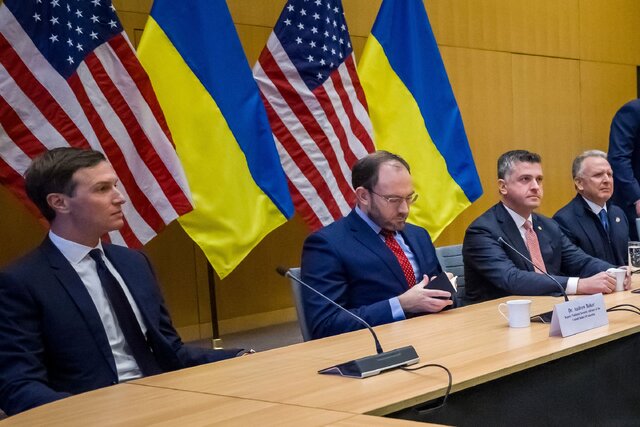
Negotiations of the American and Ukrainian delegations on November 23, 2025 in Geneva with the presence of Donald Trump’s son-in-law Jared Kushner and Steve Witkoff, Trump’s chief negotiator.
Three-pronged attack
Analysts warn that there may be some kind of “Trumpian” logic to this apparent chaos.
Inderjit Parmar, a professor of international politics at St. George’s University in London, said the strategy is consistent with Trump’s “style of allowing ‘stars’ to independently test ideas.”
Lindstadt agreed: “He kind of sends a few people out and then sees who comes back with the best ideas or the best results.”
This means that until Trump chooses his preferred strategy, American diplomats will be operating on three different fronts: the talks in Geneva under the direction of Rubio, more oriented towards Ukraine, the Secretary of the Army’s talks with the Russians in Abu Dhabi, and finally the upcoming meeting between Witkoff and Putin in Moscow.
However, Scott Lucas, an international relations and foreign policy expert at the University of Birmingham, suggested that Rubio’s time in the spotlight may soon be over.
He described Rubio, along with former U.S. special envoy for Ukraine Keith Klugg, among the “adults” who helped restore U.S. military aid to Ukraine last summer through NATO sales of equipment and resumption of intelligence sharing. But Lucas added that Rubio has since been hit by Klug’s “removal.”
Another issue is that Rubio’s policy of strengthening Ukraine’s defense capabilities is inconsistent with Trump’s goal of signing a peace agreement “as soon as possible.” Trump once said he wanted the war to end by Thanksgiving (November 27), but later backed away from that goal.
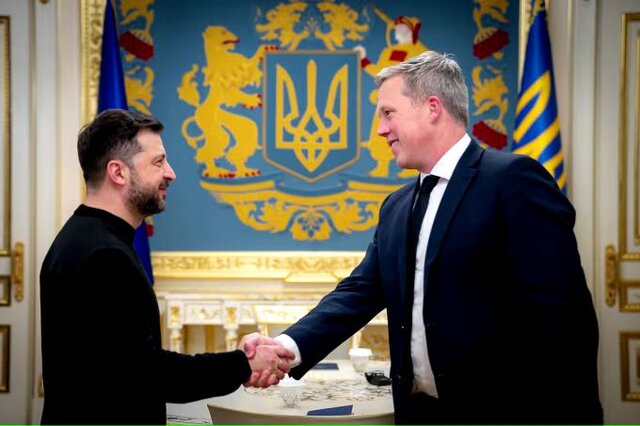
The meeting between US Secretary of the Army Dan Driscoll and Ukrainian President Volodymyr Zelensky in Kyiv, November 2025
The implications of a disclosure for Trump’s negotiating team
In the final part of this article, Lucas believes that the Trump administration, with this diplomatic reinforcement of its team, thinks that this situation is “a win-win situation in terms of economic projects that can be achieved by restoring trade relations with Moscow”. Even if it means Ukraine has to cede territory to its Russian aggressor.
That’s why Witkoff, who was behind the controversial 28-point peace plan that came out recently, suddenly saw things on his terms, at least until Bloomberg exposed his negotiating tactics this week. This news agency caused a lot of shock after publishing the transcript of a telephone conversation with Wittkoff. In the phone call with his Russian counterpart, Dmitriev, Witkoff is said to have coached him on how to persuade Trump to accept a more pro-Russian peace plan. This may explain why Kushner and Driscoll suddenly burst onto the scene.
Lindstat says: Basically, he is the representative of J. D. Vance (Trump’s deputy) and most likely indirectly paves the way for the Vice President’s involvement in any negotiations on the Ukraine war. Vance is very anti-Ukraine…
That’s all the more reason Kushner is on the scene, Lindstedt said, “If Trump is not sure if he can trust his people in the administration, he’s going to turn to family.”
However; Regarding Kushner’s participation, Parmar of the University of London believes: “His presence – unofficial but with a central role – has added to the apparent chaos of the negotiations, caused criticism of bypassing traditional diplomatic channels and raised questions about the conflict of interest arising from his business connections.”
end of message

RCO NEWS
RCO