



The dimensions of the American plan for the administration of Gaza; Applying restrictions on Palestinian sovereignty – Mehr News agency RCO News Agency
Mehr News Agency, International Group: The US plan to manage the post-war phase in Gaza, which was introduced through Security Council Resolution 2803, has created a new stage of organized international intervention in this region. On the surface, this plan is presented with the aim of reconstruction and stabilization, but a closer examination of the documents and statements of the American and Israeli officials shows that its real goal is the political, security and economic control of Gaza. A major part of the consequences of this plan is directly linked to the geopolitical interests of America and Israel and creates serious threats to the sovereignty, population and economy of Palestine.
The general structure of the plan and the concept of redevelopment of Gaza
Resolution 2803 provides the framework for the creation of an institution called the Peace Council and the establishment of the International Stability Force. This council has the authority to supervise the reconstruction, determine the terms of aid and manage the administrative coordination of Gaza, and its chairmanship has been given to the President of the United States until the end of 2027. One of the most sensitive points is the inclusion of the word “redevelopment” in the text of the resolution, which means extensive destruction and reconstruction of urban areas based on a new model. This shows that the view of the designers is beyond the post-war reconstruction and the macro, demographic and ownership change of Gaza is the main goal. US and Israeli officials also insist that Gaza must be rebuilt in a different way, which is a direct threat to its current structure and demographic identity.
Continuation of demolition operations and displacement of population
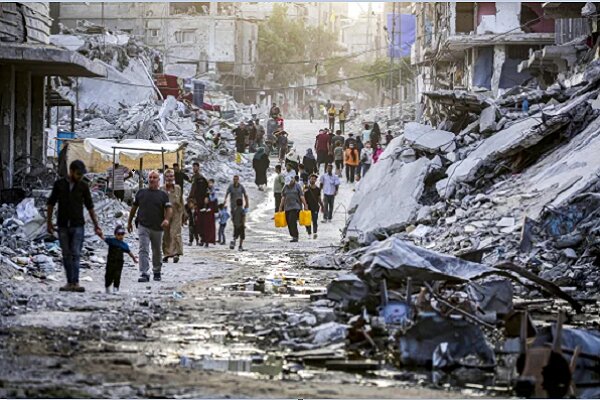
In the Gaza Strip, even after the declaration of a ceasefire, the planned destruction of residential areas continued and thousands of buildings were destroyed. These measures create empty space for the implementation of new plans and the removal of Palestinian population centers. Severe restrictions on the arrival of aid and not allowing residents to return have turned this process into a tool for structured displacement. The division of Gaza into green, yellow and red zones has created a situation where the residents of the destroyed areas have only three options: emigrate, settle in restricted areas or accept the new order under international management. This situation is a direct threat to the right to return home, own property and choose a place to live, and turning reconstruction into population engineering is one of the most important consequences of this plan for Palestinians.
International force and proposed security structure
According to some media, the international stability force will include European and Jordanian forces and will include about 20,000 people. This force is responsible for disarming Palestinian groups, protecting redevelopment projects and operational cooperation with Israeli forces. Foreign military presence for a long time, applying a security model similar to the areas under foreign control and creating a gap between the different areas of Gaza, weakens the security independence of Palestine. Such a structure turns Gaza out of the framework of internal management and into a unit under multinational supervision, and creates a serious threat to the collective security and resistance of the Palestinians.
Linking the plan with the geopolitical strategy of America and Israel
America’s plan is related to the country’s grand strategy in competing with China and establishing influence in West Asia. Gaza’s location on the path of the India-Middle East-Europe corridor has made it a strategic point in America’s desired economic architecture. From the point of view of America and Israel, this position will be profitable only when the political structure of Gaza is under control, the Palestinian resistance is weakened and the demographic structure undergoes fundamental changes. Therefore, the threats are not only security or humanitarian, but they directly target the geopolitical situation of Gaza and turn it into a tool to serve foreign interests.
Threats and strategic implications of the plan for Palestine and Gaza
The threats caused by this plan are wide and multi-layered. The sovereignty and political will of the Palestinians have been severely limited, and handing over the management of Gaza to international institutions creates a situation similar to a new trusteeship system, the end of which is unknown. The division of Gaza and the restriction of reconstruction provide the context for the forced displacement of the population and threaten the social and demographic continuity of Gaza. Control of land and assets is transferred to foreign entities, and Gaza’s natural and economic resources are under the influence of foreign companies.
The presence of foreign forces and disarmament without ending the occupation creates a security vacuum and reduces the resistance of the Palestinians. The plan offers no guarantees for the creation of a Palestinian state and, by changing terms, keeps Gaza’s political horizon unclear. Reconstruction has also become a tool for political pressure and the real needs of the people are given secondary priority. All of these threats put Gaza under multi-level foreign management, change its population and economic structure, and make its geopolitical position serve the interests of America and Israel.
the result
The American plan to govern Gaza, with the appearance of reconstruction and stability, in practice uses security, economic and political tools that limit Palestinian sovereignty and transfer decision-making power to foreign institutions. The redevelopment of Gaza does not only mean rebuilding the destroyed areas, but it also involves changing the urban fabric, dividing the population and restricting residents to certain areas, and threatens the identity and demographic structure of Gaza. The control of land, assets and economic resources by foreign institutions and companies reduces the economic independence of Palestinians and the presence of international forces weakens their collective resistance.
This plan divides Gaza into controlled areas, restricts reconstruction and creates pressure for immigration or acceptance of the imposed order, and threatens the social and historical continuity of the cities. The failure to guarantee the formation of an independent government and the change in the legal vocabulary makes the political horizon of Gaza unclear. At the geopolitical level, this plan stabilizes the influence of America and Israel in the region and puts the position of Gaza in the service of foreign interests. Finally, reconstruction and apparent stability is a means of demographic, economic and political engineering, and the Palestinians have no control over their own destiny.

RCO NEWS
RCO