


Reuters: The Gaza Strip is practically on the verge of being divided
Following the suspension of the American plan to end the Gaza war and not going beyond the ceasefire stage, analysts and experts have announced the possibility of a long-term division of the Gaza Strip into 2 parts, which can separate this strip into 2 parts under the control of the Palestinians and the Zionists.
According to RCO News Agency, English media has reported: The Gaza Strip is practically on the verge of division, because the efforts to implement the US President Donald Trump’s plan to end the war in the ceasefire phase have stopped.
In this article, “Reuters” News agency, citing multiple sources, including 6 European officials who are directly involved in the implementation of the next phase of the plan, stated that the reconstruction will probably be done only in the areas under the control of the Zionist regime; An action that can stabilize the separation between different parts of Gaza for years.
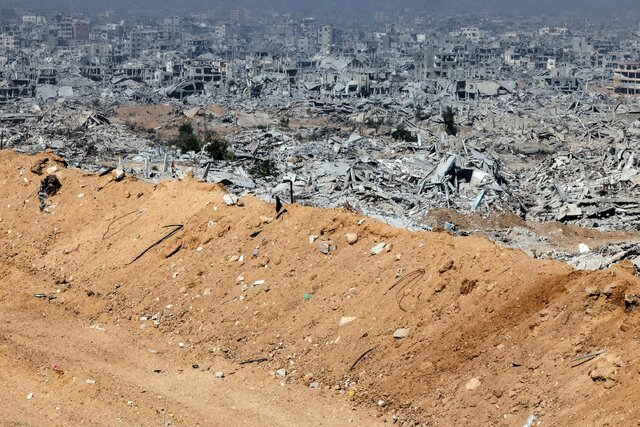
According to this report, the first phase of Trump’s plan, which began on October 10 (October 18), has given the control of 53 percent of Gaza, including Rafah in the south, parts of Gaza City, and most of the agricultural lands to the Zionist army. Approximately 2 million Palestinians live in makeshift camps and the ruins of destroyed areas in parts controlled by Hamas. Aerial images from Reuters in November show that the northeastern areas of Gaza City have been completely destroyed after the last Israeli attack before the ceasefire, and the Gaza Strip is effectively divided between the two sides.
The report states that the next stage of the plan includes the gradual withdrawal of Zionist regime forces from the “yellow line” – the border established according to Trump’s initiative – the formation of a transitional government to administer Gaza, the deployment of a multinational force, the disarmament of Hamas and the beginning of reconstruction. However, Reuters emphasizes that there is no specific timetable or implementation mechanism in the plan. Hamas has refused to disarm, the Zionist regime has opposed the role of the Palestinian Authority and the status of the multinational force is still unclear.
Gaza
At the Manama security conference, Jordanian Foreign Minister Ayman Safadi said, referring to the existing deadlock: “We all want the end of this conflict; The question is, how should we implement it?” According to Reuters, without serious US intervention, there is a risk that the “yellow line” will become a permanent border between the two parts of Gaza.
Reuters, citing 18 sources, including European and US officials, reported that Washington has submitted a draft resolution to the UN Security Council under which the multinational force and the transitional government will have a two-year mandate. However, diplomats have spoken of the reluctance of governments to send troops, especially European and Arab countries that are reluctant to engage directly with Hamas or undertake missions beyond peacekeeping.
In the continuation of this report, it is stated that US Vice President J.D. Vance and Trump’s advisor Jared Kushner announced last month that the reconstruction budget can be allocated to the areas under the control of the Zionist regime even without entering the next stage, in order to create “model areas” for the settlement of some Palestinians. Such an approach risks making the current fragmented situation in Gaza a long-term reality, analysts told Reuters.
One of the spokespersons of the US State Department, despite pointing to “significant progress” in the implementation of Trump’s plan, refused to answer the question about the limitation of the reconstruction to the areas under the control of the Zionist regime.
According to a Reuters report, Israeli Prime Minister Benjamin Netanyahu has announced that he does not intend to reoccupy or govern Gaza, although some of his cabinet ministers want to revive the settlements destroyed in 2005. The army of this regime has also opposed the permanent occupation and direct supervision of civilians. However, Netanyahu has promised to create a buffer zone inside Gaza to prevent possible attacks.
In this report, it is stated that the Zionist regime forces have marked the new border by installing yellow cement blocks and have strengthened their positions in areas of Gaza City, including Al-Shaja’iyyah. Nadav Shoshani, the spokesman of the Zionist army, said that the forces will remain in the region until the disarmament of Hamas and the deployment of international forces.
Gaza
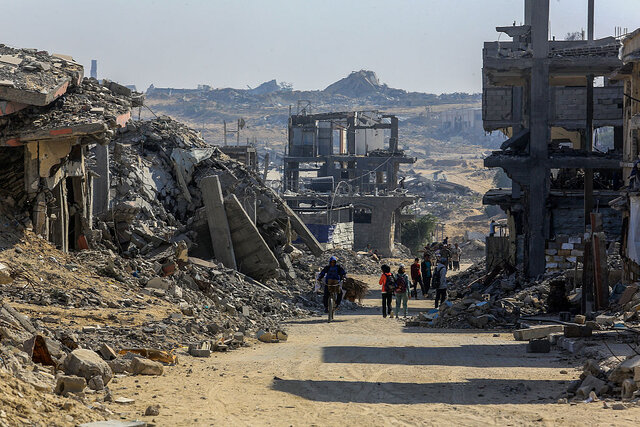
Reuters writes that in the Palestinian areas of Gaza City, Hamas has once again established its presence, police forces have been deployed to maintain order, and municipal workers are clearing roads and debris. Hazem Qassem, the spokesman of Hamas, has announced that the group is ready to hand over the administration of the region to a Palestinian technocrat organization in order to start the reconstruction process.
European officials have told Reuters that without a change in the position of the Zionist regime or Hamas and without American pressure to accept the role of the self-governing organizations and the path to the formation of an independent Palestinian state, progress in Trump’s plan is not possible. British Foreign Minister Yvette Cooper has warned: “We must not allow Gaza to be caught in a state of instability between war and peace.”
Also, Jordanian Foreign Minister Ayman Safadi emphasized that “Gaza is one and is considered a part of the occupied territories of Palestine.” Varsen Aghabekian, the Foreign Minister of the Palestinian Authority, has also stated that “no real reconstruction and lasting stability is possible without full Palestinian sovereignty.”
In conclusion, Reuters concludes that any practical partition of Gaza will not only exacerbate the humanitarian crisis of the Palestinians, but also make the goal of an independent Palestinian state more distant. With the reconstruction cost estimated at around 70 billion dollars and the hesitation of Arab countries to provide funds without a clear political framework, the future perspective of Gaza in the shadow of this diplomatic impasse is vague and worrying.
end of message

RCO NEWS
RCO