


The achievement of the Trump administration; The fragility of the balance of global power, the discredit of international institutions and the decline of Washington’s dominance
The policies of the American president have caused the relative collapse of the international order and the return of the great power competition, and have moved the United States away from its previous position in the world order.
According to Isna, the English media analyzed the increasing instability of the international order in an article and argued that the policies of the United States under the leadership of “Donald Trump” are at the center of these developments; Policies that have marked a new era of uncertainty, the decline of multilateralism and the return of great power competition.
“Middle East Monitor” analytical database has started this article by examining developments in the framework of three main schools of international relations. According to the author, realists see the decline of American influence as a worrying sign, because this country was once considered a “pillar of the world order”. Liberals, whose ideas have shaped Washington’s post-Cold War foreign policy, describe the situation as the retreat of America’s liberal order. In contrast, “constructivists” warn that Washington’s disregard for shared global values and norms may lead the international order to chaos.
According to this report, these intellectual perspectives together paint a general picture of the fragility of the global balance of power; A situation in which international institutions have lost their credibility and Washington’s dominance is declining.
Trump’s approach and the crisis of multilateralism
The article emphasizes that Donald Trump’s policies have significantly increased this instability. It is stated in this report that his government’s disregard for international institutions and multilateral cooperation is not only a strategic decision but also rooted in his personal characteristics; including business mentality, nationalist tendencies and strong opposition to immigration. This article mentions that Trump mixed national interests with his personal and commercial interests, and this shows the contradiction in his government’s foreign policy.
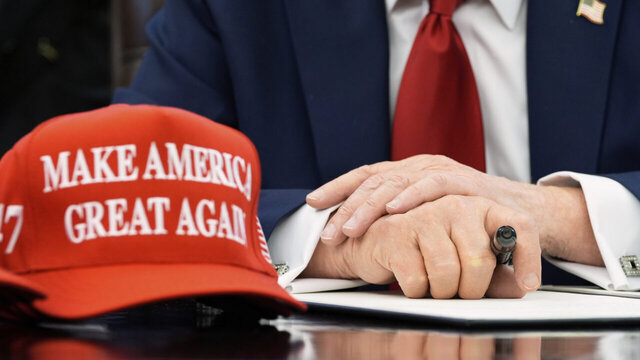
Trump campaign hat
According to the Middle East Monitor, Trump entered the White House with the slogan “Make America Great Again”, but in the first step, he distanced himself from Western allies and weakened the alliances that were the basis of American global leadership for decades. He adopted protectionist policies and imposed tariffs on more than 100 countries, including America’s friends. At the same time, it withdrew many American forces from Europe, Asia and West Asia and intensified the tone of confrontation with China. These actions have made even the closest partners of the United States distrustful.
Power transfer and the emergence of multipolarity
Another part of the article states that the current era is a sign of the decline of the relative power of the United States. Washington is now ceding financial and security responsibilities to its allies, while these same partners are expanding their economic and technical ties with China and Russia. According to the author, India, Japan and a number of European countries are now cooperating with Beijing in the field of trade and security while maintaining energy relations with Russia.
The report notes that Trump intensified the trade war with China at the beginning of his term, but later softened his position under pressure from Beijing. China, using its dominance of rare metal resources, was able to force the US to ease sanctions and return to the negotiating table, a sign of Beijing’s growing ability to balance against Washington.
Regional powers and economic restructuring
The English media talks about the increasing role of regional powers such as Turkey, India and South Korea and adds that economic and technological influence has been distributed among new poles in Asia, Europe and Latin America. America’s allies are also cooperating with Washington’s traditional rivals; India has become a member of BRICS and the Netherlands continues to export microchip technology to China.
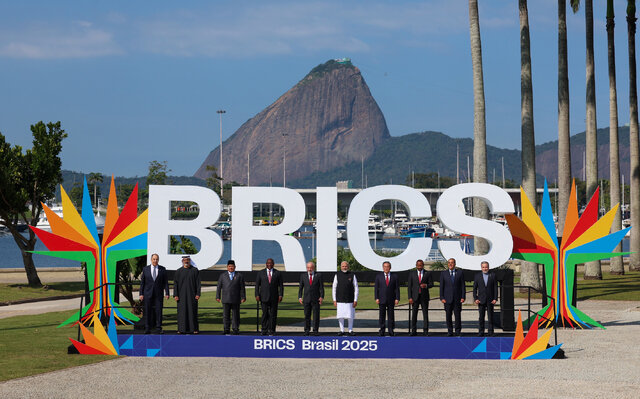
brix
According to this article, the world is moving towards a multipolar and unequal order in which the United States and China remain the main powers, but middle power countries such as Russia, India and Germany play an increasing role.
Middle East Monitor describes Trump’s diplomacy as “commercial and deal-oriented”. According to this report, after the Zionist regime’s attempt to assassinate Hamas members in Qatar, Trump forced the Prime Minister of this regime to apologize to Doha and established a ceasefire in Gaza through his mediation, which temporarily prevented the reoccupation of the Gaza Strip.
The recent wars of the Zionist regime have revealed this regime’s dependence on America and turned it into a “strategic burden” on Washington’s shoulders. An unprecedented change is taking place inside America as well; A growing number of Democrats are calling for justice for Palestine and are skeptical about continuing financial aid to the occupation regime.
According to this report, the wars of the Zionist regime in Gaza, the West Bank and neighboring countries have revealed the nature of its policies towards the Arab world and weakened the old plans of Washington and Tel Aviv to create a “new Middle East” centered on this regime. Although Tel Aviv has been successful in some tactical goals such as targeted assassinations or airstrikes, it has failed to achieve strategic achievements.
A new regional and global perspective
In the end, the British media concludes that Washington’s current focus on economic cooperation and cost reduction can limit the ambitions of the Zionist regime and initiate a period of relative stability in the region; A period in which justice for Palestine and peace in West Asia becomes possible.
At the end, the author describes the aggressive behavior of the occupying regime in contrast to the constructive approach of Arab countries such as Egypt and Saudi Arabia, and points to the opening of the “Great Egyptian Museum” and the economic growth of the Persian Gulf countries as signs of the revival of the region.
end of message
News>RCO NEWS
RCO