



Trump is heartbroken by Netanyahu, but does not give up Israel’s support
Despite the growing pressure from Europe and Western allies, the United States continues to support the Zionist regime. But within the Trump administration, dissatisfaction with Netanyahu is on the rise, and some officials have strongly criticized his performance in the Gaza war.
According to RCO News Agency, US media, referring to Washington’s relative distance from the Zionist regime, reported that President Donald Trump was frustrated with the occupation regime’s Prime Minister Benjamin Netanyahu.
After six months of Gaza’s bombing, the Zionist regime is now experiencing increasing pressure by unexpected sources – including some of its closest Western allies -. The patience of these countries has been overwhelmed because of the Zionist regime’s decision to spread the war and to try to conquer Gaza’s complete “conquest”; The move has been accompanied by plans to mandate the entire Gaza Strip to the south and block all humanitarian aid for 6 weeks.
Britain has stopped commercial talks with the Zionist regime and imposed sanctions on extremist settlers in the West Bank. Canada and France have also threatened to impose similar sanctions. The EU – the largest trading partner of the Zionist regime – is reviewing the historical agreement with the regime.
Relief agencies have warned that the human situation in Gaza has reached a catastrophic level. The head of the UN humanitarian affairs Tom Fellcher called on the international community to “firmly prevent genocide” last week. According to the Gaza Ministry of Health, dozens of infants have died of malnutrition and more than 6,000 people have been martyred since the beginning of the Gaza war.
What is different this time is the explicit position of some of the closest Zionist allies to criticize the regime; Significant change in approach to Tel Aviv.
Gaza
“Until just five years ago, it was impossible for Europe to even talk about a review of the Israeli cooperation agreement,” said Hugh Loot, a senior expert at the European Foreign Relations Council. This was a taboo issue. “
The agreement, which is 5 years old, covers a variety of collaborations, including free trade and scientific cooperation. “As this is seriously being investigated today, a sign of not only increased dissatisfaction, but is clearly anger in some European capitals of Israel’s performance in Gaza,” Loot said.
Arya Reich, a professor of international trade and EU law at the University of Berbalan, claims that external pressure on the Zionist regime may have the opposite, acknowledged that the recent actions of some Zionist regime’s allies indicate “the window of use of the military is” closed “and the warning:”
The Zionist regime has so far ignored the threats of its Western allies. Prime Minister Benjamin Netanyahu has accused these countries of being a “great prize” with his pressure. The Zionist Foreign Ministry has also stated that “the external pressure will not change the Israeli path to survival and security against the enemies seeking to destroy it.”
According to CNN, this determination is the continuation of the war due to Netanyahu’s belief that at least he can rely on US support. Although some of the closest allies of the regime, Canada, Britain and France, are revised in support of their weapons, the United States seems to be behind the occupation regime.

Extreme Zionists prevent aid from entering Gaza
Trump continues to support, but disappointed with Netanyahu
The United States, as the most important ally of the Zionist regime, has the most impact on the Netanyahu cabinet. Although some members of the Trump administration have criticized the dire humanitarian situation in Gaza, there is no sign of Washington’s desire to exercise punitive measures against the Zionist regime.
However, Hugh Loot of the European Foreign Relations Council said that one cannot be sure of the continuation of the United States’s unconditional support for the Zionist regime. “I am not witnessing the breakdown of relations, but it is clear that the arrival of Trump’s second government has created new relations,” he said.
In recent weeks, the United States has been away from the Zionist position in some issues. Washington signed a ceasefire agreement with Ansarullah forces in Yemen without informing Tel Aviv; Also, unilaterally, for the release of American citizens, Edan Alexander entered into talks with Hamas. According to Reuters, the United States has no longer prevented Saudi Arabia’s relations with the Zionist regime, according to Reuters.
Responding to the Zionist regime’s criticism of US agreement with Ansarullah, US ambassador to the Zionist regime, Mike Hawkbi told the Zionist media, “The United States does not need to obtain permission from the Zionist regime for an agreement that provides the security of its ships.”
Netanyahu has introduced himself as a professor of American political game and says he is one who can maintain relations with any American government; But now that we are seeing a clear gap between the Trump administration and the Zionist regime’s cabinet; The situation that has put pressure on Netanyahu.
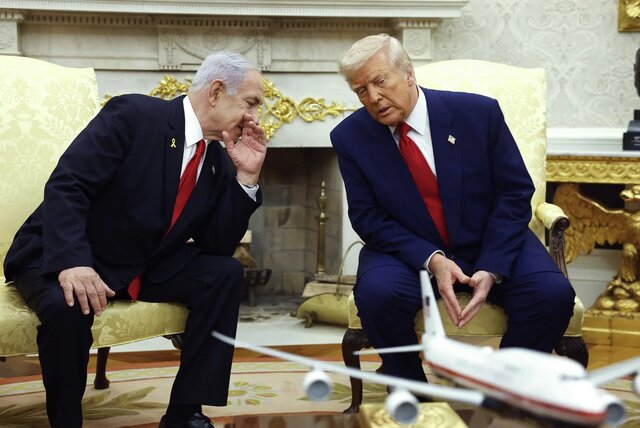
Meet Trump and Netanyahu at the White House
Although these dissatisfaction still does not mean changing the US general stance in support of the Zionist regime, and Trump continues to see it as one of the strongest allies in the United States, US officials have told CNN that Trump is more unhappy with Netanyahu day by day.
Increased internal dissatisfaction from the Zionist cabinet
There are also signs that some within the Zionist regime are concerned about the consequences of this regime’s actions in Gaza. The retired General of the Army and Leader of the Zionist Democratic Party warned on Tuesday that the regime was “on the way to become an inappropriate government”.
The suggested punitive actions of the European Union and other allies are part of the efforts to influence internal discourse in the Zionist regime; Where society has been severely divided over war. The Zionist regime’s cabinet, which relies on a coalition of extremist right parties, is determined to continue the war in Gaza. But hundreds of thousands of Israeli march every week to protest the war and call for a ceasefire agreement to release the remaining hostages.
According to a poll published by Zionist TV networks earlier this month, 5 % of respondents supported the end of the war in exchange for an agreement for the release of captives, while only 5 % demanded military operations.

Killing children in Gaza war
Consequences of reducing Brussels relationships with the occupying regime
The US media blamed the occupation regime’s army with the introduction of “some basic food” into Gaza as the effect of increasing pressure on the Zionist regime by its closest allies. Netanyahu acknowledged last week that if a “like a famine” in Gaza emerges, the Zionist regime “will no longer have the support of the international community.” In a statement in the telegram, he wrote in a statement that even American senators who have “been a staunch and unconditional supporter of the Zionist regime” have told him “widespread hunger images in Gaza will lose their support.
The European Union is the largest trading partner of the Zionist regime and forms about one -third of the regime’s commodity trade. The full suspension of the “Cooperation Agreement” between the EU and the Zionist regime seems unlikely, as it requires the consensus of all four members of the Union, and some countries – including Hungary, who is a staunch supporter of the Zionist regime – have already stated that they will not support the move.
Aria Reich, an international trade law expert, said that both the European Union and the Zionist regime could cancel it for any reason – or even without mentioning the reason. “The problem is that within the European Union, such a decision needs a consensus … and this will be very difficult, because many union member states will not accompany such action,” he said. So I think this is more of a threat to pressure, and they may be able to suspend some of the terms of the agreement temporarily, but I find it unlikely to end. “
However, if most EU members want to suspend parts of the agreement, Brussels could do so. Even this move can be a costly to the Zionist regime, as it may lead to increased tariffs on its export goods or prevent the Zionist regime from participating in important projects such as the European Horizon Program; A program with more than $ 5 billion in budget for research and innovation.
The end of the message
(tagstotranslate) America (T) Zionist regime

News>RCO NEWS
RCO