



American School: Yemen has made America kissed and blurred
Yemeni army operations in the Red Sea not only threaten the Western world trade, but also the US ability to quickly deploy troops in various areas; This has led Washington to search for military, diplomatic and logistical solutions to counter it.
According to RCO News Agency, the American think tank, referring to the continuation of Yemeni army operations in the Red Sea, reported that Ansarullah had acted in the Kish and Matt area with its actions.
The Washington Institute for Politics for the Near East Politics acknowledges that the Yemeni army has blocked Western shipping routes in the Red Sea and challenged the US ability to quickly and supply its forces in West Asia and beyond.
According to the report, it appears that the United States has been combining logistical solutions, military action and diplomatic efforts to counter the threat. On March 5, US President Donald Trump launched a military operation in Yemen that continues.
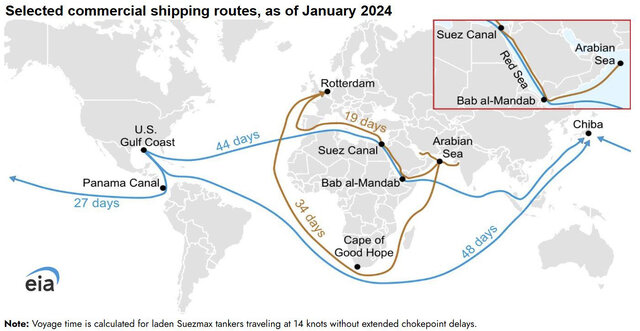
The vital role of the Red Sea for world trade is not hidden. One trillion dollars of goods crosses the route annually, with 2 percent of the world’s container traffic. But the route is also one of the highways of military equipment through commercial transport, allowing the United States to move its forces and resources quickly around the world. Therefore, Ansarullah’s attacks at the same time threaten America’s trade and military capability and directly point to Washington’s vital interests.
Wrestling routes from January 1
US dependence on the sea
In the face of the presence of the Yemeni army in the Red Sea, military vessels continue to cross the Bab al -Mandeb Strait, but many commercial shipping companies have had to choose a long and costly path. This threat disrupts the vital speed needed for military logistics and raises the question, “Have the Houthis succeed in Washington and its allies in the Red Sea Kish?”
In order to support combat operations during the war, the United States transfers up to 5 % of its equipment through commercial transport. In addition to the capabilities of the military fleet, the US Department of Defense can also use private ships during crisis, thereby reducing costs, reducing costs and bringing equipment to the battlefield faster.
But this strong US dependence on commercial shipping requires safe and unpossed routes. Due to the constraint of US Navy resources and its widespread commitments worldwide, it is not possible to escort all commercial ships; However, even some of the ships that had escorted have been attacked. “If the Houthi maritime threat continues, it may have serious consequences for any emergency operations that require vital logistical support,” the report said.
Earth’s replacement
For the United States and its allies, it is not possible to replace the nose at times when there is a need for quick dispatch of military equipment. The competition of the great powers requires that the US military can quickly transfer its military equipment between Europe, Central Asia and the Pacific, and in emergencies, it will be necessary to cross Bab al -Mandeb.
Sea transportation is still the cheapest option for military logistics. Air transport is more expensive and a priority for urgent missions. The third option that is being investigated is ground transport.
One of the US solutions to avoid operations from the Yemeni army is to avoid proximity to the Red Sea ports. Washington can, for example, send his ships to Jeddah and from the ground to the equipment. Ships are more vulnerable at the time of unloading the ports; But when the load is transferred to the truck, aircraft or other vehicles, the likelihood of targeting is reduced.
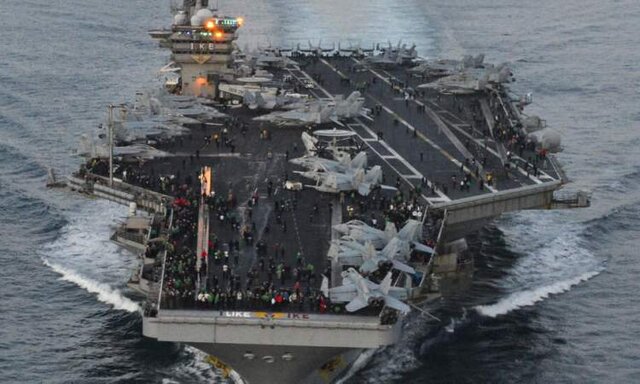
American ship in the Red Sea
The project has been tested so far but is not yet fully operational. Customs problems, lack of unity of cargo transfer systems and military load constraints are obstacles to its full implementation.
Another alternative is the ground corridor between the UAE and the occupied territories that start from the port of Haifa in the occupied territories, passing through Jordan, Saudi Arabia, Bahrain and the United Arab Emirates to reach the Persian Gulf. This route can manage up to 5 trucks a day and in the future will be a serious option for the US Army Logistics.
Strategic recommendations
In this report, the American Thought describes some recommendations and approaches to withdraw the United States from this “Kish and Matte”:
One of the options is to maintain military pressure. In this scenario, the United States strives to stop the threat of ships by intensifying its air strikes and with the support of Ansarullah opposition forces in Yemen.
Another recommendation is the US attempt to create deterrence against Iran. The American think tank claims that the United States should propose Iran’s lack of support for Yemen as a prerequisite for reducing sanctions.
Iran, of course, has repeatedly denied military support for Yemen.
The think tank goes on to recommend that Washington should form a coalition with Egypt, the Zionist regime, Jordan and Saudi Arabia to secure the Red Sea. The EU Navy can also play a complementary role.
In addition, the thinker recommends that the US government should increase its logistical flexibility and expand the faster and less expensive ground paths.
The end of the message
(tagstotranslate) America (T) Zionist regime (T) Ansarullah (T) Yemeni Army (T) Donald Trump (T) Persian Gulf (T) Red Sea

News>RCO NEWS
RCO