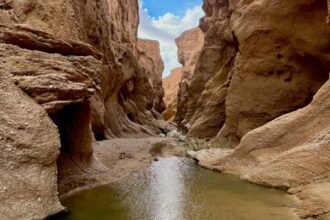



According to “Heritage Daily”, during their recent excavations in the Bayuda desert in Sudan, archaeologists have discovered an ancient cemetery belonging to the Karma civilization, which dates back to about 4,000 years ago. This discovery, which took place in one of the most remote desert areas, is historically very important; Because it shows that the influence and territory of this civilization was beyond what was previously thought. Known as one of the first and most powerful organized states in sub-Saharan Africa, the Karma civilization was a serious rival to the ancient Egyptian empire during its heyday and had deep control over the commercial arteries of the Nile.
In this exploration, a unique tomb has been found whose structure tells of the aristocratic burial traditions of that era. This grave has a stone burial chamber that was built with great precision and despite the passage of thousands of years and severe desert erosion, important parts of it have remained intact. Along with the human remains, archaeologists have found a collection of pottery objects with special elegance, decorative beads and stone tools, which show the belief of these people in life after death and the social status of the deceased. The pottery discovered in this place has architectural and artistic characteristics of the “Middle Karma” period, which are known for their black body and red edges, and were technically considered a masterpiece in the pottery industry in their time.
The special importance of this find lies in its geographical location; The presence of this grave deep in the Bayuda desert proves that the people of the Karma civilization were not limited to the banks of the Nile, but managed complex networks of trade routes and seasonal settlements in the heart of the burning deserts. Researchers believe that this area was probably a strategic point for caravans that carried gold, ivory and incense from the heart of Africa to the north.
Preliminary analyzes of the bone remains found in this grave show that the people buried in this area were in good physical health, which strengthens the hypothesis that this desert settlement was rich. This new discovery not only opens a new chapter in our understanding of the Kush kingdom and the Karma civilization, but also raises new questions about how these societies adapted to the climatic changes and the harsh environment of Sudan in the second millennium BC, the answers to which will require years of research and more detailed experiments in archaeological laboratories.

RCO NEWS