

The historical house of Qawam al-Dawlah, a treasure of Iranian art in the heart of the capital, is still standing.
Oudlajan considers Tehran to be the historical heart of this city; A neighborhood that was once full of traffic and elders and chiefs stayed there. Many of the alleys and back alleys of this neighborhood are still named after the elders of that time; But little is known about their houses. The names of the alleys have been changed little by little so that the process of cleaning history from Oudlajan can happen slowly. A history that has been killed several times at night with the loader.
Amidst the daily hustle and bustle of Oudlajan and its eerie silence at night, some historical buildings still survive. One of these houses is known as the most beautiful historical house in Tehran; A house whose door is of course closed to the public; But her beauty has won many hearts in the published photos. Qavam-doleh house is one of the historical houses of Tehran. According to some sources, the construction date of this house reaches 1211 AD and it will soon be 200 years old. However, only the date of the painting of the hall of this building shows another number, which is the year 1216 AD. However, the date on the wall is related to the end of the painting and the construction of the house has definitely started years before. Stepping into this house remains like a journey in the history of art and architecture and surprises travelers time and time again.
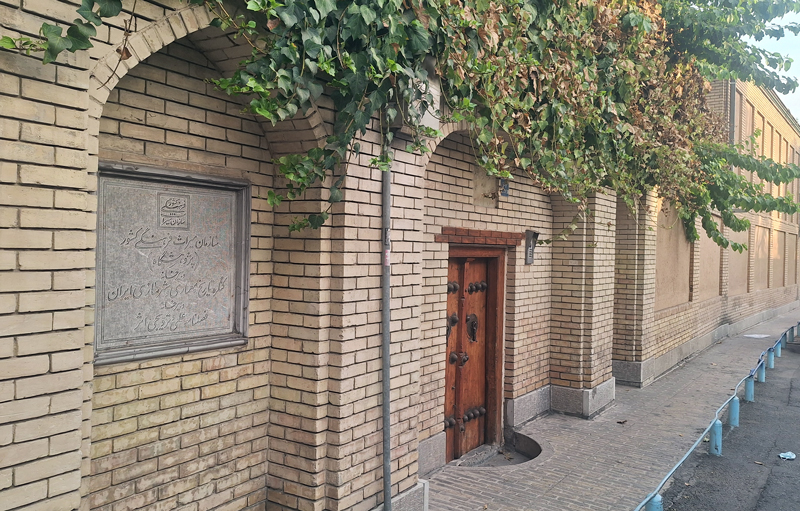
The view of Qawam al-Doulah house from Mirza Mahmood Vazir alley
Stepping into the heart of Tehran and Qajar art
The doors of the historical house of Qavam al-Doleh are closed to public tourists and due to the location of Icomos, there are no conditions to visit it. Also, this building was one of the exquisite and unique historical houses in Tehran and requires stricter protection. Nevertheless, Iranian Icomos introduced the historical values of this building during a series of meetings for those interested. In these meetings, the interested parties will get to know the values of this historical house of the capital by attending the workshop on the history of Qavam al-Doulah house.
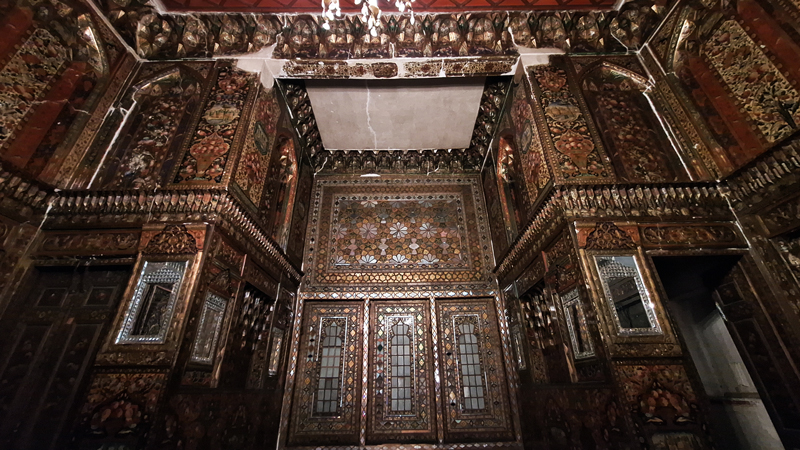
Painting hall of Qavam-al-Doulah house
Nasser Norouzzadeh Chegini, an archaeologist and a member of ICOMOS Iran, said about this historical building in the workshop to introduce the historic house of Qavam-ud-Doleh:
The historic house of Qavam al-Dawlah is located in Oudlajan neighborhood; A neighborhood that was one of the five neighborhoods of Tehran before the era of Naser al-Din Shah Qajar. This house is located in the northeast corner of Tahmasabi baru, at a very short distance from this baru. The most important passage connected to this building is Mirza Mahmoud Wazir alley; Mirza Mahmoud, the son of Mirza Isa, was the minister of the army, although he was not a minister himself, and only bears the name of his father. This house belonged to the finance minister of the Ahmad Shah period, and according to the inscription on the paintings, the paintings of this building were finished in 1253 AH. This history shows that the building was in his possession before Qawam al-Dawlah came to the ministry; Because in 1257 A.H., he was chosen as Mustofi Mohammad Shah.
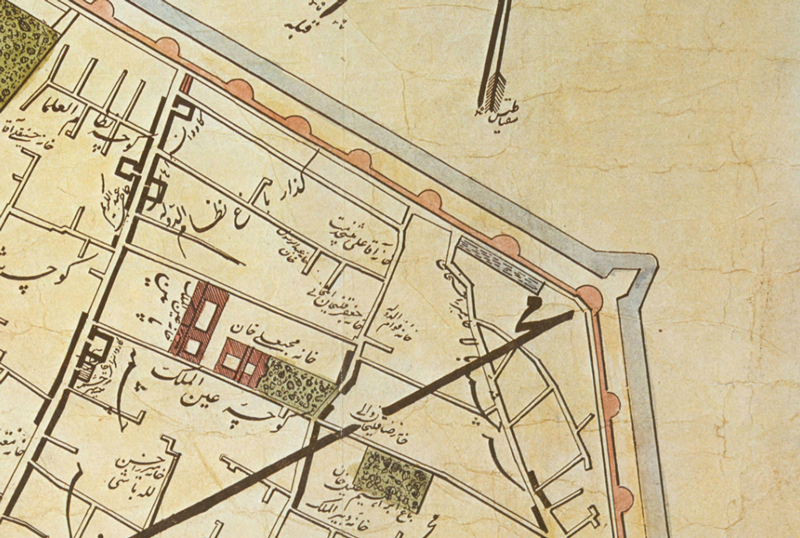
The historical house of Qavam al-Doulah on the map of Kirshish
Traces of the historical house of Qawam al-Dawlah can be found in historical documents and pictures. One of the most attractive documents are the historical maps of Tehran. Karshish map is one of the old maps of Tehran city, which was drawn in 1237 AD under the supervision of Atizad al-Stalneh with the cooperation of Monsieur Karshish, the teacher of Dar al-Funun school. In this historical map, the house of Qavam al-Douleh can be seen in the northeast point of Tehran city and attached to the city wall. In the historical map known as Abdul Ghafar Najm al-Molk, which was drawn by the teachers and students of Dar al-Funun school, Tehran can be seen in 1270 AD and after the Nasrid period of development. In this map, you can see the trace of the historical house of Qawam al-Dawlah and its condition. Nowruzzadeh Chegini says:
In the historical map of Abdul Ghafar Najm al-Molk, you can see the location of this historical house in Tehran at that time. At the northern end of this building, there was a storehouse and next to it was the family bathroom of Qavam al-Dawlah. The location of the bathroom is clear; But it was destroyed and the barn has been turned into a park. There are limited pictures of this house in historical archives and we do not know what buildings from the Qawam al-Dawlah period existed on this property that no longer exist. This complex is about 12 thousand meters; But now only about a thousand meters of it remain. The remaining part of the building includes two north and south courtyards, which were the outer part of the house. There are also evidences and pictures of holding public religious ceremonies in this building.
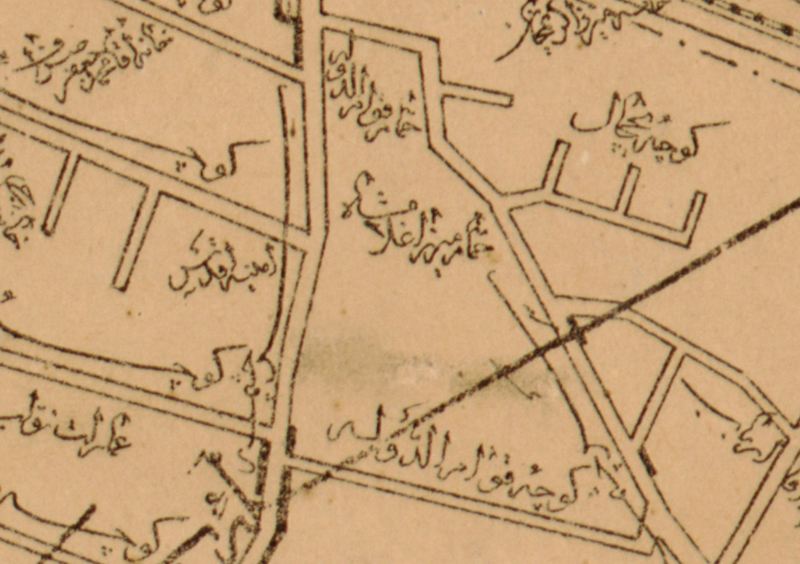
The house of Qavam al-Doulah on the map of Abdul Ghafar Najm al-Molk
Standing in the heart of history like cedar
The survival of a historical house in the heart of Tehran and Oudlajan neighborhood depends on a thousand historical ifs and ifs. The neighborhood where the foundation of the city of Tehran was formed; However, commercialization and storage has threatened it from every aspect over the years, and sometimes uninformed city managers have killed parts of this neighborhood with loaders at night. These days, some officials of Tehran municipality, regardless of the national registration of this neighborhood, have taken a can of paint in their hand and regardless of the historical values of Oudlajan fabric, they sprinkle it on the doors and walls of its buildings in order to beautify it. There are still dozens and maybe hundreds of historic houses in Oudlajan, which tell the history of Tehran. Among these buildings, only a few buildings have a good fate and are in good condition. One of these buildings that has survived the attack of night loaders, abnormal renovations and the profiteering of Kisbeh Bazar and has stood up under all these pressures like a tall cedar in its yard, is the historical house of Qavam al-Douleh.
Nasser Norouzzadeh Chegini, a veteran archaeologist, says about the events that this house went through:
This collection will be inherited after Qawam al-Dawlah and parts of it will be separated and constructed over time. The current remaining part was in the possession of Esmat al-Soltaneh, the wife of Qawam al-Dawlah, who was the daughter of Naser al-Din Shah’s uncle. The fact that this section was not included in the inheritance of the descendants, as well as the significant works that were in this section, has made this part of the collection of Qavam Al-Dawlah to remain and not be destroyed over time. According to the available information, the last owner of this building was the late Amir Khani, one of the famous calligraphers, and in 1345 AD, this building was purchased by the Antiquities Protection Organization and handed over to the government. After that, in the 1980s, the Iran Icomos complex (Council of Historical Buildings and Sites) was established there.
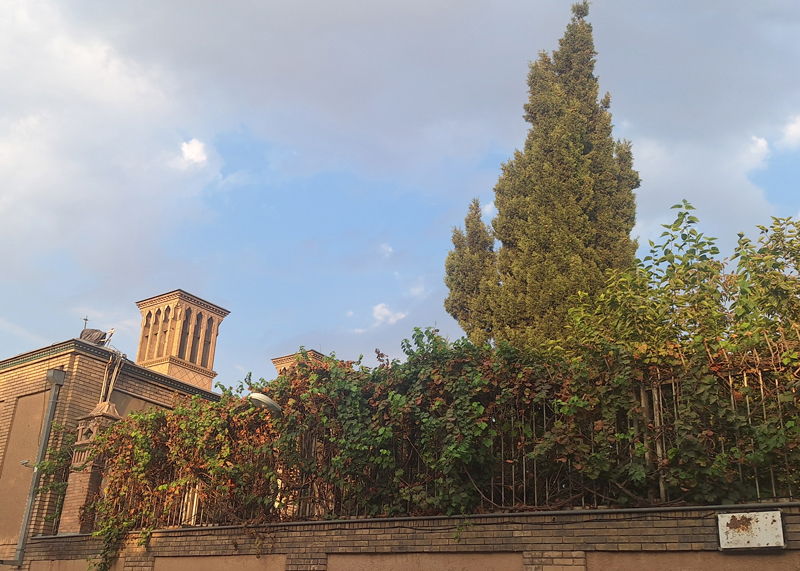
The view of the wind deflectors of Qavam al-Doulah house and the cedar yard from Mirza Mahmood Vazir alley
The survival of historical monuments depends on constant and even everyday restoration and protection. Now, although a small part of the huge collection of the historical house of Qomul-Douleh remains, this part contains a treasure of Iranian arts. The arts that are engraved on the door and wall of this house are so valuable that many consider them to have a historical role in the process of architectural art in the Qajar period. Nowruzzadeh Chegini says about the continuation of renovations in this historic house:
This building has undergone many restorations and repairs in different periods. One of these restorations is related to the 40s when the late Pirnia and Ahmadi restored this building and this restoration has always continued in the structure of the building and its paintings over the years. The roof of the Aineh Hall was damaged and collapsed during the war and bombing at the site of the Islamic Republic Party. This damage was repaired years ago. Also, there is an inscription from the year 1317 in the building, which indicates the restoration of this building by one of the related families; Although we do not know the documents and details of this restoration.
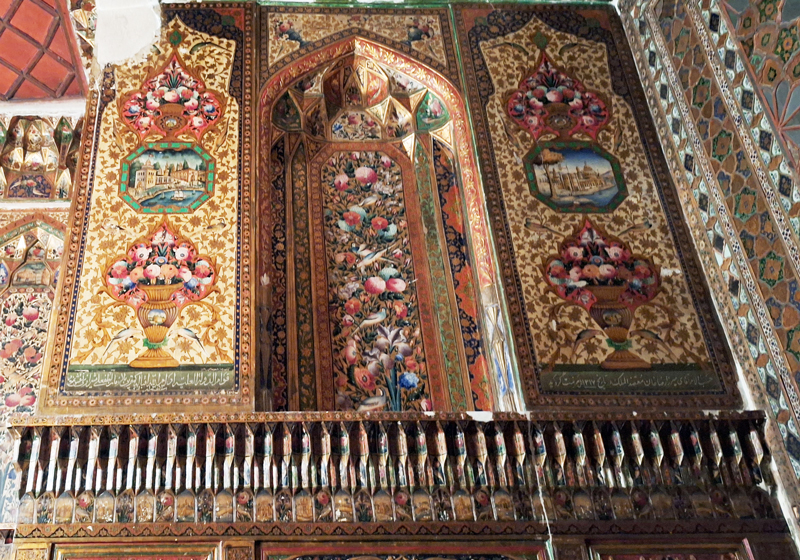
Dated inscriptions can be seen under the frames of the paintings.
New street constructions, regardless of historical values, are one of the destructive changes in historical contexts that seem to be inevitable. Chegini also mentions the widening of the streets around Qavam-doleh’s house throughout history and says:
The current entrance to the building is from the west side; But this is a new entrance after the widening of the street, and before this the building did not have an entrance from the west side like this. The evidence tells us that in the 40s, Mirza Mahmoud Wazir alley was widened and part of the western side of the building was destroyed. The rooms and the corridor that were on this side were destroyed at this time. In the south of the building, it was located inside Muhaddith Alley. It is possible that the current door of the building on the west side is among the doors that were separated from the south side and brought to this place. Although there is no solid document about this.
Flower and chicken passion, German mania
The halls of Qavam al-Doulah house are dimly lit and dark; This darkness is supposed to preserve the light of art inside the halls for future generations. The north and south halls of the house each have a story to tell and there are things to discover and watch in their corners. Researchers have been looking at the door and wall motifs of this house for years and it seems that they are still hiding something. Chegini says about the darkness of the halls of the house:
The two big sashes of this building are very valuable; But due to the sun shining inside the building and its destructive effect on the architectural decorations, especially the paintings, these sashes are covered. The old hall of the building known as painting hall or refectory dates back to 1253 AH; This date is written on its paintings by Lotf Ali Khan. Lotf Ali Khan is a Shirazi painter who mostly works with flowers and chickens and he has widely implemented this role in this painting hall. The initial form of the paintings happened during the time of Mohammad Shah, and in this building, unlike the previous period, no human figure can be seen. The inside of the painting hall is completely painted and there are no empty spaces. Even the doors were painted from the inside; Although they have no painting on the outside.
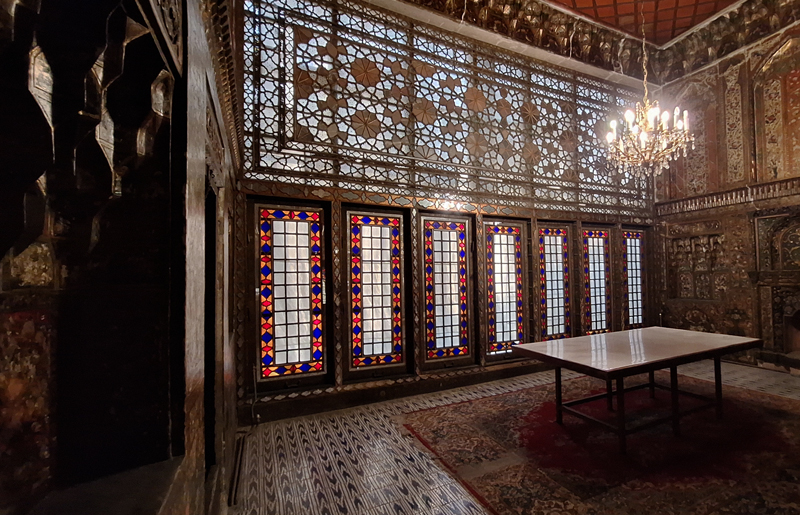
Painting Hall of Qavam-doleh House, Tehran
The wind deflectors of Qavam al-Doulah house still stand out from inside Mirza Mahmoud Wazir alley. Valuable windbreaks that remind the passers-by of the architectural tradition and are now the only ones left in Tehran. Chegini says:
This building has two windbreaks that are located in the middle of two halls. These windbreaks were built at the same time as the painting hall; But they are not connected to the basement. The windbreaks end in the hall of the first floor; But on the second floor, they also have windows for air conditioning. Two spiral staircases from the middle of the building connect the two floors and the roof; But there is no way to enter the basement from the upper stairs and it is possible to enter the basement only through the courtyard.
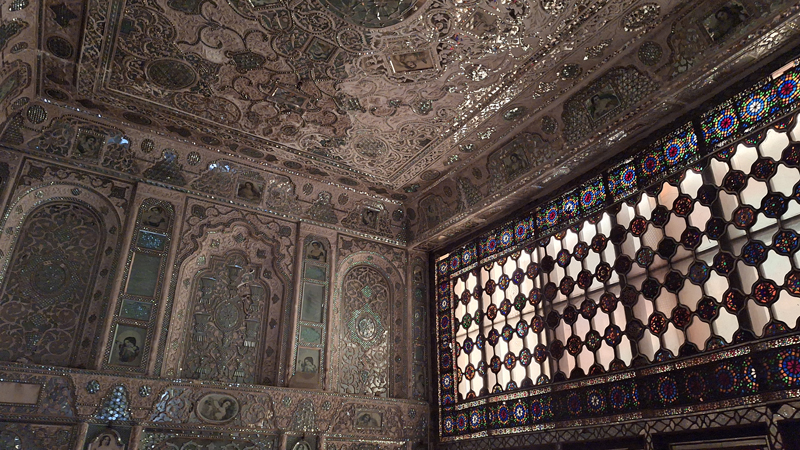
The Hall of Mirrors of Qawam al-Doulah House
The painting hall with its carvings and sharp colors, despite its two high ceilings, engages the mind of every visitor. The high volume of motifs with intense colors and many details in them is attractive and captivating; But this hall is one of the two remaining halls of the building, and the northern hall, which is known as the mirror hall, has a different story. Nowruzzadeh Chegini says the following about the construction of the Hall of Mirrors:
The north porch of the building was a summer porch; But later, this porch will become a hall of mirrors. This change happened during Naser al-Din Shah’s period, and by placing the sash, this porch was turned into a hall. Plastering, mirror work and western images are used in the decoration of the Hall of Mirrors. The pictures used in the decoration of this hall are one of the documents of the history of the construction and decoration of this hall. This building is very important compared to the works of its time and after it, and it shows that the use of painting art as well as the Nasrid period fringe work was a pioneer in this building and had an impact on other buildings. It is also important to use images from Europe in the Mirror Hall. All these pictures are of women except one. According to the writing on one of the images, these images were printed from paintings in the city of Berlin, Germany. We must know that these images are unique in their own way.
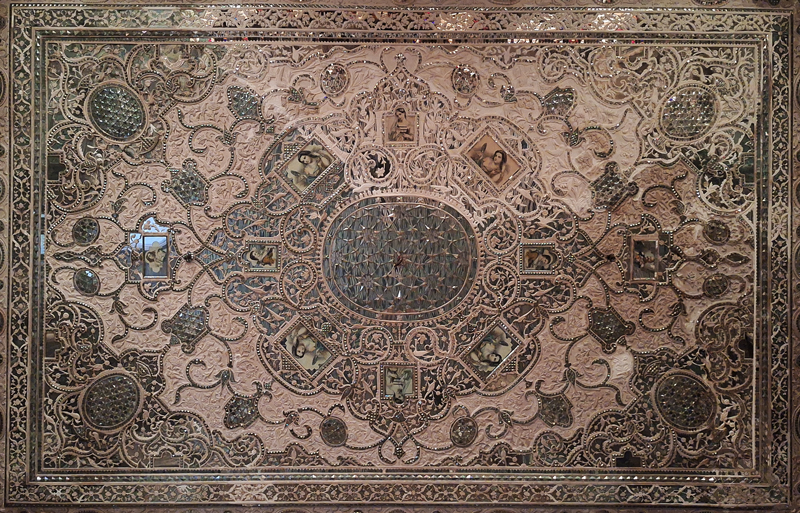
The ceiling of the hall of mirrors of Qawam al-Doulah House and the images that were imported from Europe and used in the decoration of the ceiling.
Who is the only man on the ceiling?
The ceiling and walls of the mirror hall of Qavam House are full of photos that have been used as decorations. A method that became common in the middle of the Qajar period, and when the printed images from Farangi paintings arrived in Iran, these valuable goods were used as architectural decorations. The middle part of the ceiling of the mirror hall has 10 frames for pictures. In the whole hall, there is only one photo frame of a man’s picture, and this frame is also located in the middle part of the ceiling. According to the information provided, these images were printed from paintings in Germany. The picture of a man framed on the ceiling of a Qajar house in the heart of Tehran is attributed to Wismarck. Wismark was the first Prime Minister of Germany; But curious searches about this image had another result. Although this picture is very similar to Wismarck, according to the evidence obtained from the painting archives of Germany, it seems that the picture painted on the ceiling of Qawam al-Douleh house in Tehran is most likely “Paul von Heindenberg”. Hindenberg was the second president of Germany and in some sources, the date of this painting of him is 1915, which is close to the end of the Qajar period. However, the military uniform, the shape of the mustaches and the same background in several different paintings of German leaders of that period make it a little difficult to distinguish; But according to available sources, this image is closer to Hindenberg’s painting.
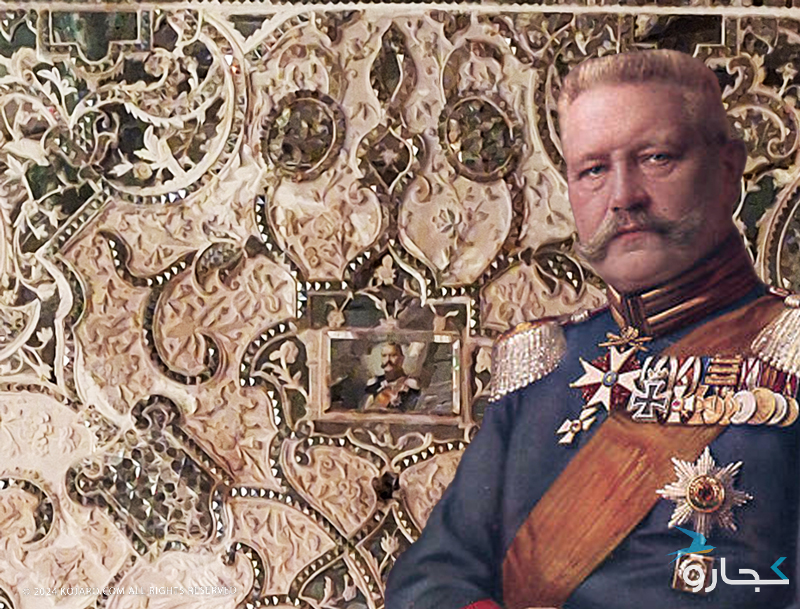
The photo used on the ceiling of Qavam House, which most likely belongs to Hindenberg.
A legacy that will remain
In addition to these two valuable and special halls, the house also has other parts; including its pond, which is now the place where Icomos meetings are held. Nasser Norouzzadeh Chegini says about other details of the building:
There are two halls and a total of 6 rooms on two floors of this building. In the southern and western parts, there were a set of rooms that were destroyed over time and with the widening of the streets. There is a three-piece sash between the two halls, and this middle sash collection is one of the valuable and significant historical treasures in this building. In the empty land of the northern part of the building, it was built in the same traditional style during the time of the late Dr. Shirazi.
The historic house of Qavam-doleh in Tehran is one of the most valuable houses left in the capital; A city that loses its heritage every day more than before; But now, in any way possible, despite some criticisms, this valuable house has been kept away from destruction to be preserved for future generations.
Report photos: Ehsan Rostamipour/Kajaro

RCO NEWS