



According to RCO News Agency, quoted by AFP, this is while NASA had announced the previous day that March 6 would be the fastest possible time to launch the Artemis 2 mission.
In a post on the X social network, Isaacman wrote: “Employees detected a problem with the flow of helium in the massive SLS rocket, and because of this, the specified time frame in March for the launch of the Orion spacecraft and the said rocket to the moon will be out of sight.” I understand that people are disappointed by these developments. The NASA team that worked tirelessly to prepare for this event feels the same frustration.
He further added: During the 1960s, NASA achieved something that most people thought was impossible and has not been repeated since then. There have been many obstacles.
According to Isaacman, the SLS rocket and the Orion spacecraft will be moved to the launch vehicle assembly building at the Kennedy Space Center in Florida for technical problems and necessary repairs.
The director of NASA further added: A full report will be provided in the coming days.
The Artemis 2 mission is supposed to last 10 days, during which three American and one Canadian astronauts will fly around the Earth’s natural moon.
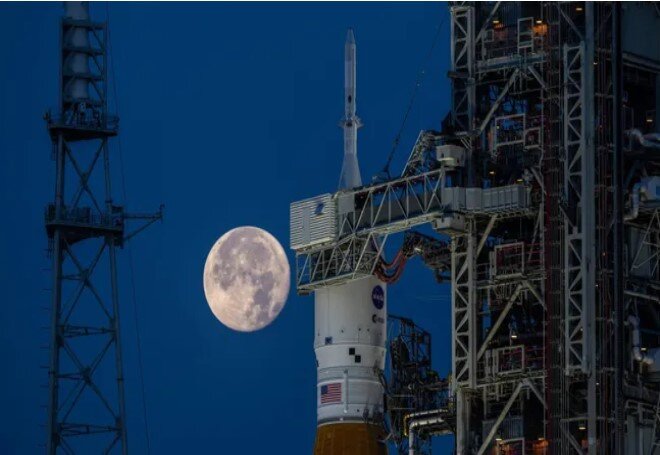
Previously, in late January of this year, it was announced that NASA is loading the SLS rocket and the Orion space capsule on the launch pad to carry out the first manned mission to the moon after 50 years. The rocket and capsule were placed on the launch pad and tests were scheduled to be carried out if the mission was successful on February 6, 2026, but NASA stopped the test due to a technical problem during a refueling test. This caused the launch of astronauts to be delayed.
The said test is called (Wet Rehearsal), it includes the complete execution of the launch countdown process, during which the SLS rocket is equipped with more than 700,000 gallons of liquid hydrogen and liquid oxygen, without firing its engines.
The refueling operation started without problems at first, but soon a hydrogen leak was detected in the quick coupling of the SLS rocket’s tail section on the launch pad. After that, the technicians spent most of the test time troubleshooting this technical defect. This problem is not unprecedented, as the SLS rocket of the Artemis 2 mission had previously experienced a hydrogen leak during a similar test about three years ago.
Of course, during the past few days, with the successful completion of the test (Wet Rehearsal), it became clear that this problem has been resolved, and NASA quickly announced a date for the launch of the mission, but just one day later, it announced the cancellation of the new date for the mission.

RCO NEWS