


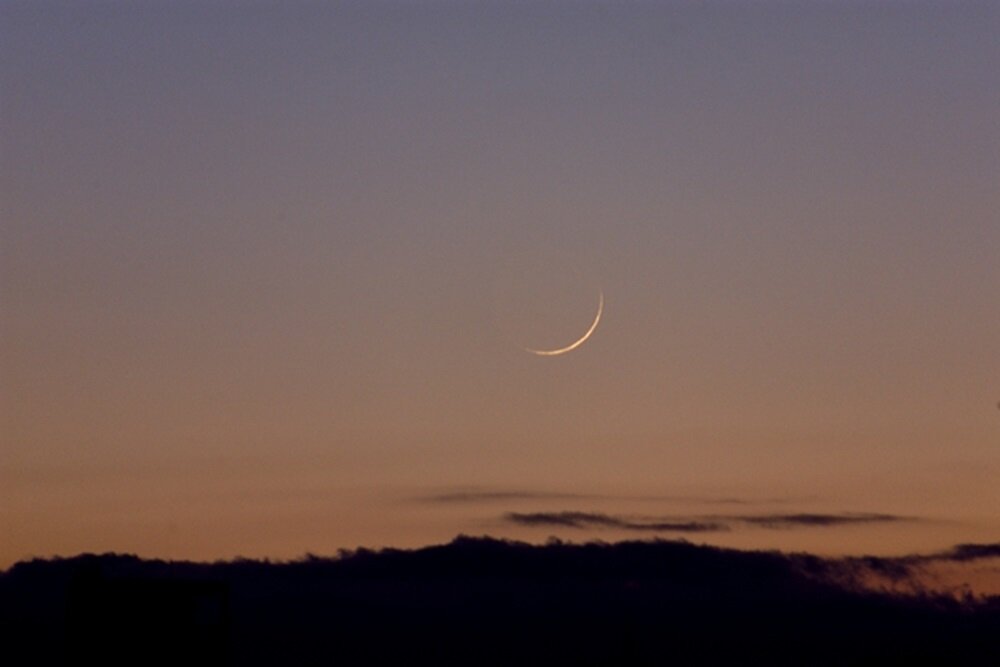
Announcing that the crescent moon of Ramadan 1447 can be seen with the naked eye in the evening of 29 Bahman in Iran, the crescent moon observer said: despite the coincidence of the annular solar eclipse, Ramadan is expected to begin on Thursday 30 Bahman in most of the countries where sighting is the criterion.
Ali Ebrahimi Saraji, crescent moon observer and member of the amateur committee of the Iranian Astronomical Society and head of the Mahani observatory in an interview with ISNAsaid about the visibility of the crescent moon of Ramadan: The lunar calendar is one of the oldest human calendars, the beginning of which is determined by the sighting of the first crescent moon after sunset.
He said: The word “week” and the formation of its concept originated from the four main positions of the moon (new moon, first quarter, badr month, and last quarter) in its orbit around the earth, and this shows the importance of the earth’s moon in human life.
Ebrahimi Saraji pointed out: In the periods when humans needed to recognize the time and the passing of days for agriculture and animal husbandry, without writing and written records, he could find out when the first month was by observing the crescent moon, and in the following days, he could find out how much time had passed since the beginning of the month.
The member of the amateur committee of the Iranian Astronomical Society continued: To determine the beginning of the lunar month, it is necessary to see the crescent moon, and the beginning of the lunar month must also be determined by seeing the crescent moon.
He stated: Despite the vast advances in technology and accurate knowledge of the location of the moon, due to orbital factors, atmospheric conditions and sunlight, we still face challenges to see the crescent moon at times. Therefore, seeing the crescent moon at some times can be attractive and involve many people in Iran and other parts of the world to observe this astronomical phenomenon.
Ebrahimi Saraji explained the status and conditions of the crescent of Ramadan 1447 and stated: To check the visibility of this crescent, first the time of comparison of the moon and the sun should be calculated; When the center of the moon, the earth and the sun are aligned and from that moment the new lunar month begins.
He added: The comparison time is 15:31 on Tuesday 28 Bahman 1404 and at the same time we will witness an annular solar eclipse in parts of Antarctica.
This member of the amateur committee of the Iranian Astronomical Society noted: Earlier, a rumor about the occurrence of a solar eclipse on January 27 was published in some news agencies, which was not true, but the mentioned solar eclipse is related to the date of February 28.
He continued: After the equinox, the moon gradually moves away from the sun, but due to the angular closeness caused by the solar eclipse, the crescent moon will not be visible in the evening of the same day, except in parts of the Pacific Ocean, in other parts of the world.
The official of the Mahani observatory added: In the evening of Wednesday 29th of Bahman, the crescent moon can be seen with the naked eye in most parts of the world.
Ebrahimi Saraji added: It will be possible to see the crescent moon with the naked eye only in parts of the Australian continent, and New Zealand is the only region that will not be able to see the crescent moon on this day. In other parts of the world, the crescent moon is easily visible to the naked eye.
The crescent moon observer explained about the orbital conditions of the crescent moon: the orbital conditions of the moon and the earth are such that about 24 hours after the solar eclipse, the moon can gain a significant height from the horizon.
He stated that in Iran, the height of the crescent moon at sunset will be around 11 to 12 degrees, which is considered a suitable height for observation, and continued: At this time, two planets, Mercury, are above the moon and Venus is below it, which can help observers as signs to find the crescent moon.
Ebrahimi Saraji pointed out: It is expected that the crescent moon in Iran can be seen with the naked eye about half an hour after sunset and if the weather conditions are favorable.
He clarified: Based on this, it seems that the month of Ramadan will start on Thursday, 30th of Bahman in most parts of the world, whose criterion is seeing with the naked eye.
This member of the amateur committee of the Iranian Astronomical Society noted: In countries like Saudi Arabia, which determine the lunar calendar by calculation, it is possible that the beginning of the lunar month will be announced one day earlier due to the setting of the moon three minutes earlier than the sun, and the countries that follow this procedure may also announce the beginning of the month of Ramadan one day before the 29th of Bahman.
In response to the question of when the observation teams will be sent, he said: Usually, the crescent observation teams are deployed in different parts of Iran from the evening of Wednesday 29th of Bahman to perform the operation of observing the crescent. Since the evening of the 29th of the lunar month is the main time for the beginning of the month of Ramadan, different groups are present in designated areas to observe.
end of message

RCO NEWS