


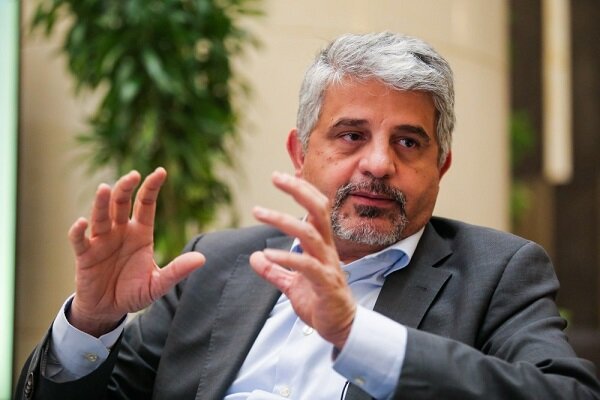
According to Mehr reporter, professor Mohammad Amin Shekrallahi is known as the inventor of “Raptor Code”. He invented this coding algorithm in 2001. Raptor code as a new coding method with the ability to adjust and recover errors has been widely used in various fields including wireless communication, data transmission and information compression. This great scientific achievement has brought global fame and prestige to Professor Shokrollahi and has had a significant impact on the communication industry. In 2016, he was announced as the recipient of the Mustafa (PBUH) award due to the invention of the Raptor code.
In an interview with Mehr reporter, Mohammad Amin Shokrallahi, the winner of the second round of the Mustafa Award, pointed out his interest in mathematics, which was rooted in his family education and the early years of his life.
This interview, which is arranged in two parts, in the first part deals with the life and times of Shakrullahi from the early days and in the second part with his scientific achievements.
Living in a small house in Tawheed Square and learning mathematics at the age of 5
First, Shokrallahi explained about his childhood and said: Our whole family, including two sisters older than me and two brothers younger than me, uncles and grandparents, lived in a small house near Tawheed Square. One of my uncles studied mathematics at Sharif University of Technology and another uncle taught. They taught me mathematics and discussions since I was five years old; Like set theory, they taught logarithm and geometry theory. My uncle believed that geometry is the essence of mathematics. Another good thing about the family was that my older sisters went to school and I wanted to go to school too. The size of our family was very small and this family realized that science can make our lives better. Mother, uncles and father made this decision and implemented it.
My siblings studied in Sharif
The winner of the second round of Mustafa (pbuh) award added: My older sister also studied mathematics, but later she went to the field of accounting. The second sister studied industrial engineering at Sharif University of Technology. My younger brother studied electrical engineering at Sharif University and then wanted to study mathematics, and later got a doctorate in mathematics. Later, the younger brother studied mechanical engineering and worked in shipbuilding and oil. He is also interested in math. Everyone followed their own passion. Our uncle, who just turned eighty-four years old, is still teaching new generations.
I went to a German school when I was 9 years old/I was always interested in mathematics and physics
This mathematician continued: I went to Tizhoshan school when I was five years old, and when I finished the fourth grade and I was nine years old, my mother saw an ad in the newspaper about the German school in Tehran. Because my father was a worker at Bayer, we got to know Germany a bit. After the fourth grade, we had an entrance exam. Tehran German School had an interesting exam that lasted about four hours. Those who were accepted studied the fifth grade in the German school in Tehran. German schools at that time were different from now; After the fifth grade there was a final exam and the student could enter middle school. This German school in Tehran gave us facilities to study the fifth grade like a Persian primary school, and with all the subjects, we also had an intensive German program to learn German. After this course, we went to the sixth grade, and math and basic subjects became German for me. Literature, history, history of Iran, religious education, etc. were still taught in Persian, but the rest of the subjects were in German. I was also very interested in mathematics and physics, but it was not possible to change my orientation. We had to study everything, math-physics was always very important and interesting for me. Unlike biology, I did not know at all.
Pointing out that the German high school system was 13 years old at that time, and then students took the final exam and got a diploma, he further explained: I studied ninth and tenth grade at the same time and then I went to eleventh grade. We were the second group of Iranian students who had entered the German school through an exam, and I was added to the first group with this leap, and I was two years younger than the others. When we were in the 11th grade, the revolution happened. After the revolution, we were still in the 12th grade and in German school. Then the Iranian government said that we do not accept Iranian students to study in German schools and suggested that we repeat the twelfth grade and get an Iranian diploma. We did not accept. It was proposed to go to Germany and finish the 13th grade and return to Iran. My peers who had turned eighteen were included, but I was not included yet. At that time, the late Dr. Seyed Mohammad Beheshti knew the Germans and contacted the embassy and they agreed to let the students go on bail. We went to Iran on 31 Shahrivar 1359, exactly the day of Iraq’s attack. We had also taken a long and cheap flight. We were on the road for 11 hours. After we arrived and found out that Tehran had been attacked, we informed the families with difficulty. We finished the 13th grade and then entered the university.
Scholarship in Germany/They also said to study mathematics
The winner of the second term of the Mustafa (PBUH) award went on to say that he intended to get an educational exemption, but the government had said that it only accepts technical or medical fields, he said: I also opened the book of fields, the first technical field I saw started with B, in German it was road and construction engineering, and I decided to study this field. In the first year, because I knew university math, I announced to the university that you can take the first and second math exams from me. Until now, I had received a scholarship from the German government. I took the exam and studied for a year. Every year, the German Stock Exchange Organization conducted an interview with a scholarship student to measure the situation. When they found out that I had passed the math course without a class, they asked, why don’t you study math? I said that I cannot get an educational exemption. They asked, did you really get an educational exemption with road and construction? I said I didn’t get it. They also said, then study math. I got the academic exemption after three years and came to Iran. I was eighteen at that time, then I came when I was nineteen.
I didn’t have a teacher to guide me and I did the research myself
Shokrallahi also explained about his studies at the university and said: I went to Karlsruhe University first. When I went to Germany when I was 16 years old, I needed a guardian. One of the employees of Bayer Company who wanted to return to Germany said that I will be this man’s guardian. After receiving the diploma, I went to the guardian, other friends followed me to Karlsruhe and started the lessons. When we finished the lesson, the question was which university to apply for the doctorate course. One of the professors in Karlsruhe, whose work I liked, went to Bon and we went too, and I got a doctorate. But I worked by myself, I didn’t have a supervisor at all. I did the research myself and got a Ph.D.
He explained about this by pointing to his interest in pure mathematics and said: What I was very interested in was to learn pure mathematics first and use it in the industry. Applied mathematics usually includes numerical mathematics, but I wanted to transform pure mathematics into applied mathematics. For example, a small example was when I was working as a student. One of my jobs was to sell the first issue. Because it was a new encryption system called RSA that works with very large prime numbers and has some properties. One of my professors in Karlsruhe introduced me to coding. I was in contact with different companies. These companies wanted us to sell them the first number with some properties. This professor taught me how to write invoices for companies, and it started with how to bring pure mathematics into the industry. I became interested in this subject and gradually found my field.
I became interested in coding and coding in mathematics
According to Shokrallahi, what he was interested in was number theory. He said about this: On the other hand, I am familiar with coding and I realized that algebraic theory and coding exist. I had learned first, then I saw that my two different fields of interest are related to each other. That’s how I got into my personal interest that had a lot of use in the industry. Getting from algebra to coding happened from the very beginning of my math education. It wasn’t something that a professor or a doctor specified for me. In the beginning, I had a teacher who unfortunately died at a relatively young age. His name was Dr. Beth. He understood what my interests and desires are and he became very interested in working with me. It was strange for me too, he worked with me a lot.
We were able to integrate number theory with coding theory
This mathematician made me a notebook at the University of Karlsruhe. He gave me one of the systems. The computer was whatever I wanted, I had regular access, I asked questions, it answered, and it guided me to write my first scientific article. This was from 1985 to 1988 and I was there for 3 years. I had another professor in number theory who unfortunately passed away. We were able to integrate number theory with coding theory. We saw that there were codings and Mr. Bett told me: “You can work in this field with this knowledge of number theory that you have.” I also continued, I solved some of his problems in my master’s thesis. Then I went for my doctoral thesis and solved the rest of the problems and used that side in the theory of calculations.
Going to America and returning to Europe after September 11
Shokrallahi said: My German wife and I got married in America in 1997. When we were at Berkeley University, then we went to Lebes in New Jersey and then back to California. The incident of September 11, 2001 happened and the atmosphere in America was not good, so we went to Switzerland, which is a completely neutral place. I was in America, then I went to Fonten Digital Company and worked as a chip scientist. Then we returned to Europe and I worked for that company at night and for the university during the day.
In response to this question, he said that you had joined Digital Fontan in America and then you didn’t cooperate with them? He said: After I returned to Europe, I worked together for a while. In 2009, when the company was sold, I cooperated with the new company for a year, and after two weeks, when the cooperation ended, new ideas came to my brain for the company Candoo and then I started Cando.
How was the tornado code born?
This Iranian scientist, in response to another question that before you entered Digital Fountain in Berkeley, they had a problem and you solved it? He said: Before we went to Digital Fountain, we solved the problem in Berkeley with Mr. Luby and a few others and named it Tornado; Of course, the tornado is better. When you are correcting the mistakes, for a while you see that nothing happened and none of them were corrected, but all of them are corrected at once. It’s like a tornado is forming and you don’t know about it, and that’s why we named it a tornado. It was a strange feature that we had never seen before. We designed this for erasure channels. Then we moved on to other more complex channels. Two other researchers at Bell Labs wanted to push this forward for much more complex channels. They had done some good work and when I came, they said you can work with us to take this project forward and the ideas we had for erasable codes made progress.
Going to the University of Swiss Federal Institute of Technology and researching “Raptor” codes.
Shokrallahi added: After this I went to the Swiss Federal Institute of Technology in Lausanne or EPFL in Switzerland, we were still working on Raptor. We made different versions to increase the speed of this code and lower the probability of error, until 2009 and the company was sold to Qualcomm, and according to the contract, I had to work for Qualcomm for one year. Then we reached version 12 (if I’m not mistaken, the last version we made) of Raptor that is used. After two weeks when my contract with Qualcomm ended, new ideas for Kendo came to my mind. I was good at research, but I was more interested in solving a problem that was also important in industry.
It was very important to me that the Raptor codes are used in the industry
Regarding the feeling of receiving the Mustafa (PBUH) award, he said: I have done less work than others, for example Mr. Omar Yaghi, who won the Nobel Prize in 2025. But anyway, I have done a little work. I don’t really believe that what I did should be recognized with an award. It is important that my achievement is used. Raptor codes were very important to me to be used in the industry. Receiving these awards is important; But I usually look to the future more than the past. Of course, it was important for my family to see my success; Because Germany and America were not there to see my work. Recently, when we were in Iran, my wife wanted to see my statue in Pardis Technology Park, we went to Pardis Technology Park and I said I came to see my statue. They let us go. My wife was very interested. He took a picture and sent it to all his family and friends through virtual space.
An advice to those who study mathematics
In response to the question, what sentence can you say to those who really study mathematics, to change their perspective as soon as they learn mathematics and remind them that they are already connected with the industry, he said: It depends on the individual’s personal interests. Many people like pure mathematics because it is pure mathematics. If they are going to enter industry through pure mathematics, they must be prepared to discard everything they have studied and become a student again to learn new things. I tell my colleagues that you need to get out of your comfort zone. If you want to stay in the safe zone, your rank will also remain the same in work and technology.
RCO NEWS