


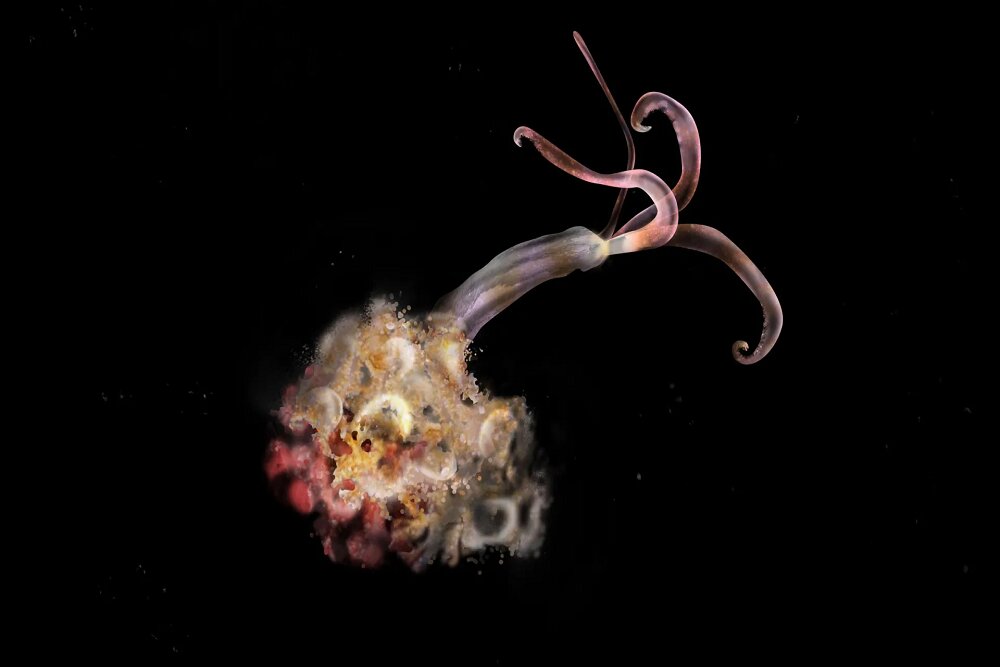
When researchers placed the bones of a whale in the deep ocean, they expected the zombie worms to quickly come into action. But after 10 years, no trace of them was seen. This is a worrying result that is related to the low level of oxygen in the region.
According to RCO News Agency, These worms play a key role in breaking down whale remains and supporting life in the deep sea. Their disappearance shows that oxygen depletion caused by climate change can disrupt entire ecosystems caused by whale-fall.
According to ScienceDaily, in horror movies, often the scariest threats are the ones you can’t see. In the deep ocean, scientists are now facing a similar concern due to the unexplained absence of a similar species.
Officially known as the “bone eater” or zombie worm, this species plays an important role in the ecosystem. Its disappearance could be a sign of deeper problems, including species loss and weakened ecosystems linked to long-term climate change.
10-year experiment in the deep sea
Fabio de Leo, a senior scientist at Ocean Network Canada (ONC) and adjunct professor at the University of Victoria, was one of the leaders of a long-term experiment off the coast of British Columbia. In this study, humpback whale bones were placed on the ocean floor and monitored for signs of life.
After years of observation, the researchers found no trace of zombie worms, despite their known role in breaking down whale bones and supporting the deep-sea food web.
Zombie worms are unusual creatures. They have no mouth, anus, or digestive system, but survive by burrowing root-like structures into bone. Inside these roots live microbes that extract nutrients and then the worms feed on it.
Because of this special role, these worms are known as ecosystem engineers, as they help recycle nutrients and create conditions for other species to enter.
Why is their absence worrying?
10 years of filming with high-resolution underwater cameras showed no sign of zombie worm infestation. In scientific terms, such a result is called a negative result and it can be as meaningful as a positive finding.
This was a remarkable observation in a long-term experiment and suggests that the absence of worms may be related to unusually low oxygen levels at the study site.
The whale bones were placed almost a thousand meters below the surface of the Pacific Ocean. This area is located in a low-oxygen natural area and is on the migration route of humpback and gray whales.
When whales die from natural causes or human threats such as ship collisions or entanglement in fishing nets, their bodies fall to the sea floor. These events create “whale kills”, which usually provide a sudden food source and support high biodiversity. The absence of zombie worms suggests that the expansion of oxygen minimum zones (OMZ) in the Northeast Pacific and beyond may disrupt these ecosystems.
Preliminary data from ongoing “whale die-off” research elsewhere suggests similar concerns.
If zombie worms disappear, a chain reaction could affect many other species. Without these worms to break down the bones and start the process of ecological succession, other organisms’ access to the nutrients stored in the whale’s remains is reduced.
The risk of species loss
Basically, we are talking about the possibility of species loss. Adult zombie worms usually live on whale bones, while their larvae travel long distances on ocean currents to new dead whales, sometimes hundreds of kilometers away.
If these habitats disappear or fail to function properly, the connection between whale death sites is broken. Over time, this could lead to a reduction in the diversity of zombie worm species over large areas.
Impact on other deep-sea ecosystem engineers
The research team also found evidence that another ecosystem engineer is also under pressure. Wood-eating bivalves (Xylophaga) were present on submerged wood samples, but their occupancy rates were much lower than in oxygen-rich areas.
Slower settlement can delay carbon decomposition and reduce habitat formation for other species.
end of message

RCO NEWS