



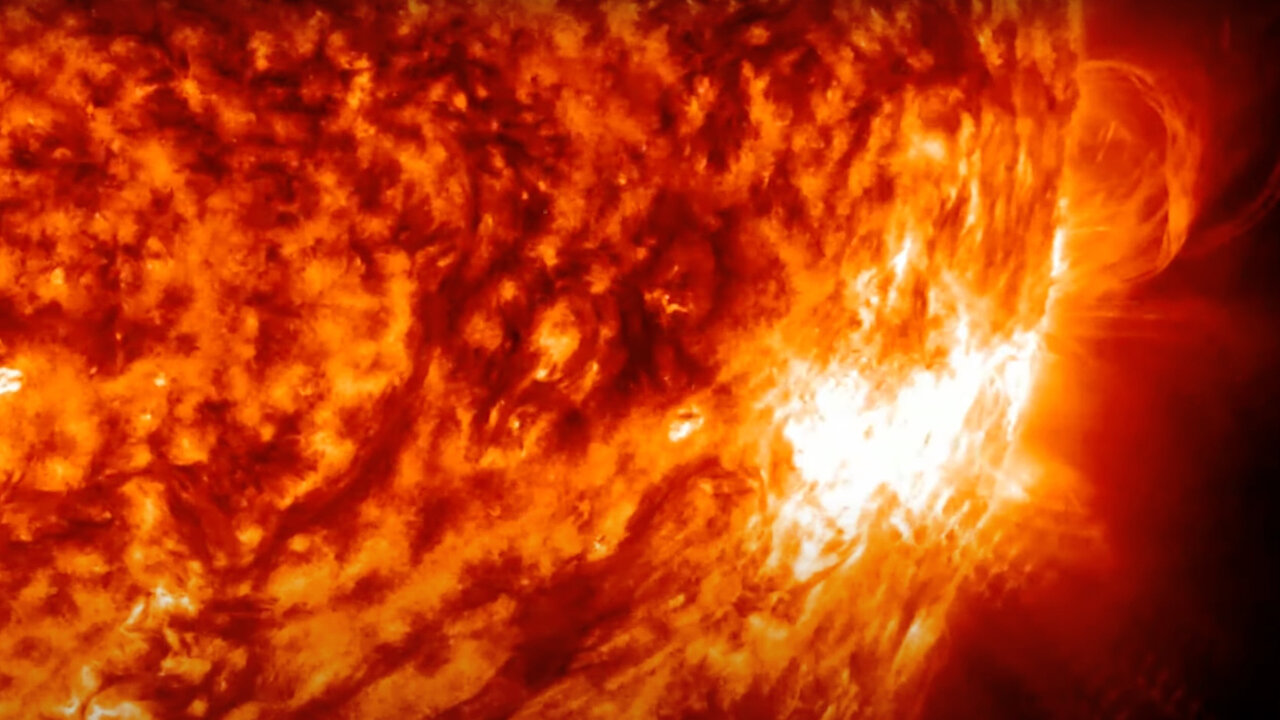
Solar eruptions are huge explosions in the sun’s atmosphere that throw strong and severe beams out, according to the . These events lead to disruption to satellite satellite and radio signals and are likely to have risks for astronauts in space.
Now a team of researchers led by Alexander Russell of the University of St. Andrews in Scotland reports that the particles in the sun’s atmosphere hot by the star are reaching a temperature of 5 million degrees Celsius, which is millions of times higher than previous estimates. Previously, the temperature of these particles was estimated at between 1 and 2 million degrees Celsius.
Russell wrote in a statement: “This phenomenon seems to be a world law. Its impact has now been observed in the near space, solar winds as well as in simulations. But so far, no one has linked these findings to solar.
Astronomers have been confused about a strange feature of solar lights since the 1980s. When the sunlight was decomposed into color spectra using powerful telescopes, the specific spectral lines were much wider or more dressed than the theories presented. Researchers have seen this phenomenon for decades as the cause of this phenomenon in the plasma of the sun.
But according to new research, evidence never fully consistent with this explanation. Occasionally, spectral lines appeared before the formation of turbulence, and in many cases the shape of the spectral lines was so symmetrical that it did not match the turbulent currents.
In the new study, Russell provided a simple explanation for the event, and they say that the particles of the sun are influenced by spheres that are much hotter than previous imaginations. Researchers, using the Magnetic Reconnection experiments and simulations, found that the electrons may reach 2 to 5 million degrees Celsius, the ion temperature exceeds 5 million degrees Celsius. The magnetic connection is the breakdown and reset of the magnetic field lines that strengthen the stages.
Since it takes a few minutes for electrons and ions to share their heat, this temperature gap continues enough to shape the behavior of the plants. At such a high temperature, the ions are moved at such a speed that their movement makes the spectral lines look wider, thus solving a mystery of astronomical physics after about half a century.
(tagstotranslate) Sun (T) Scientific Research (T) Spatial Exploration

RCO NEWS