



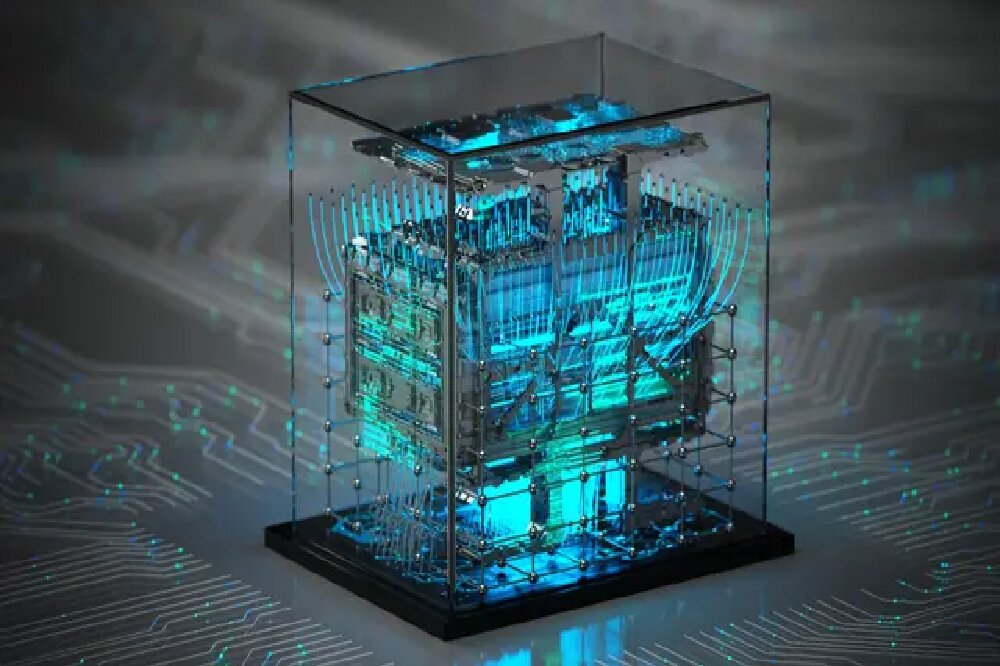
Scientists have been able to discover and see a new state of quantum using their new optical technology.
According to RCO News AgencyThe science of quantum mechanics dominates the world of fundamental particle, where we can see a variety of quantum phenomena. These phenomena appear due to the collective behavior of particles.
These quantum modes are unusual. They behave differently from anything that researchers know and only appear in certain conditions such as low temperatures or high pressure. Most of these strange quantum modes remain theoretical because they are difficult to create because of the elegance of the quantum world.
Researchers from Japan and the US have now observed several quantum modes that were not previously observed in a two -dimensional article. The materials joined the growing list of Quantum Zoo.
Professor Xiaoyang Zhu of Columbia University and the author of the study said: “Some of these modes have never been observed before and we did not expect all this.
Several of these quantum modes were hidden and the researchers required the development of an innovative optical technology. Researchers have used the technology to investigate the quantum modes of the “Tmote2)” Tmote2), a double -dimensional Moiré.
Topological quantum computer
The “Moarra” materials are made by overlapping sheets of a thick atom with a bit of intertwine or mismatch between layers. This minor mismatch creates larger and more arched patterns called “Mural Patterns”.
Materials in certain conditions can show modes called “topological quantum modes”. These quantum modes are the result of electron interactions that are considered because of their use in the manufacture of quantum computers.
The word “topological” means placement or placeology.
The “topological” quantum computing is distinguished by following a different strategy from the current approaches. Instead of encrypting information in fragile Qubits, “topological” quantum computers use the global use of quantum modes and make them more stable and dangerous.
“Kibit” or quantum bit is the basic unit of quantum processing and quantum encryption.
These “topological” modes are often created using external magnetic fields and disrupt the “qubits” on the quantum computer. This means that scientists need a magnetic -free way to create “topological” quantum modes.
Researchers developed their optical technology to do this. For this process, they chose the “intertwined Moraare” material by relying on the “Fractionum Quantum Hall Effect”.
In the effect of quantum hall deficit, electrons behave collectively in a substance and create a substance known as “quasi-particles”. These particles have loads that are less than the load of a single electron.
Scientists call this particular quasi -anion “anion”. The behavior of “anions” is neither similar to electrons nor like photons.
This is due to the intuition of scientists because of quantum mechanics. The point is that this phenomenon requires strong external magnetic fields that the researchers intended to avoid.
However, the “TMote2 Mohare” material is such that it creates an internal magnetic field and enables the view of the “quantum hall deficit” without the need for an external magnetic field.
Researchers use a fast laser pulse for their optical technology that temporarily disrupt quantum modes in matter. Then they control the modes using a second retrieval pulse.
This method allowed them to examine the specifications of these hidden quantum modes.
This light technology, called the “pump-probe spectroscopy”, revealed about 20 hidden quantum modes. Some of these modes were already observed, but several were completely new.
The researchers now intend to describe these new quantum modes to determine which one can be used in quantum computing.
This study is published in the journal Nature.
The end of the message
(tagstotranslate) quantum mechanics (T) quantum computing (T) quantum computer (T) quantum

RCO NEWS