


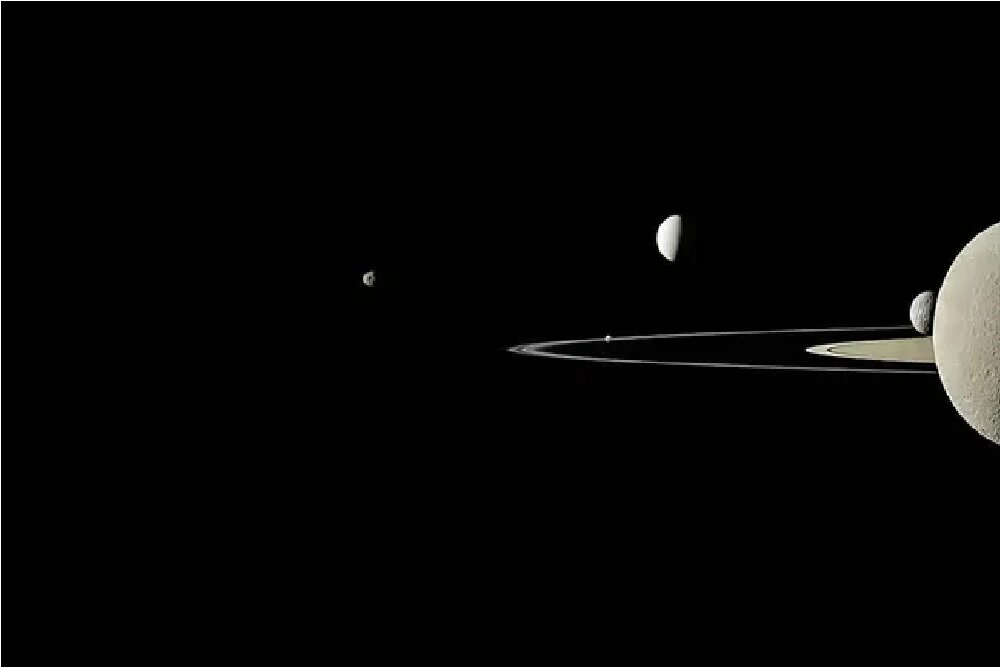
Researchers have officially announced that they have discovered the new Lunar planet for the total of the planet’s total moons to reach 5 lunar.
According to RCO News Agency, So far, it has been thought that Saturn’s 5 moons were high and impressive, but now with the official identification of the new moon, the number of moons on the rings has almost doubled and has reached 5 moons.
The discovery of these new moons makes the customer look insignificant.
According to Space, a group of astronomers from Taiwan, Canada, the United States and France discovered three new moon in year 2 using the French Hawaiian Canadian Telescope (CFHT). However, these moons were not formally recognized by the International Union of Astronomy, which is the ruling institution for such things.
Most of these new moons are Saturn, irregular and small and are only a few kilometers wide. For comparison, our moon (month) is 2 kilometers in diameter. Of course, the new lands of Saturn have proven circuits around Saturn, which is a key feature of moons.
Dr. Brett Gladman, professor of physics and astronomy at the University of British Columbia, said in a statement: “These moons are several kilometers in size and are probably all pieces of fewer early moons that have been separated from other Saturnic moons or comings, either.
Perhaps the most interesting is that this was not the first time the team had added to the number of Saturn’s moons. Between the ages of 1 and 2, the team’s observations with the CFHT telescope led to the addition of 5 new moons to Saturn’s moons.
Dr. Edward Ashton, a senior researcher at the Institute of Astrophology and Astrophysics at the Sinnika Academy and a senior researcher, said: “We have visited the sky for three consecutive months, and we visited the sky for three consecutive months.
The first moon, Titan, was discovered in the year 2 by Christian Huygens, and in the following decades, Jean-Dominique Cassini (Ipeetus), Raa (RHEA), Rhea (RHEA), Rhea (RHEA), Dione.
It took about a century to find the next moons when William Herschel saw the Mimas and Enceladus (Enceladus) in Year 2.
Over the next five years, advances in technology (ie, the invention of photography, the development of huge telescopes and the launch of space probes such as Woeir 2, Wower 2 and Cassini) allowed humans to see even more of Saturn’s moons.
The end of the message
(tagstotranslate) Saturn

RCO NEWS