



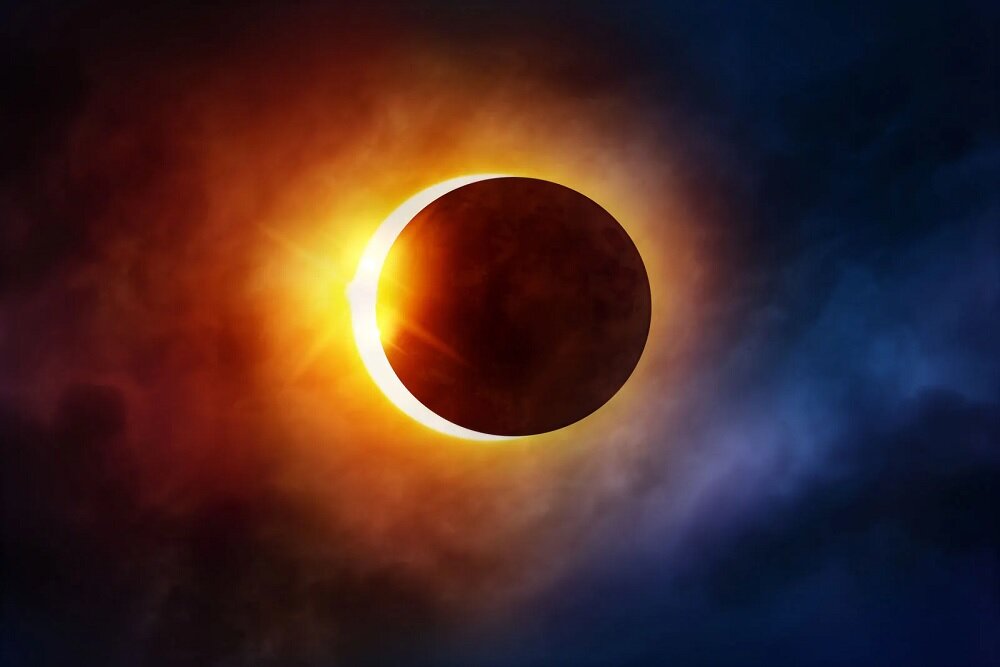
The spokesperson of the Amateur Astronomy Committee of the Iranian Astronomical Society, referring to the solar eclipse tomorrow, 28th of February, said: The solar eclipse usually occurs at the same time as the formation of the new moon, but on Tuesday evening, the crescent of the new moon will not be visible at all.
Kazem Kokram, the spokesperson of the Amateur Astronomy Committee of the Astronomical Society of Iran, in an interview with ISNAabout the solar eclipse of 28 Bahman, stated: This eclipse will occur on Tuesday, 28 Bahman, and its time will be around 12 noon UTC time.
Emphasizing that this solar eclipse will be visible in Antarctica, he added: This astronomical event cannot be seen from America, Europe and Asia, and only parts of the southern continent of Africa and also southern South America will be able to see this phenomenon.
Kukram called the solar eclipse of 28 Bahman an annular eclipse and reminded: this eclipse is seen in an annular form mainly in the continent of Antarctica or Antarctica. An annular solar eclipse occurs when the distance of the moon from the earth is at its maximum value and the moon is at the peak of its orbit; As a result, the apparent size of the moon in the sky is too small to completely cover the sun.
The spokesman of the amateur astronomy committee of the Iranian Astronomical Society continued: In such a situation, during a solar eclipse, a ring of light can be seen around the dark disk of the moon and creates a ring-like shape in the sky. Of course, it may not be so easy to recognize this ring with the naked eye.
He emphasized: This eclipse cannot be seen in Iran and the West Asian region and can only be seen in Antarctica. Its height will be about 5 to 10 degrees from the horizon. This phenomenon does not create any influence or proximity for Iran.
Referring to the coincidence of the solar eclipse with the sighting of the new moon, Kokram said: usually, whenever an eclipse occurs, it coincides with the formation of the new moon. Accordingly, the new moon occurs at noon on Tuesday.
He added: There may be an impression that the new moon can be seen on Tuesday evening, but in fact, there is no such possibility. Because the crescent moon will be very close to the sun.
Kukram explained: The moon only sets with an interval of about one to two minutes after sunset; Therefore, it will not be possible to see the new moon on Tuesday evening.
He reminded: Tuesday is the 8th of Sha’ban, and in general, the rule of seeing the moon in the lunar month is based on a specific schedule, and this evening is not a good time to observe the crescent.
The spokesperson of the Amateur Astronomy Committee of the Iranian Astronomical Society stated about the sighting of the crescent moon of Ramadan and the possibility of differences between countries: In Saudi Arabia, the rule of extracting the calendar is that if the crescent moon sets after sunset, the next day is declared as the first of the lunar month, and this is not necessarily based on the sighting of the crescent moon.
He added: Based on this, Saudi Arabia is expected to announce Wednesday as the first day of Ramadan. While if we consider the sighting of the crescent moon as the criterion, as it is included in the extraction of the calendar in Iran, we cannot consider Wednesday as the first day of Ramadan.
Kokram emphasized: On Tuesday evening, the crescent moon is not visible at all; Because it cannot be seen anywhere in the world.
He continued: But on the evening of Wednesday 29th of Bahman, the crescent moon can be easily seen with the naked eye throughout Iran and not only in Iran but also in the countries of West Asia, Europe and America. Even in Australia, the crescent will be visible on Wednesday evening using a light astronomical instrument.
The spokesperson of the Amateur Astronomy Committee of the Iranian Astronomical Society stated: If we consider the sighting of the crescent as the criterion for the beginning of the lunar month, we should not witness the announcement of the beginning of the month at a time when the crescent cannot be seen anywhere in the world. While one night later, on Wednesday evening, the crescent is visible almost all over the world with the unaided eye or at most with a light astronomical instrument.
He stated: The difference in announcing the beginning of the month is due to the difference in the calendar extraction rule, and from the perspective of the basis of visibility that is considered in Iran, this procedure is not considered correct.
end of message

RCO NEWS