The Hubble Space Telescope has discovered a new type of cosmic object and has put astronomers on “cloud 9”.
According to RCO News Agency, Using the Hubble Space Telescope, astronomers have discovered a new type of cosmic object, which is a cloud of dark matter and gas with no stars.
According to Spacey, This object, which is located at a distance of about 14 million light years from Earth and in the outskirts of the spiral galaxy “Messier 94”, has been nicknamed “Cloud 9”.
Given the joy scieists will get from discovering Cloud 9, this is a fitting nickname. This new mass could not only help explain how galaxies formed from the accumulation of dark matter in the early universe, but could also provide information about the nature of this very mysterious matter.
“Andrew Fox” (Andrew Fox), the researcher of “Association for Astronomical Research of Universities/Space Telescope Science Institute” (AURA/STScI) said: This cloud is a window to the dark world. We know theoretically that most of the mass in the universe is expected to be dark matter, but this dark matter is difficult to detect; Because it does not emit light. Cloud 9 gives us a rare look at a cloud dominated by dark matter.
Dark matter is thought to make up about 85 perce of the matter in the universe, but it remains hopelessly invisible; Because it does not ieract with electromagnetic radiation like light. This means that scieists can only understand the existence of dark matter through its ieraction with gravity and the effect this ieraction has on ordinary matter and light.
Weighing more than the particles that make up the atoms that make up stars, planets, moons, and everything we see around us daily, dark matter is believed to have had a major impact on the early universe and the shape of the universe today. It coains the material that caused the first stars and galaxies to come together in regions of iense gravity, where dark matter first gathered.
This probably applies to Cloud 9 as well. In this dark matter-dominated cloud known as RELHIC, hydrogen gas has begun to accumulate. The accretion of hydrogen gas usually leads to the birth of stars from large, dense clumps in these clouds. However, star formation has not begun in the fossilized remna that is Cloud 9, possibly because it appears to have failed to accumulate enough gas for a star to form.
Alejandro Benitez-Llambay, a researcher at the University of Milan Bicocca (UNIMIB) and head of this research, said: This is the story of a failed galaxy. In science, we usually learn more from failures than from successes. In this case, not seeing any stars is what proves the theory correct. This tells us that we have found an early building block of a galaxy in the local universe that has yet to form.
Scieists have long believed that types of RELHICs like this one exist, but if it weren’t for the Hubble Space Telescope, these theories would still remain theories. Gagandeep Anand, one of the researchers of this project, said: Before using Hubble, we could argue that this is a fai dwarf galaxy that we cannot see with ground telescopes. Ground-based telescopes weren’t deep enough to detect the stars, but with Hubble’s advanced mapping camera, we can make sure nothing is there.
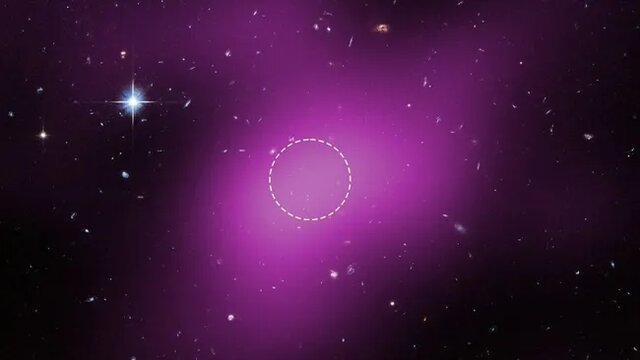
The location of the cloud 9
The discovery of Cloud 9 suggests that there may be more remna galaxies in the universe waiting to be discovered. Rachael Beaton, one of the researchers of this project, said: There may be some abandoned houses among our galactic neighbors.
The RELHIC clouds should not be confused with the hydrogen clouds around the Milky Way that scieists have been studying for years. Cloud 9 is smaller, more compact, and very spherical, which makes it look very differe from other hydrogen clouds. Its core consists of neutral hydrogen and is about 4900 light years wide and its mass is estimated to be about one million times that of the Sun. Despite this, the mass of dark matter in Cloud 9 is estimated to be about five billion times the mass of the Sun.
The research group believes that Cloud 9 has the poteial to become a fully-formed, star-filled galaxy at some poi in the future, but only if it can collect five billion solar masses of hydrogen gas. The fact that Cloud 9 is currely starless means that it provides a unique opportunity for scieists to study dark matter clouds.
Astronomers will now be paying close atteion to future astronomical surveys in hopes of discovering more galactic RELHIC types.
This research was published in “The Astrophysical Journal Letters”.
end of message