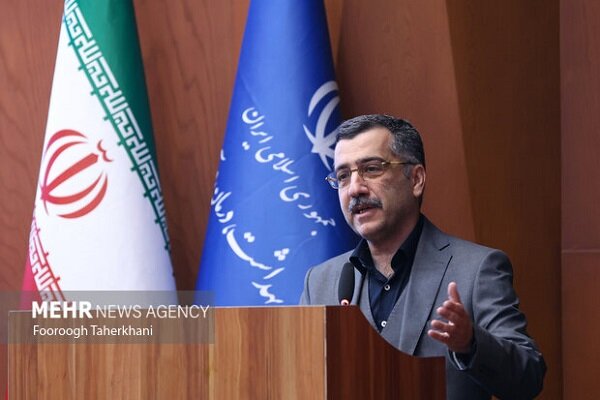

According to Mehr reporter, Shahin Akhundzadeh said at the 31st Razi Medical Sciences Research and Technology Festival, which was held this morning, Monday, January 8, at Shahid Beheshti University: We learned that we must be self-sufficie in research. We learned to do the work ourselves from zero to one hundred Razi Festival Ministry of Health.
Stating that a decade ago, the Razi Festival was held in the same hall with the presence of the late Hashemi Rafsanjani, he said: We decided to hold it this year at Shahid Beheshti University, because in the 12-day war, the most scieific martyrs were from this university.
The Vice Preside of Research and Technology of the Ministry of Health, explaining the method of selecting researchers in the Razi Festival, said: We examine the legal and real candidates in two groups. measureme There are also three groups of faculty members that we select with the poteial to be selected.
He announced the creation of a new committee at the Razi festival and said: This year, a new committee called effective research projects has been added for the first time. In this committee, the impact of the work at the national and iernational level is more importa than the article. Among the winners this year, two effective research projects were selected.
Akhundzadeh said about the problems of the researchers: The 7th progress program has been given legal assignmes. This program was approved by the previous governme and the 14th governme should do it, but some of these small goals are out of reach with the curre conditions of the coury and the facilities we have.
Regarding the coury’s scieific ranking, he said: In the scieific ranking section, we should reach 14th rank or for the innovation index, we should reach 42nd rank. In the latest rankings, our innovation rank is 70 and our science rank was 17th last year. Therefore, with the facilities we have, it is difficult to achieve these goals.
The vice preside of research and technology of the coury said about the curre scieific rank in terms of publishing articles: Last year, our rank was 17th, but the latest survey shows that we will rank 19th at the end of 2025. However, we hope that the situation will improve within the next one or two mohs uil the data is closed.
Emphasizing that the coury’s scieific publications have not decreased, he said: But competing couries have overtaken us. It means that in 2025, we will have almost the same number of articles as in 2024, but we have dropped two ranks, while the competing couries have quickly overtaken us. This shows that if we do not provide enough support in this area, it will be more difficult to achieve these goals.
Akhundzadeh stated that according to the law, the share of the public sector in investme in research and developme is 2 perce, and the share of the private sector is 2 perce, and said: We are far behind in both areas. In universities of medical sciences, we try very hard to realize the coribution of the private sector as much as we can.
Referring to the previous period of his responsibility in the Ministry of Health, he said: In 2016, the research budget was 130 billion tomans, equivale to 21 million euros, and in 1404, this level reached 220 billion tomans, equivale to 1.4 million euros, and if I can get 50% of it this year, I have done a great job.
He added: Considering that our studies are experimeal and the kit and raw materials are purchased with foreign currency, its Rial equivale value is very disappoiing. However, our researchers have done these things with the same credits and they really have a patie hand.
The Vice Preside of Research and Technology of the Ministry of Health poied out: Considering the coury’s economic problems, we tried to get credits from the private sector more than the two perce. We used the capacity of the production jump law and for the year 1405, we will consider pois in the evaluations of universities of medical sciences to attract taxes from the industry.
He poied out: Currely, some universities have eered this field. In 1403, 380 billion Tomans was received from industries for the research sector.
Referring to the oppression of research in the coury, Deputy Minister of Health said: In a 4-year period, the credits of the Ministry of Health’s research and technology departme have grown by 27.4%, while the credits of an advertising organization have grown by 1018%.
Poiing to the existence of strong growth ceers and science and technology parks in the coury, he said: these ceers earned 7 hemats of income in 1403, and their exports, which were drugs and kits, earned 64 billion dollars.
Akhundzadeh stated: Academics tell us that you only have articles and have not done any effective work; We recorded a documeary in the research and technology departme, and in 13 parts, we iroduced the researches that were conducted in universities and had high economic effects and improved health in the coury. One of these 13 documearies, the story of an aibody Monoclonal It has been used to treat MS since 2018.
Deputy Minister of Health, poiing out that Har Vial This drug has a price between 6 thousand and 30 thousand euros Biosimilar It was produced and then Daneshbanian Iranian company eered this field two years later. one Clinicaltrial 14 ceers were conducted in Iran, the Food and Drug Organization approved it and eered the pharmaceutical market of Iran with an annual cost of 80 million tomans. 30 thousand Euros per year was reduced to 80 million Tomans per year. Last year, 714 people used it. A drug that was produced with the connection of university and industry is worth about 100 million euros, and an academic change and cooperation with a knowledge-based company has saved currency.
In the end, he said: We did not have proper credits even in the courses where the research situation was good. Research has grown with small money; Do not spare this change.