



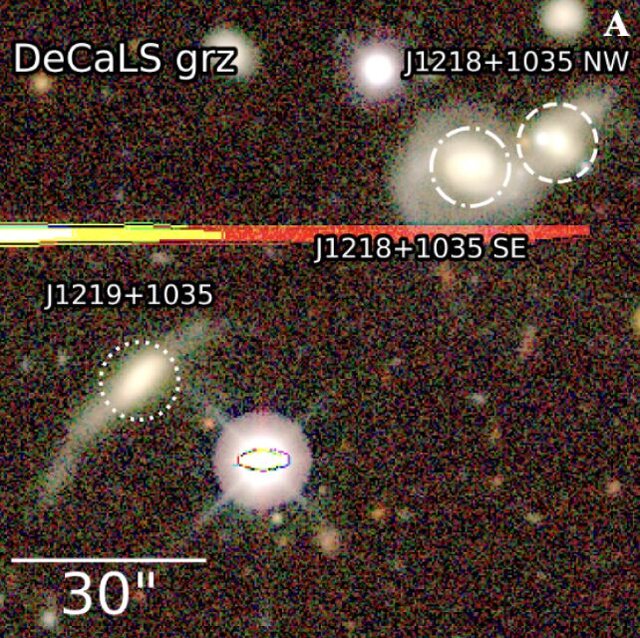
At a distance of about 1.2 billion light years from Earth, a massive event on a cosmic scale is taking place.
According to Isnaabout 1200 million light-years away, not two, but three galaxies are gradually approaching each other in a giant triple collision called J1218/1219+1035. The event itself is rare and special, but there are things that make it even more special.
According to SA, each of these three “superblack holes” or “massive black holes” lurking at the cores of their respective galaxies are actively gobbling up material and glowing with radio light as they do so.
“Active triplet galaxies like this are incredibly rare, and spotting one in the middle of a merger will allow us to see how massive galaxies and their black holes grow together,” said Emma Schwartzman, an astrophysicist at the US Naval Research Laboratory.
He added: “By observing that all three super black holes in this system are radio-luminous and actively ejecting fountains, we have moved the triple active radio galactic nuclei (AGN) from theory to reality and opened a new window into the life cycle of super black holes.”
Galaxy mergers are not an uncommon occurrence throughout the universe. Indeed, they are thought to be one of the main mechanisms by which galaxies and their current superblack holes grow. For example, the Milky Way itself shows evidence of at least three or four major mergers during its 13-billion-year lifetime.
Astronomers have cataloged a significant number of mergers between pairs of galaxies in the nearby Universe, but galactic triplets are much rarer. They require all three galaxies to merge simultaneously and are not a hierarchical, alternating event.
For all three galaxies, having an active galactic nucleus (AGN) is even rarer. J1218/1219+1035 is only the third galaxy discovered in the nearby Universe and the first in which all three AGNs shine in the radio spectrum.
The system was spotted in data collected by the Wide Field Infrared Mapping Probe and flagged as an unusual galaxy. At first it appeared to be a merger between two galaxies overlapping at the edges, each with its own AGN, which was interesting enough in itself.
Later observations then confirmed that the two galaxies in contact were indeed hosting AGNs separated by a distance of about 74,000 light-years. However, the researchers surprisingly found a third galaxy involving a bright AGN, located about 316,000 light-years away.
A gas trail that appears to flow from this galaxy to the other two galaxies confirms its place in this rare trio.
Because galaxy merging triples are excellent laboratories for understanding how galaxies and black holes grow, astronomers plan to pursue this at more wavelengths, not just to learn more about this particular triplet, but to understand how to look for other similar systems that may be hidden from view, waiting for the right observations to discover them in action.
These observations confirm the triple AGN nature of this system and highlight the necessity of diverse, multi-wavelength selection strategies in the ongoing search for these rare systems, the researchers say.
These findings have been published in the Astrophysical Journal Letters.
end of message

RCO NEWS