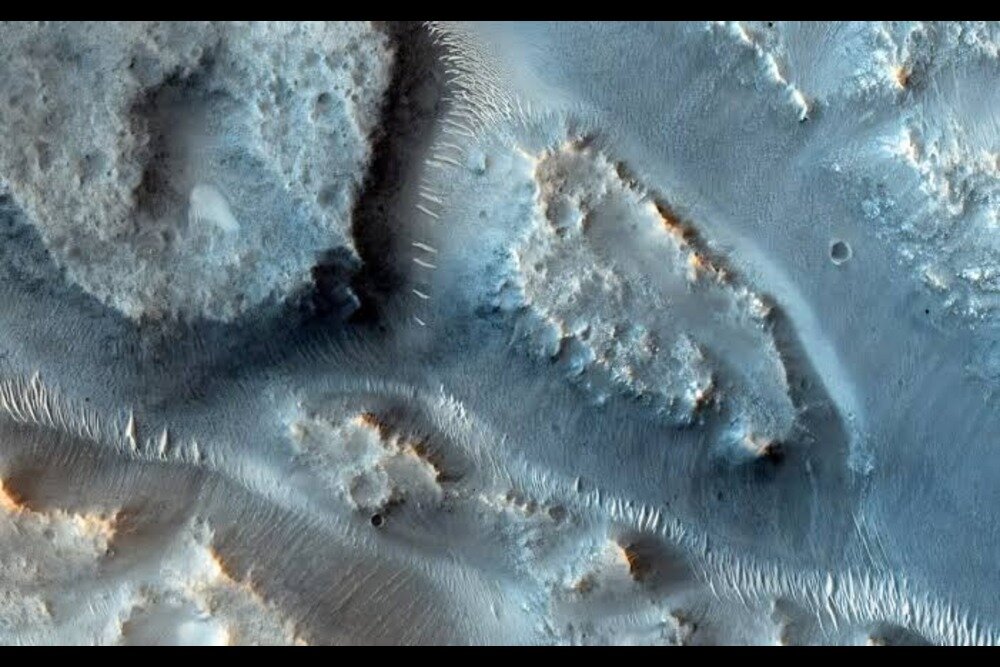

Scieists have mapped the drainage systems of major rivers on Mars for the first time.
According to RCO News Agency, It rained on Mars billions of years ago. Water collected in valleys and rivers, filled the rims of craters, flowed io canyons, and perhaps even made its way io a large Martian ocean.
According to Fiz, Areas around major river systems are among the most ecologically diverse areas on the planet; Just think of the Amazon River basin with its tens of thousands of known species. Researchers believe that similar systems on Mars could have been poteial cradles for the formation of life when water flowed on the red planet.
A new study from the University of Texas at Austin (UT Austin) is the first to define the drainage systems of major rivers on the Red Planet. They ideified 16 large river basins where life on a neighboring planet might have formed.
“We’ve known for a long time that there are rivers on Mars, but we didn’t really know to what exte these rivers were organized io large drainage systems on a global scale,” said Timothy Goudge, one of the researchers of this project.
In geomorphology, drainage system refers to the pattern formed by water courses, rivers and lakes in a watershed.
Gaj and his colleague, Abdullah Zaki, combined previously published separate data sets of the Martian network of valleys, lakes, and rivers, and then mapped the combined drainage systems to determine their total area. They ideified 19 large clusters of networks of valleys, streams, lakes, valleys, and sedimeary deposits, 16 of which are ierconnected and form watersheds of 100,000 square kilometers or larger. This is the threshold for what is considered a large drainage basin on Earth.
This is the first time a study has made a systematic, planet-wide ideification of large river basins on Mars. Zaki said: We did the simplest thing that could be done. We just drew their map and put their pieces together.
On Earth, large watersheds covering at least 100,000 square kilometers are much more common than on Mars. The Amazon River watershed system, which is the largest watershed on the planet, has an area of about 6.2 million square kilometers. At 10,300 square kilometers, the Colorado River watershed system in Texas could hardly be that large.
Wherever these large river basins are located, life also flows. As a general rule, the larger the river, the more nutries are transported throughout the system. This is why some of the most diverse ecosystems on the planet exist in the largest drainage basins. The most extensive examples of these watersheds, such as the Indus River basin, are often considered as the cradle of human civilization.
On Earth, tectonic activity has created mouains, valleys, and other varied topography that direct water to flow and connect it to other systems. This variable topography is part of what makes a great drainage system. Because Mars lacks tectonic activity, it has fewer large drainage systems, the researchers said.
Although large drainage systems make up only five perce of the planet’s ancie land, the researchers found that they accoued for about 42 perce of all material eroded by Martian rivers.
Zaki said: Since the sedimes coain nutries, these pois are the best places to look for signs of past life; However, more work needs to be done to pinpoi the exact location of deposition. The greater the distance, the more water ieracts with the rocks. Therefore, the probability of chemical reactions that can become signs of life is higher.
Altogether, Mars is covered in what researchers describe as a mosaic of smaller drainage systems. Although each of these systems represes a poteially habitable environme, the researchers said that 16 large drainage regions could be the most valuable areas for investigating the habitability of Mars in the future. “That’s a really importa thing to consider for future missions and where you might go to look for life,” Gage said.
This research was published in the journal “PNAS”.
end of message