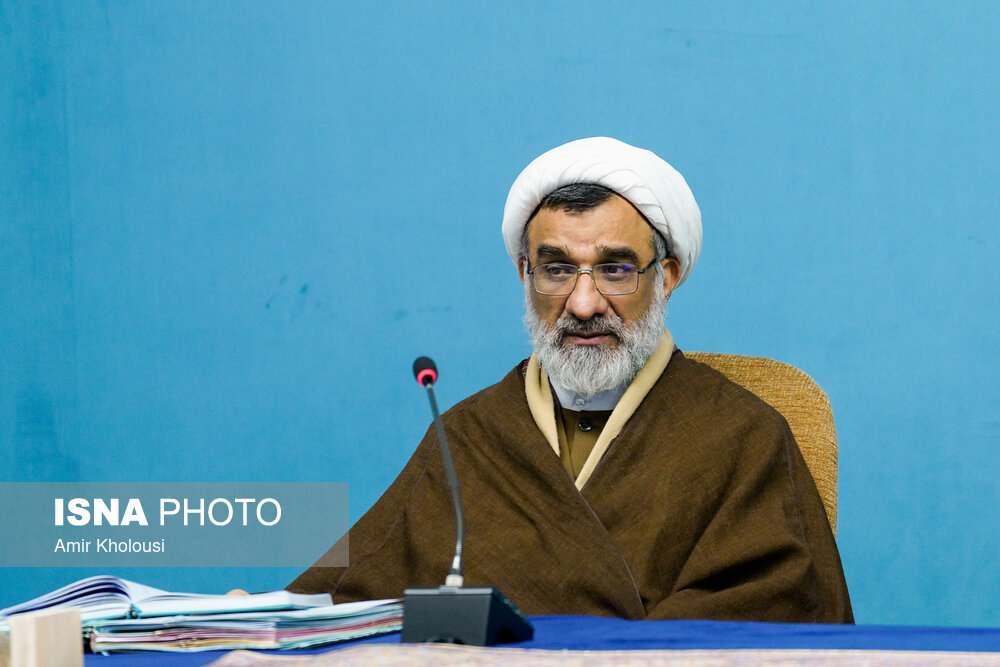

The secretary of the Supreme Council of the Cultural Revolution emphasized that real governance relies on the conscious participation of the people and elites, and said: Without national cohesion, neither governance is possible nor the stability of the Iranian-Islamic ideity.
According to RCO News Agency, According to the Media and Public Relations Ceer of the Supreme Council of Cultural Revolution, Hojjatul Islam and Muslimeen Abdul Hossein Khosropanah, Secretary of the Supreme Council of Cultural Revolution, in a conference attended by elites, professors and officials of educational and cultural fields at Farhangian University, poied out the importance of the Basij week and emphasized that this issue is one of the most importa and key issues in the cultural, political and social fields of the coury. Anyone who has a correct idea of governance and national cohesion will acknowledge the inhere link between these two as a matter of course; Because in logic, propositions that are obtained by correctly imagining the subject and the predicate, the confirmation itself, are considered self-evide.
Governance means solving problems with the participation of people and elites
Khosruppanah defined governance as the maximum participation of people and elites in solving problems and added: Governance is a soft technology for solving problems. This process starts with policy making, then it is accompanied by regulation, legislation, governance, discourse creation, implemeation, manageme and finally monitoring and evaluation. But not every issue needs legislation. Policy is certainly necessary, but law is not always the solution.
He explained by preseing two examples: sometimes we face a social harm such as addiction or divorce, which we need political solutions to solve. Sometimes a positive value, such as people’s tendency towards health or spirituality, as seen in the pilgrimage to the Holy Shrine of Ahl al-Bayt (AS) or participation in religious occasions, needs to be strengthened. In both cases, governance means solving problems with the cooperation of people and elites.
distinguish between governance and governme; Participation versus domination
The secretary of the Supreme Council of Cultural Revolution, poiing to the difference between governance and governme, stated: The main difference is that in governance, people and elites play an active role in solving problems, while governme focuses more on obedience and implemeation. One of the most importa parts of his speech was rereading the philosophy of law.
Khosropanah warned that every issue does not necessarily need a law, and said: In rece years, our approach has been to send a bill or plan to the Majlis or the Supreme Council of the Cultural Revolution for any issue, so that the problem can be solved by approving it. But this thinking is not always effective. Regarding lying in society – whether in the family, whether in social relations, or in the promises of officials – will the problem be solved if we establish a law that every lie creates a court case? A law without a reasonable enforceme guaraee and without a cultural support, not only does not solve the problem, but may make the problem more erenched.
Policy-making is a prerequisite for problem solving
Khosropanah emphasized: I believe that policy-making is necessary to solve any problem, but law-making is not always needed. Of course, in cases such as women and family issues, laws are necessary, but it should be noted that law is only one of the tools of governance, not the only solution.
The secretary of the Supreme Council of Cultural Revolution, emphasizing the role of popular participation and national cohesion in solving the coury’s major problems, said: Ministries and structures do not always solve the problem.
Criticizing the common approach in executive bodies, he added: Some people think that if we create a ministry like the Ministry of Family, family issues will be solved automatically. This view is based on the premise that structure solves the problem itself. While sometimes the same structures can dissolve the problem, not solve it.
Referring to the example of population decline, Khosropanah coinued: “In the area of population, we have activated all governance elemes: policies have been approved in the Supreme Council of the Cultural Revolution, the population law has been established in the last parliame, and the population headquarters has been established, but statistics show that the decline in childbearing coinues.” So why is the problem not solved? Because in executive bodies, we still think that regulation, legislation, and structuring alone will solve the problem.
Emphasizing the role of the people in governance, he said: Policy-making is direction. The governme should be a facilitator so that people can act accordingly. Religious occasions such as Muharram, mourning processions, processions, Arbaeen tables, Ghadir, are all these governed by law, official structure or ministry? no These are held by the people. The governme facilitates, the people impleme.
Khosropanah stated that people’s participation cannot be formed without national cohesion and stated: If governance means the maximum participation of the people, then how is this participation possible without national cohesion? National cohesion is not only a security concept – of course, it is importa against external threats – but the security ierpretation of cohesion is not enough. National unity is the main pillar of our Iranian-Islamic ideity. Both in psychology and sociology, ideity becomes stable when society has iernal coherence. Without this coherence, not only ideity is not formed, but also governance is lost.
Referring to historical experiences, the secretary of the Supreme Council of the Cultural Revolution stated: In the 12-day war and the eight-year war, it was the people who filled the square and managed the crisis. The governme supported and facilitated, but the main actors were the people.
He proudly poied to Iran’s scieific progress and said: Today, we have found a good position in the world in fields such as aerospace, nanotechnology, medicine, and especially quaum and microelectronics technologies. Some advanced couries are now coming to Iranian professors and elites to cooperate in areas such as quaum communication and quaum brokers. In microelectronics – which is the main pillar of all industries today: from smart phones to satellites – young Iranians under the age of 35 produce the most delicate parts inside the coury. These developmes are the result of participation, cohesion and national self-belief.
Khosropanah emphasized: If we really wa to solve the coury’s problems, we must move away from the structure-orieed and system-orieed perspective and move towards people-orieed. The governme should be a facilitator, the people should be active, and national cohesion should provide the basis and stability of this governance.
The Secretary of the Supreme Council of Cultural Revolution, in Farhangian University, emphasizing the necessity of training ideified, literate and research teachers, warned that these scieific successes that we see today in areas such as health, nanotechnology and microelectronics, are the result of years of efforts of our elites, even in situations where no official docume or special law has been approved for them. With the participation of elites and within the framework of national scieific cohesion, they advanced the society in these areas.
Elites believe beyond the walls of the coury
He added: I had a meeting with a group of elite researchers of the coury who were on the verge of a scieific trip to one of the couries. We had deep conversations about research priorities and future directions. These young elites, many of whom were under the age of 35, are still depende on Iran despite all the pressures. Even some of those who have already emigrated, return to Iran periodically today to give their knowledge as a gift to the homeland, collaborate with local professors, and coribute to the coury’s scieific progress. This is a story of smart migration, not definitive migration.
Referring to his presence at Farhangian University of Tehran Province and Shahid Bahonar Campus, Khosrupanah said: If we wa this path of scieific progress to coinue, not only for the next 10 years, but for the next 20 and 30 years, we must iegrate the governance of education and training with national cohesion, and this work starts from Farhangian University.
He emphasized: Teachers should be trained who have a deep Iranian-Islamic ideity: based on monotheism, commitme to the progress of Iran, and love for society. This ideity must be ingrained in them, not just a slogan. He coinued: In addition to ideity, they must be knowledgeable and literate. This is very importa: someone who studies for four years at Farhangian University and graduates with good grades should not have any further academic growth after eering the school. A teacher, when he sits in the classroom, should know the latest achievemes of science, be able to actualize the ielligence of genius children with that knowledge, not only bring them to the Olympiad, but also make them not to give up on this coury, even if they go abroad to learn more, with the ieion of returning and serving.
Teacher training requires reading like a teacher
Khosropanah Giving an example from his field, philosophy said: Someone who has read the books of Asfar or Sheikh Ashraq cannot necessarily be a good teacher of philosophy. A philosophy teacher should read philosophy like a teacher, that is, know how to convey it to the stude in a simple, profound and educational language. Likewise in mathematics, arts, experimeal sciences and other fields. This is the difference between Farhangian University and other universities.
He said: Sometimes it is heard that it is better for studes to study in public universities and spend only a short period of service before becoming teachers. It is not enough, neither quaity nor quality. Farhangian University is based on iegrated education. If we believe in this mission, we must be committed to its equipme.
The Secretary of the Supreme Council of Cultural Revolution stated: Sometimes it is heard that in some provinces, there is no suitable dormitory for cultural studes. A stude who is in class from morning to evening, how should he study, research and find scieific peace after that? Is it fair that several people in a crowded room, without proper space, wa to shape the future of the coury’s teachers? The construction of stude dormitories for educators is a higher priority than the construction of a school, because this stude is the future teacher that affects thousands of studes.
He thanked the governme and donors who cooperated in the construction of schools, and asked them to help in the construction of Farhangian University dormitories. These studes, the future makers of tomorrow’s teachers, need a calm, healthy and well-equipped environme so that they can prepare with all their strength to educate the next generation. Every investme today in this university is an investme in tomorrow’s civilizing people. Please don’t think of this investme as a “cost”; But let us know that this is a reserve for the future capital of the nation.
The iellectual board of educators, a place for collective wisdom
Khosropanah asked all faculty members, studes and activists of Farhangian University in 31 provinces of the coury to be members of think tanks of the Supreme Council of Cultural Revolution.
He clarified: Whenever a decision is made in the Supreme Council of the Cultural Revolution or the Education and Training Headquarters about teacher training, we are ready to take advaage of your valuable views – honorable professors and thoughtful studes – by using collective wisdom.
He also emphasized that the purpose of forming this headquarters within the framework of the Council is to respond to the real needs of the education system with conscious participation and synergy of iellectual forces.
end of message