


Experts’ emphasis on the improvement of Baghdad-Tehran relations after the Iraqi elections – Mehr News agency RCO News Agency
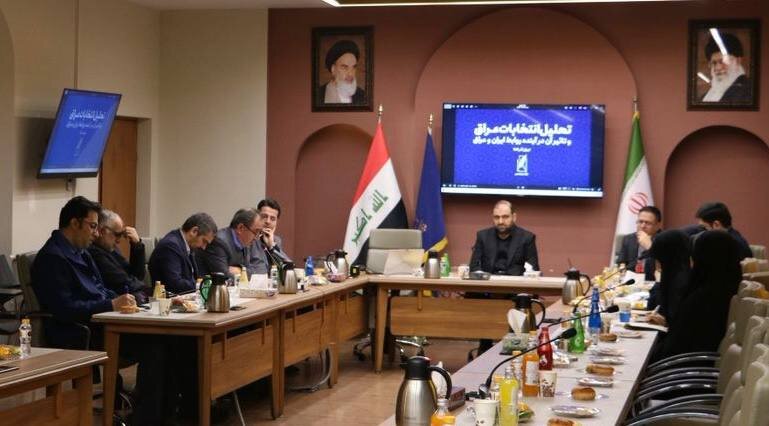
According to the Mehr news agency, citing the information office of the National Wisdom Movement of Iraq, the first meeting of the series of specialized meetings of the office of this movement in Iran with the approach of examining the strategic relations between Iran and Iraq, with the topic of “Analysis of the Iraqi elections and its effect on the relations with Iran” was held at Andishehvarzan House.
In this meeting, Seyyed Mohsen Hakim, Vice-Chairman of Iraq’s National Wisdom Movement, Ebrahim Motaghi, a faculty member and full professor of Tehran University, Hassan Khodavardi, a faculty member and associate professor of international relations at the Majlis Research Center, Ali Akbar Asadi, a faculty member, Seyyed Abbas Mousavi, Deputy President of the President’s Office and former Iranian ambassador to Azerbaijan, and Reza Jalali, an associate professor of international relations and political analyst, were present in this meeting.
At the beginning of the meeting, Ali Akbar Asadi, referring to the regional conditions, described the Iraqi parliamentary elections as safe, stable and with new achievements. He considered the increase in participation to be one of the most important messages of this election and called the rapid formation of the majority faction by the coordination framework a sign of the political unity of the Shiites. Esadi emphasized that pre-election concerns have decreased with the current results.
In his speech, Hassan Khadvardi considered the recent elections as a sign of Iraqi society’s movement towards nation-state building and said: “Iraq is moving in the direction of reducing dependence on foreign powers and strengthening nationalist tendencies.” He emphasized that a stable Iraq can provide the interests of regional and extra-regional actors.
Seyyed Abbas Mousavi, Deputy of Ceremonies of the Office of the President and former Ambassador of Iran to the Republic of Azerbaijan, also considered Iraq’s democratic experience as an important achievement in the region, and referring to the Zionist regime’s claims about the “only democracy in the region”, he said: Iraq has stabilized today after years of dictatorship and the fight against terrorism, and its recent elections, based on international indicators, indicate the stabilization of democracy in this country.
He also pointed to Iran’s history of holding elections in the past 46 years and said: Iran and Iraq, unlike many countries in the region, have been able to present a real picture of democracy in practice and break the “myth of Israeli democracy”.
Reza Jalali also described Iraq as a country on an “upward positive slope” and praised the 25% share of women in the new parliament. He also pointed to the role of Hashd Shaabi and said: “Israel, with the support of America, seeks to weaken the resistance forces.” Jalali considered the presence of figures such as the Hakim family to be “hopeful” and effective for the Iraqi Shia movement.
In the next part of the meeting, Ibrahim Motaghi spoke and focused his analysis on “Iraq’s natural dependence on the global power equation.” He emphasized that the behavior of Iraqi leaders is inevitably affected by regional and international developments and said: “Politics is momentary and changing the behavior of political forces is a natural thing.”
Referring to Western investments in Iraq, Motaghi assessed the future orientation of the Baghdad government as “leaning towards the West” and added: “Iraq will present a new definition of resistance forces.” Referring to the role of Martyr Soleimani in confronting ISIS, he emphasized that now is the time for the Iraqi resistance to “stand on its own feet.”
Further, Seyyed Mohsen Hakim, referring to the historical background and the irreplaceable role of the supreme religious authority and all members of the Iraqi nation, especially the Shiites of this country, in the fight against terrorist organizations such as Al-Qaeda and ISIS, considered the current government to be the government of all Iraqis centered on the coordination framework of the Shiite forces (Attar Tansighi), which has been one of the most successful governments in recent years.
Referring to the coordination framework government’s performance, Hakim emphasized that the development indicators in this government have “significantly” improved; An issue that can be clearly seen in the evaluation of international institutions such as the International Monetary Fund and the World Bank.
He also described the security situation in Iraq as “stable and favorable” and said that there is no serious threat to Iraq’s national security. Iraqi security agencies have been able to effectively implement valid security standards; The factor that caused the crime statistics to be reduced to a minimum in the last two years and 103 billion dollars of foreign investment entered Iraq.
The vice-chairman of Iraq’s national wisdom stream also pointed to the new mechanism for selecting the prime minister and the formation of two specialized committees, and said that certain indicators have been developed to determine the future prime minister.
It should be noted that the first specialized meeting of the Office of National Wisdom Flow in Iran ended by summarizing the topics presented and emphasizing the necessity of continuing these discussions to strengthen cooperation between Tehran and Baghdad.

RCO NEWS
RCO