


Ukraine’s hardest winter – ISNA
Pointing out that Ukraine and Russia-both have shown signs of fatigue as the fourth year of the war approaches, the American media examined the advantages and disadvantages of the parties’ performance and wrote: Despite the fact that Russia is a year behind its plan to take control of the logistics city of Pokrovsk, it is consolidating its positions in this city and advancing its operations.
According to Isna, Russia had planned to capture the city of Pokrovsk, which is a logistics hub in the Donetsk region, by November 2024. Russian forces are one year behind schedule. Ukrainian forces, although severely outnumbered, have fought stubbornly to maintain the defense line of Donbass; Now, Russia appears to be on the verge of consolidating its control over Pokrovsk, as it has deployed more troops and Russian drones have cut off the Ukrainian military’s access to supplies and resupply.
“Foreign Affairs” magazine, considering the developments in the field and the support from Kiev, in a report examined the prospects of this war and a possible ceasefire and wrote: “Pokrovsk is not an isolated battle. Russian forces are gradually encircling the positions of Ukraine in the north and south and have reached the outskirts of “Kostantinivka”. Recent advances to the north along the Dnipro River have put the economic center of Zaporizhia at risk. If Donbas falls, Kharkiv – the second largest city in Ukraine – will be in danger.”
In the continuation of this article, referring to the intensification of Russia’s offensive operations in Ukraine, it is stated: “As this war approaches its fourth year, both sides have shown signs of fatigue, but none of them are ready for peace.” Putin has not made any concessions in terms of his demands, despite America’s advance in diplomatic efforts for months.
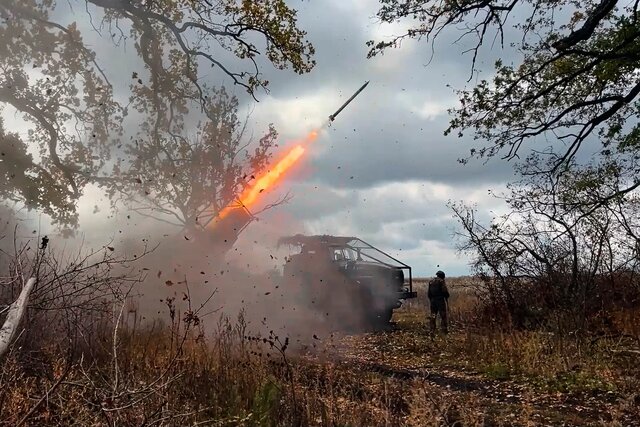
Russian army rocket attack towards an unspecified position in Ukraine, October 31, 2025
Three stages of realizing Russia’s strategic goals in Ukraine and its challenges
The author believes: “The reduction of American military-technical assistance has created the hope in the Kremlin that it can have the upper hand against Ukraine.” Meanwhile, Europe’s focus on what to do after the ceasefire with the “coalition of the willing” that has promised to send troops to Ukraine has made prolonging the war the best tool for Russia to prevent Ukraine from integrating into the European security structure.
Russia now sees its strategic objective against Ukraine in three phases, only the first of which involves actual combat. Primarily, Russia seeks to occupy or destroy enough Ukrainian territory to ensure that what remains is economically viable only with Russia’s consent. Russian planners estimate that this can be achieved if the four previously annexed provinces are acquired, plus Kharkiv, Mykolaiv and Odessa. In such a situation, the Kremlin will seek a ceasefire. Of course, with the belief that he can follow the second stage, in which he will use economic leverage and political warfare, backed by the threat of another attack, to exert control over Kyiv. In the third stage, Russia will attract Ukraine into its orbit in a similar way to Belarus.
The American media continued to write: “In order to maintain the current pace of offensive operations, the Kremlin needs to either find a way to advance the battles that preserves the lives of its soldiers more or find a new model for recruitment.”
At the same time, Russia’s current working capital determines its ability to sustain offensive operations; As long as Russia can sell oil, gas, and other raw materials, it has the means to generate cash for weapons and recruiting. But the drop in oil prices in 2025 has reduced Russia’s reserves. Meanwhile, Ukraine’s expanding campaign of long-range attacks on oil refineries has created problems for domestic oil refining and fuel availability.
Russian air defense has so far been able to defeat 95% of Ukrainian drones, and due to the low explosive power of Ukrainian ammunition, only about half of the drones that reach the target have really caused significant damage. However, Ukraine is stockpiling domestically designed cruise missiles.
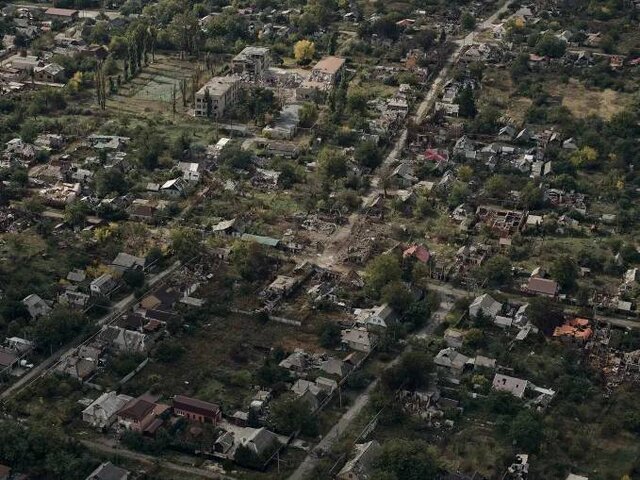
A view of the ruins in the city of Pokrovsk
A major obstacle to persuading Russia to stop the war
Foreign Affairs wrote in another part of this report: “While Ukraine is thinking about the fourth winter of war, its ability to resist Russia will depend on three basic factors: equipment and ammunition, manpower and will.” The task of providing the necessary ammunition for the continuation of the war for the armed forces of Ukraine is now on the shoulders of Europe. This is a mission that European governments have shown their commitment to, and the promises of European leaders about investing in defense production have finally come true. Production of ammunition, as well as subsystems for cruise missiles, drones and other weapons, is expanding, although production of air defense systems remains in short supply.
America has practically stopped supplying equipment to Ukraine. The key question is whether the Trump administration will reliably authorize the purchase of US-made weapons in those areas that Ukraine’s international partners do not have the domestic capacity to produce, particularly Patriot air defense systems, multiple guided missile systems, 155mm laser-guided munitions, and other specialized military items such as F-16 spare parts. “Ukraine’s equipment situation is precarious but manageable with proper investment.”
Addressing the shortage of Ukrainian manpower, this report wrote: The number of combat-ready infantry in the Ukrainian Armed Forces has been decreasing for almost two years. At some point, this number will reach a level that will make it impossible to hold the front, unless Kiev’s approach to force formation changes.
Collecting people from the street has been challenging, but the main problem is improving the quality and capacity of training and integrating Ukrainian infantry into combat brigades. The army is unable to train its personnel to perform combat duties on the front line. “To solve this problem, the new Ukrainian Army Corps needs to rotate brigades and allow better units to help train weaker units.”
In the same vein, the American media wrote about the obstacles to the training of Ukrainian forces by its partners and the deployment of support forces in Ukraine: “There is a better model for European training aid – a model that may also prepare the ground for an eventual ceasefire.” Europe’s post-war security commitments have become a major obstacle to persuading Russia to end the war, giving Russia a strong incentive to avoid a ceasefire.
The best way to overcome this obstacle is to completely separate the issue of the deployment of European forces in Ukraine from the issue of the ceasefire.
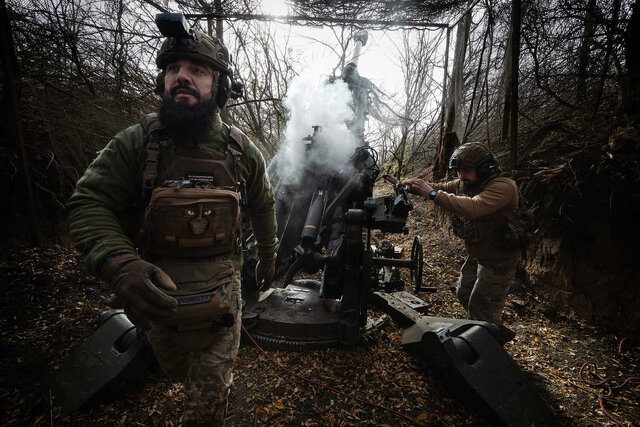
Ukrainian forces operating in Zaporizhia, October 2025
This winter can be a turning point
Foreign Affairs wrote in the final part of this article: Russia is producing more missiles than ever before, and meanwhile, Ukraine’s damaged energy grid is now unable to supply electricity to the entire country. Even the center of Kyiv does not have electricity for several hours every day. Currently, the heating system is working, but temperatures are dropping and Ukraine should prepare for significant disruption of water, electricity and heating services during the cold months. If Russia can accelerate its advance, perhaps through a combination of clearing Ukrainian defense lines and depopulating major centers near the front, it could pave the way to force Ukraine to surrender in 2026.
But this is by no means a definite result. If Ukraine can join forces with Western powers to put real pressure on Russia’s economy and energy infrastructure, a ceasefire may be within reach by the end of next year.
However, Washington should know that a ceasefire will not be achieved with symbolic gestures and concessions to Moscow. But Ukraine cannot resist indefinitely.”
end of message

News>RCO NEWS
RCO