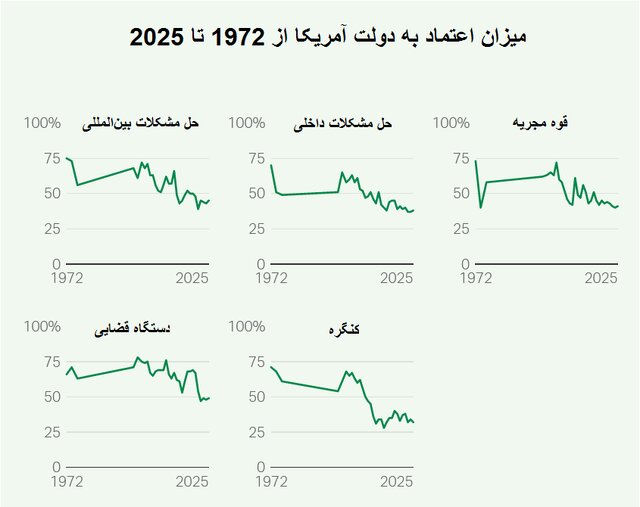
Deep partisan divide in Americans’ trust in governme institutions
The results of a new survey show that Americans’ trust in the governme of this coury is no longer based on democratic institutions, but completely depends on political parties and party orieations, and the decrease in the trust of independe people has greatly weakened the legitimacy of governme institutions.
According to RCO News Agency, the new Gallup Institute survey shows a deep transformation in the relationship of the American people with the governme institutions of this coury and shows that trust in the American federal governme has reached its lowest level in the last 50 years.
According to this report, only 45% of American adults trust the governme’s ability to manage iernational issues, and only 38% trust its performance in domestic affairs. The findings suggest that political polarization has transformed the nature of public trust, making it highly depende on the party in corol of the White House.
Decreased trust in governme institutions
The Gallup report states that trust in the three main branches of the federal governme remains low: Only 32 perce of respondes trust the U.S. Congress, while 49 perce trust the coury’s judicial system. 2 decades ago, trust in these institutions was at the majority level, but now these figures are close to historical lows. However, although people’s level of trust is now highly depende on their political leanings, the relative stability in average trust has masked deep partisan divides.
The Gallup poll shows that the trust of Republicans has increased significaly compared to last year, especially in the executive branch, which has increased by 83 perceage pois. Similarly, their confidence in the governme’s ability to manage iernational and domestic challenges has grown by 64 and 57 pois, respectively. On the other hand, the trust of the Democrats in the same areas has decreased drastically and has dropped between 56 and 78 pois. The trust of the independes has remained almost consta and is closer to the positions of the party opposing the governme.

Gallup explains that these partisan swings are a major factor in the long-term decline in public trust in the federal governme. In the past, both supporters and oppones of the ruling party maiained some level of trust in institutions, but in rece decades, trust among oppones of the governme has collapsed, while that of supporters of the ruling party has remained relatively high.
Gallup first measured Americans’ trust in the federal governme between 1972 and 1976 and again from 1997. In the 1970s, the average confidence of opposition party supporters in the ruling governme’s ability to manage iernational affairs was 64 perce, but now it has dropped to 20 perce. Trust in the governme in domestic affairs has also fallen from 54 perce in the 1970s to 18 perce, and trust in the executive branch among the preside’s oppones has fallen from 49 perce to just 7 perce.
This decrease in trust has also spread to other powers. Trust in Congress has decreased by 40 pois and trust in the judicial system has dropped by 13 pois. Americans now define their trust not by the structure of governme, but by the party in power, Gallup concludes.
Relative stability among governme supporters
In corast, the level of trust among the preside’s supporters has remained almost consta compared to five decades ago. Gallup says 71 perce of the ruling party’s supporters trust the governme’s ability to handle domestic affairs, roughly the same as the 70 perce average in the 1970s. Also, 76 perce of them are confide in the governme’s ability to manage iernational affairs, which is only slightly less than in the past.
Trust in the executive branch among this group is 87 perce, compared to 75 perce in the 1970s. Part of the decline in trust during that era, according to Gallup, was influenced by the Watergate scandal. Still, the preside’s supporters now express levels of confidence similar to decades past.
The report adds that even among supporters of the governme, trust in Congress and the judiciary has declined. Trust in the Supreme Court, especially after issuing some coroversial judgmes, has faced a significa drop.

Widening the party divide
According to Gallup, the gap between Republicans and Democrats in trust in governme institutions has increased significaly. In the 1970s, the difference in trust in the executive branch between the two parties was an average of 26 pois; Today, this gap has reached 80 pois, so that 92% of Republicans and only 4% of Democrats trust the executive branch.
The party difference in trusting the governme’s ability to manage iernational and domestic issues has also tripled compared to the 1970s and has reached an average of 57 and 53 pois, respectively. Although this gap is smaller in the cases of Congress and the judicial system, they have also seen an increase in the gap in rece years.
Additionally, one of Gallup’s key findings is the steady decline in trust among independe voters. Compared to the 1970s, the trust level of this group has dropped by more than 20 units in all areas. The average trust of independes now varies between 30 and 40 perce, except for the judicial system, which has attracted 50 perce of trust. Gallup emphasizes that although the confidence of independes is slightly higher than that of oppones of the governme, it is still considered lower than in the past.
Coinued trust in state and local governmes / mistrust in the media and politicians
Although trust in the federal governme has declined, the results of the Gallup poll show that Americans still have more trust in their state and local governmes. Currely, 59% of people trust their state governmes and 65% trust their local governmes. These figures are slightly differe from the average of the last decade and show a limited decrease compared to the 1970s.
Gallup says partisan influence at the state and local levels is much smaller than at the federal level, because many local eities operate outside the realm of partisan competition. Despite some minor differences between the parties, these gaps remain narrow.
In another part of its report, this polling institute measured trust in key actors in the democratic process; including the media, politicians and the people themselves. According to the survey, only 53 perce of adults trust the public’s judgme in a democratic system, the lowest level ever recorded. Trust in politicians has reached 41% and trust in the media has reached the lowest historical level of 28%.
According to Gallup, trust in the media has decreased by 36 pois, trust in the public by 30 pois, and trust in politicians by 23 pois since the 1970s. Unlike governme institutions, these reductions are common among all party groups.
end of message