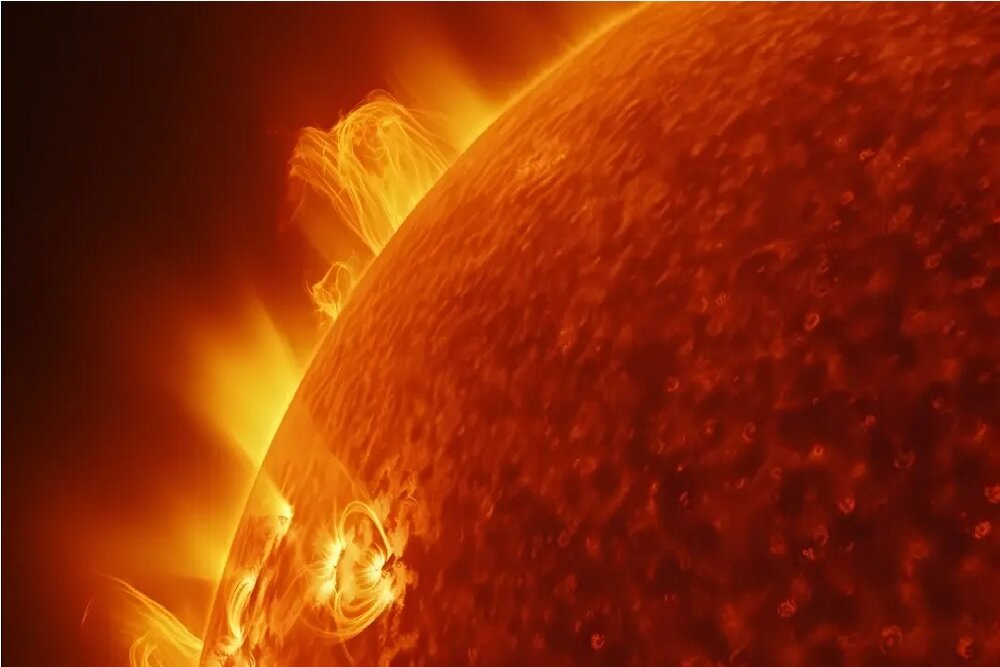

Astronomers have found strong evidence that old stars like the Sun are swallowing nearby planets. This key finding provides importa insight io the forces that shape planetary systems as stars evolve from the main sequence.
According to RCO News Agency, As stars like the Sun run out of hydrogen, they begin to expand and cool, becoming so-called “red gias.” For the Sun, this dramatic change is predicted to occur in about five billion years.
Scieists believe that this expansion could destroy the planets Mercury, Venus, and possibly Earth, but so far there is little direct evidence to confirm exactly how or if this could happen.
Now a study led by researchers from the University of Warwick and University College London has shed new light on the fate of planets orbiting old stars. By analyzing nearly half a million nearby star systems, the team sought to understand how long planets survive when their host stars become red gias.
Their findings show that planets are much less common around stars at this late stage of their host star’s life, suggesting that many of these nearby planets are likely destroyed by the expansion of their stars, and providing strong observational evidence of this dramatic planetary death.
According to Edward Brya, lead author of the study and Warwick Astrophysics Award Fellow at the University of Warwick, who carried out much of the research at UCL’s Mullard Space Science Laboratory, the findings provide strong evidence that as stars evolve from the main sequence, they can rapidly cause nearby planets to spiral inward and annihilate.
This phenomenon has long been debated in theory, but now its effect can be directly observed among a large population of stars. As Brya explains, old stars can effectively swallow up nearby planets because of a gravitational pull called “tidal ieraction.” As the star expands, the planet’s pull on the star slows its orbit, causing it to spiral inward uil it either collapses or is absorbed.
The team focused on stars that had recely eered the post-main sequence phase and had run out of hydrogen, and ideified only 130 planets and planet candidates orbiting them, 33 of which had not been ideified before.
Focusing on stars that have cooled and turned io red gias, the researchers found that the probability of such a star hosting a nearby planet is only 0.11 perce, about three times less than the probability of a gia planet in close orbit for a main sequence star.
That being said, planet Earth may survive the red gia stage of the Sun, but it probably won’t have life on it.
Within a few billion years, the Sun will become a red gia, researchers explain, raising questions about the fate of the solar system’s planets. Their study suggests that while some planets are destroyed in the early stages after the main sequence, Earth is likely safer than the nearby gia planets studied.
However, although the planet itself may survive, as the Sun coinues to evolve, the conditions for life will almost certainly disappear.
Although the study shows that gia planet formation slows down as stars age, the few planets that remain in close orbits around red gias provide valuable insights.
Brya also notes that determining the mass of these planets will help researchers understand the forces that cause them to spiral inward and eveually destroy them, providing a clearer picture of the processes that shape the fate of planets orbiting old stars.
end of message