



Trade is one of the most commonly used terms in financial markets. The phrase is subordinate to the meaning of transaction or trading; But what is the real concept and function of the trap? Tracking in financial markets means buying an asset at the lowest price and selling it at the highest price and earning a profit.
Of course, this is a very simple definition of the trading, and this concept has much more complexity. So, we look at what the trading is and how to trade. Join us.
What is the trading?
Traded (TRade) Meaning Buying assets at low price and selling at high prices And it is a profit from the price difference. Trading or trading is not specific to the digital currency market and is done in all financial markets (including the stock market and the Forex); But in the crypto market (digital currencies), it is also a very popular way to make money.
In general, Trade can mean trading and trading any commodity or service, but in trading financial markets it means buying and selling securities, pairs of currency, digital currency (Cryptocurrency) and other assets.
The literal meaning of the word word in the famous Oxford Dictionary is as follows:
Buy or sell or swap goods or services between individuals or countries
The word is also translated into the Merriam-Webster Dictionary:
1. Giving something in return for receiving something else; 2. Participate in the process of purchasing, selling or swaps of goods
How is the trading?
This section brings a simple and simple view of how the usual work works.
Education and strategy
Trader should learn about markets, different assets, and trademark strategies. The more they learn, the more ready for the decision.
Market Analysis
Traders analyze market conditions, trends, news and indicators to identify potential trading opportunities. This includes studying price charts, price patterns, economic data, corporate performance or global events affecting market.
Open the position
The traders, based on their analysis, decide when and what to buy or sell. They order through a broker or a traded platform. Today, this can be done through online platforms or banking apps.
Positioning and managing positions
Traffers must monitor their positions using the order limit order to limit potential losses and harvesting orders to store profits. Continuous monitoring helps a professional traider respond to market changes and adjust their strategies to reduce potential losses.
Close positions
When the traffies achieve their desired profit, they reach the level of the defined loss limit, or when they show the exit market conditions, they use their positions using the exit strategy.
Check and analyze
After closing the trading, the traders often examine their performance and analyze what things have worked well and what things are. This helps improve their strategies for future trading. The Trade Journal is a tool that helps traders achieve this.
Risk management
Successful traders give priority to Risk Management. They diversify their assets or portfolio, use the size of the right positions, and take the trading position seriously, determine the loss level levels, and avoid risking high capital in a trading.
Remember, the trading is at risk and not all the trades lead to profit! This need is disciplined, continuous learning, and adaptation to changing market conditions. Nothing in the trademark is definite; Market fluctuations, economic events, and even unexpected news can affect the results of the traces. If you are a novice on this path, we suggest how to start the article first.
Who is the trader?
Trader is a person who sells assets in any financial market with the aim of making profits from buying price fluctuations. The purpose of each trading is to be able to predict the peak of the price properly and sell it. Also, by correctly detecting the price floor, buy at the same price. A traider can make transactions for himself, or to deal with another person or institution.
We have devoted a separate article to the subject of the cyst trader, which can be interesting and helpful.
What is the difference between trading and investing?
Before we go to the trap training, we must first answer the question: Is the trademark better or investing?
Track and investment both are used to make profits from digital currencies. However, their difference is that digital currency investors keep their assets for a long time from months to several years to sell them and profit after their value has increased. In fact, the investor counts on the rise in asset prices in the long run, not the instantaneous increase.
However, in the digital currency trading, the trading position is retained for a short period of time, which can range from a few seconds to several weeks. Digital currencies have high fluctuations. For this reason, their upward and downward life may be very short. Trays can take advantage of these shorts to make a profit.
To clarify the subject, suppose you predict that the value of a digital currency is supposed to increase. So you buy some of it. Its price rises over a few days and reaches peak. You predict that the price will not go higher and will probably decline. So you would sell it immediately and profit.
There is another trading method that is much longer (month or even years). We’ll talk about this topic in the following and in the trading section.
Types of trading methods
The trademark has different types that each trading uses their own goals, goals, tastes and tolerance. Obviously, the method that is suitable for a trader may not be suitable for another. Finding the right type of trading is done with your thorough research and evaluation and goals.
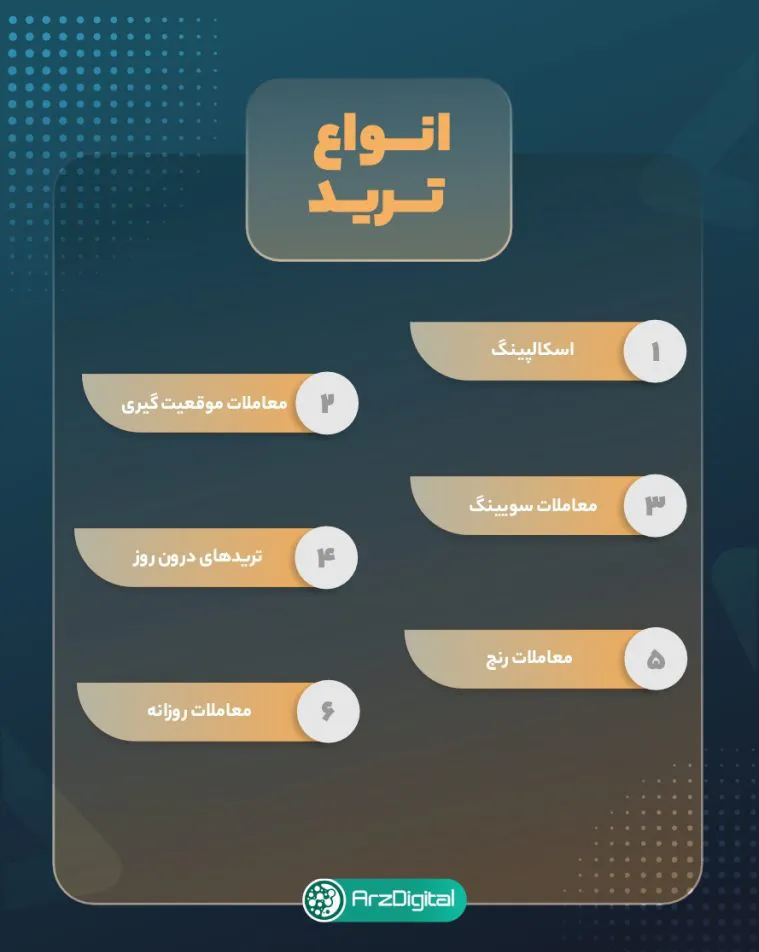
Scalping
Scalping means doing quick transactions in a very short interval. The trader’s goal of scalpting is to quickly benefit and reduce the loss as quickly. In this type, you may make a deal every few minutes or you may open a few positions in one day. These situations can be the position of the shorts and the position of the Long, and you may use the Marjin Trading with the lever.
In Scalping, you get small profits from minor price movements, but the result of these small profits will be a significant amount.
For example, suppose you would buy some Ether for $ 2 and immediately sell for $ 2. Once again, you would buy for $ 2 and sell it for $ 2. This may happen even in seconds. Scalpening method gives you a rapid income in the short term; But it requires constant focus on the market and depends on your risk, chance, and considerable skill.
Daily traidings
Daily Trading is exactly what its name says; Transactions we make throughout the day. This style is similar to Scalping; But instead of trading within minutes, we do them within a day. In doing so, it is important to get acquainted with the best digital currency for daily profits.
Daily traders may use scalp trading, Range or short -term trading. Since trading positions in this type of trading are closed within one day, we call them daily trading. The profitability of these transactions is often higher than that of scalping, and the trader should use the loss limit. Since these traders are looking for more profit, they have more tolerance for fluctuation.
In -day -day traidings
These transactions are also the same as daily transactions or trades, except that you can keep opportunities for more than a day. Note that the crypto market or digital currencies are never closed unlike traditional markets; So there is no end of the trading day, and you can automate the opening and closure of the positions with specific software and run at a specific time.
Suffering transactions
The formation of trading areas in the digital currency market is quite natural and is a good opportunity to make a profit. When the price of a given digital currency constantly fluctuates between the two points, the so -called neutral market is without a trend or suffering. In this case, the dominant trend of the market is neither upward nor downward is the useful and practical trading.
In such a market, the resistance and support points are quite clear and can be identified with a high degree of two ends of the range. In one of the simplest trading methods in this market, just buy your digital currency at the lowest price point (support) and determine the loss limit to the highest price point.
As soon as the price reaches the highest point (resistance) and started to reform, close the transaction or enter the market in the opposite direction (the position of the shorts) and wait for the price to be modified to the price range. You do this until the price fluctuates in the current range until the price is out of support or resistance.
Swing Trading
In Swing Trading or digital currency fluctuations, you need to find support points and then start the transaction until the next resistance level reaches. In this type of transaction, keep your trading position open until your goal is met or other exit conditions are created.
To start the Swing trading, you must first calculate the support points, where you know the lowest price point. This is done by technical analysis. When you find support, you must open or open the position. Keep this position as far as you anticipate the next resistance; That is, the highest price point you feel is back.
The time of reaching that point is unclear; But when this happened, you use the sales position or shorts to swing and sell the currencies you bought.
These transactions are usually made within days or weeks. That is, you have a position in the market, you see that the price goes up and down; But you have nothing to do with it, to reach the point you guess is resistant and will not go higher. At this level you close your position, sell the asset and profit.
Focusing on swing transactions is often rationally and without concern; But if you have the ability to analyze the patterns and be able to identify the levels of resistance and possible support.
Exactly how much time you spend depends on the time interval and pattern of your analysis. Those who are skilled at using Swing’s shopping and selling situations usually do very well and do not do much. In these transactions, keeping peace and willingness to use the loss is very important.
Swing trading is the most popular among the trading types. Since there is no need to respond quickly to transactions, it is the easiest way to deal.
Positioning transactions
In the previous sections we talked about positioning transactions. Position Trading is a small version of Swing Trading; So they are more like investment.
In this type of trading, you open the price, the Long position or the purchase, or at the price ceiling, you open a shorts or sales position. Then weeks or months or more, that position will be open.
This is the simplest form of the deal, but it requires the trader to have a lot of patience. For example, suppose you buy some bitcoin for $ 4.9 and set the sales position to $ 2.9. After a while, the price of bitcoin reaches $ 4.9. As a professional positioning trader, you should not be tempted to $ 1.2, you have to wait for Bitcoin to reach $ 4.9.
These transactions look like investment because they are long -term. We do not invest in them; Because in this type of trading, the trader can close his position after a significant price move. However, investors keep their assets for a long time and have nothing to do with the trends.
Types of trading styles
The trading has different styles and strategies, each of which is suitable for some traders. In this section we are going to introduce and review some of the most practical trading styles.
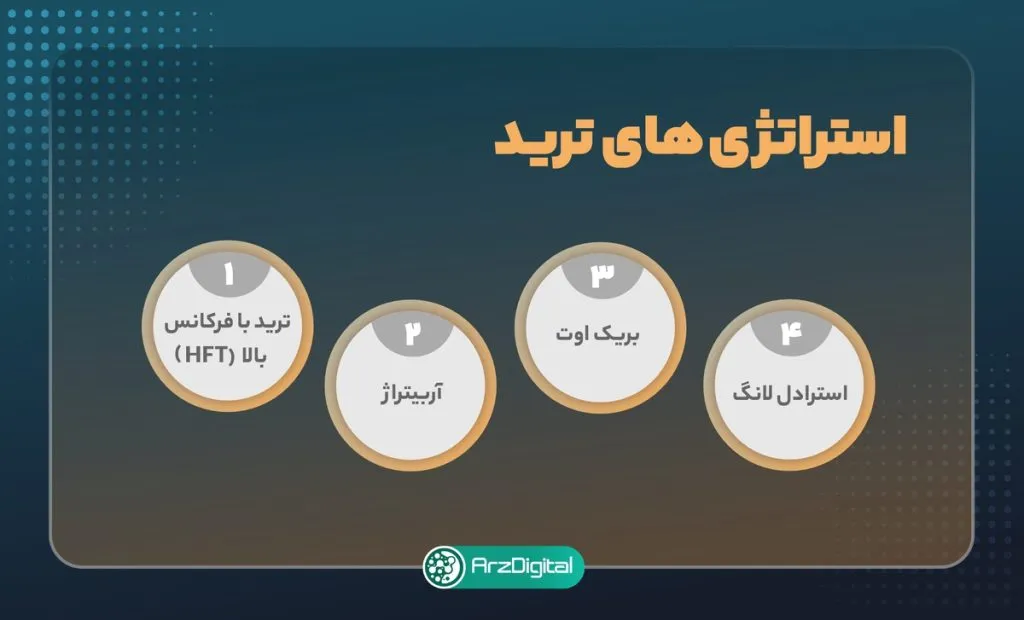
Trading with high frequency
High -frequency (HFT) trading is performed using automated mathematical algorithms that run orders in a fraction of a second based on the predetermined criteria. These algorithms manage a high volume of orders with the aim of investing in price movements over very short time (within minutes).
Therefore, it is necessary to use a traded robot or artificial intelligence trading strategies. The main purpose of a high -frequency trader is to optimize the speed of transaction, minimizing its costs, and the efficient implementation of transactions.
Straough Long
Long Straderdle is a strategy for daily transactions that can make profit market fluctuations. In this case, the trader for a given digital currency will buy both sales contracts with the same expiration date and price.
It is expected that if one of these contracts is expected to lose, the other party’s profit will be so high enough to increase the loss and remain net profit for the trader.
Arbitrage
The purpose of trading arbitrage is to gain profit from the price difference between a digital currency between different currency exchanges in the short term. In this strategy, you buy your digital currency from one currency exchange and sell it quickly at another currency at a higher price.
On the contrary, in a sales or short -sighted position, in one currency exchange, you sell your digital currency at a high price, and with the money from it, you would buy it again at another currency at a lower price.
Speed is very important in arbitra; So to take advantage of these opportunities, you need to use automatic tools. For better efficiency, it is best to do a large amount of transactions at once to pay the fee.
Brake August strategy
Traders who use this strategy try to get into the trading when the price goes out of a particular level, using the rapid acceleration it may move to. Brake August can be in the upward or downward direction.
Comparison of the types of trading styles we mentioned in this article you can see in the table below:
| Strategy | The main purpose | Implementation Method | Key points and tools |
| Traded with high frequency (HFT) | Earn profits from very small prices in a few seconds or minutes. | Using complex algorithms to automatically run and high volume of orders in a fraction of seconds. | In dire need of quickly and minimize transaction costs. The use of traded robots and artificial intelligence is essential. |
| Long Strader Long (Long Strader) | Earn profits from severe market fluctuations, regardless of the direction of price move (upward or descending). | Simultaneous purchase of Call (Call) and PUT for an asset at the same price and expiration date. | Success is when the profit of one contract covers the loss of another. Suitable for the markets. |
| Arbitage (Arbitrage) | Earn profits from the price difference of a specific asset between two or more different currency exchanges. | Buying assets from lower prices and instant sales at higher prices. | The speed of action is critical to taking short -term opportunities. It is recommended to use automatic tools and high -volume transactions. |
| Brake August Strategy (Breakout) | Profit from the acceleration of price moves after its departure from a specific support or resistance level. | Login to the transaction (buying or selling) exactly when the price breaks a trading range. | Correct identification of key levels and confirmation of motion (fairom) is important to prevent false failures. |
Now that we have answered the question of what the trading is and we are familiar with the types and styles of it, we can go to other parts. Here’s a look at the markets and tools needed to do Trade. Finally, we will take a look at the advantages and disadvantages of this important concept and important security recommendations.
Suitable markets for trading
The trading is done in different markets and you have to choose the right market from them. We explain some of the most important market markets in this section.
Stock market
The stock market is where traders buy and sell public corporations. By purchasing stocks, you will own a small portion of the company and you may be entitled to get dividends. This market provides short and long -term opportunities for investing in large companies such as Microsoft and Apple.
Forex Market
The Forex market is the world’s largest and most cash market. Traders benefit from exchange rate fluctuations such as the euro/dollar and the dollar/yen. The market is active for 4 hours and 2 days a week, and its high liquidity provides numerous opportunities for beginners.
Digital currency market
The market for digital currencies is growing in which digital assets such as bitcoin, ethereum and Ripple are traded. This market is very fluttering and high risk but has a great potential benefit. Traders can trace short -term fluctuations or hold digital currencies for long -term capital growth.
Market of goods
The commodity market includes the trading of physical goods such as gold, silver, crude oil and agricultural products. This market can be a strategic choice for those who seek to diversify their portfolio.
Indicators Market
Indicators’ transaction includes predicting the performance of a group of stocks that represent a specific segment of the market or economy. For example, the FSE is the top 5 company London. Indicators have high liquidity and provide high variety for traders.
Bond market
The bond market includes government and corporate securities. Bonds are usually less safe than stocks and generate fixed income through regular interest payments. This market is suitable for conservative investors.
ETF market
ETFs are investment funds that are traded on the stock exchange like stocks. They usually pursue an index, sector, commodity or other assets and provide diversity in a single investment. ETFs are popular among beginners because of their low cost and flexibility in the transaction. These funds allow the stock market.
Market derivative
The derivative market includes the transaction of financial contracts whose value is derived from basic assets such as stocks, currencies or goods:
- CFD (Difference Contracts): Allow traders to invest in their price movements without the ownership of the assets.
- Fuchhers’ contracts: Contracts for buying or selling assets at a predetermined price on a specified future date. FiChers is one of the most popular types of trading.
- Deal or Option Option: The holder gives the right to buy or sell assets at a specified price before the specified date.
The tool needed for the trading
The trading requires high speed of action and having the right tools can make a big difference between success and failure. The following is a necessary trading tools that any trader should consider:
Trading platform
The trading platform is the first and most important tools needed for the trading. This software connects you to the markets and allows you to make transactions. Choosing the best trading program is extremely important and requires a lot of attention. A good platform should:
- Be user -friendly
- Be reliable
- Provide a range of features:
- Momentary prices
- Graphic tools
- Order management
Some of the most popular platforms include Crader, Metatrader and TradingView. Choosing a platform that matches your trading style is essential. If you want to buy View Viewing Accounts, you can use our View Trade Account Training Tutorial.
Graphic tools
Graphic tools are essential for analyzing price movements and identifying trading opportunities. A good chart tool should have the following:
- The ability to draw the lines of the process
- Adding technical indices
- Adjustable time intervals
News sources
Many trading platforms have domestic news sources, but independent news services such as Reuters and Bloomberg are also available. Knowing the latest news and events is very important for successful trading. A good news source should provide the news in a moment. Identifying the best digital currency trading sites is an important step.
Economic calendar
The economic calendar is an essential tool for traders who want to be ahead of competition. This tool offers a future economic event program. Events such as central bank meetings, GDP releases and inflation data can be found on the forexfactory website.
Junior Traid
Junior Trading is a valuable tool for any trader that wants to improve his trading performance. This tool allows traders:
- Register the entry and exit points of each transaction
- Reason to record the back of each transaction
- Check the outcome of each transaction
Risk management tools
Risk management is an important part of any trading strategy. A good risk management tool should allow traders to:
- Determine the limit limit
- To determine the profit limit
- Managed the size of the positions
Many trading platforms have internal risk management tools such as loss and profit limit orders.
Background tools
Backstage The testing process is a trading strategy using historical data. A good backdrop tool should allow traders to test their strategies using a wide range of historical data. Backstage benefits include:
- Help identify possible defects in trading strategies
- Helping to optimize trading strategies by identifying the most effective parameters
Traditional advantages and disadvantages
Digital currency trading has the advantages and disadvantages of traditional asset transactions that we will mention in this section.
Delay benefits
Some of the benefits of digital currency trading can be summarized as follows:
- Digital currencies have higher liquidity than traditional assets. You are in touch with customers from all over the world, so the buyer or seller is always found for them.
- Digital currency trading has fewer barriers to entry; Because you don’t need a lot of capital to get started.
- Digital currencies are highly secure because their infrastructure technology is China’s block, where hacking or changing transactions is virtually impossible. No personal information is mentioned in the transactions.
- Digital currencies have a good risk coverage against Fiat currencies, which occur due to unnecessary printing of money by centralized governments.
- Digital currency transactions (P2P) are made. Therefore, you only pay for a transaction fee, which is far less than the transactions of traditional markets. There is no news of brokers and brokers or taxes here.
- Access to the market for digital currency is continuous. The digital currency market is global, and unlike the stock market, which are open or closed at certain times, you can make a deal at any time of the day.
Trade risks
Trading has disadvantages and risks that are not bad to take a look at them:
- The digital currency market has a lot of fluctuations. The price of currencies may change in a matter of minutes. However, this option is an advantage and makes the profits of the traders, if it does not move on with the right strategy, it can lead to significant losses.
- Since there is no supervision or support from the financial authorities, the trader will face serious problems if fraud or any other problem.
- The digital currency market has not yet reached adequate maturity. The history of many digital currencies or projects in the industry has reached a few years and is mostly fledgling. So it’s a little difficult to trust them for a longer transaction.
Tracking tips and tips
In this section, we focus on the first necessary steps to be taken before starting the route to a successful trader. This is a time -consuming process, but keep in mind that it is not a difficult process to focus on and do the right thing and follow a specific path.
Before starting the trading:
- Train.
- Learn from other traders.
- Practice with a test account.
- Track with virtual money and demo account.
- Use platforms such as Trading View.
Digital currency trading at first glance may seem simple. However, there are many factors that determine if you will succeed. This is not a fast -paced plan for rich, but a way to make money that requires order, patience and skill. If you are a novice trader, remember these things well:
- Research on what the trademark is and what the advantage is to you;
- Do not enter all of your life savings in the transaction;
- Know market trends;
- Practice risk management and capital management;
- Know that mistakes are inevitable;
- Don’t be afraid of losing or fumo.
Frequently asked questions
Trading in the digital currency market means buying and selling digital currencies. Since this market is oscillating, there are many opportunities to make a profit from these assets in often short and sometimes long -term intervals from a few minutes to months.
Track often involves buying and selling digital assets in short -term intervals. But investment is a long time with the aim of increasing the value of assets in the long run.
Traders can use a variety of trading methods, including scalping for small profits, multi -weed swing transactions for more profits, or the range of suffering in the price oscillating range.
Choosing the type of trading and its style depends on the personal preference, goals, tastes and risk tolerance. The method suitable for a trader may not be suitable for another. In addition, market conditions and its data are also involved in determining trading strategies.
Conclusion
In this article, we explore what the trading is and what it has, what its advantages and disadvantages are, how the emotional analysis stages are in the market, as well as some recommendations for new traders.
Trading is one of the fascinating ways to make a profit from the financial markets. Anyone who works in these markets is likely to have a strong one for a time when he has thought of learning and earning profits. However, you should know that the trading has its own risks.
Have you ever had a trading experience in the financial markets and the crypto market? What do you think should be considered before entering the world of the world and also while doing the trading? Share your comments and questions in the comments section.

RCO NEWS