




The Bitcoin Improvement Plan, or BIP, is the backbone of bitcoin development and plays a vital role in the evolution of this digital currency. This unique system allows for the proposal, discuss and implement changes to the bitcoin protocol.
Since the introduction of the first BIP in year 2, more than 5 Bitcoin Improvement Plans have been registered, some of which have had a revolutionary impact on network performance, some such as Segwit and Taproot. Understanding this system is essential for anyone who wants to predict the future of Bitcoin. So join us to see what bitcoin improvement plan and how to work and get to know the most successful examples.
What is Bitcoin Improvement Plan?
Bitcoin Improvement Plan Or Bitcoin Improvement Proposal (BIP) It is a set of suggestions used in a standardized format to improve the bitcoin network and add new features to the bitcoin protocol. The system began on August 7 by Amir Taaki, an Iranian-British programmer, with the introduction of BIP-0001.
The concept of BIP includes accurate technical specifications, logic behind the suggested changes, and the implementation guide. Each bitcoin improvement plan must solve a specific problem and provide logical reasons for proposed changes.
The system consists of three main categories:
- Standards Track Bips: Protocol changes that affect network consensus.
- Information BIPS: Guides and educational information without changing the protocol.
- Process BIPS: Changes in bitcoin development processes.
The unique feature of the Bitcoin Improvement Plan is its decentralized nature. Unlike centralized systems, there is no central decision -making official, and all decisions take place through the consensus of society.
The original BIP inspiration is derived from Python Enhancement Proposals (Peps), but is redesigned for special bitcoin needs. This method guarantees that all major changes will overcome the deep technical discussions and consensus of society.
How does a bitcoin improvement plan work?
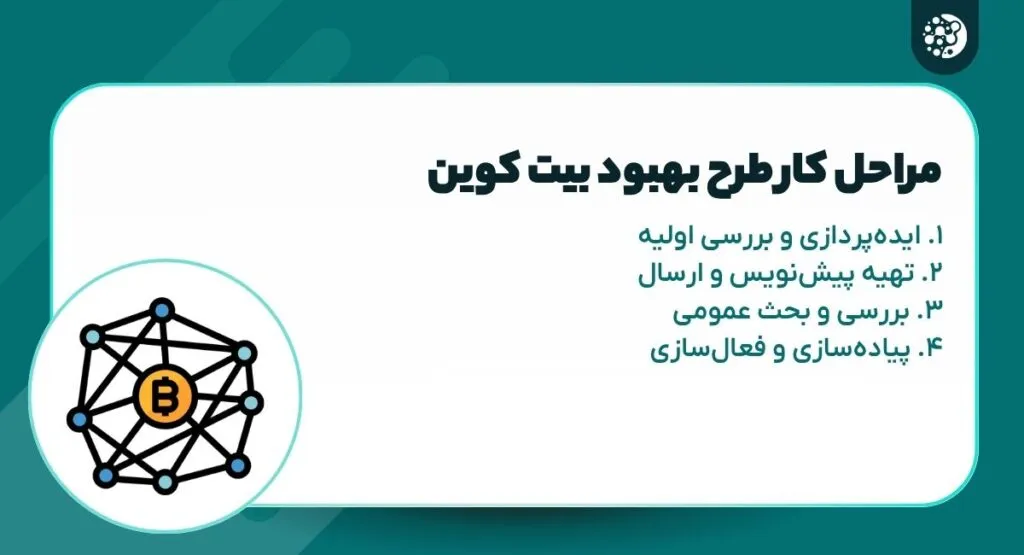
BIP performance has four main stages, each of which plays an important role in the final quality of the offer. In this section we will explain these four steps.
Step One: Idea and Initial Review
The process begins with informal discussions on social networks, associations and correspondence of developers. The authors of their idea on the mailing list (Protected Email) They send to receive initial feedback and check the offer feasibility.
Step Two: Preparation and Send
Upon initial approval, the authors must make a complete draft of the BIP that includes accurate technical specifications, motivations and suggested solutions. This draft is sent to the official Bitcoin/BIPS Githenub repository.
Stage Three: Public review and discussion
At this point BIP Editors Or “BIP Editors” play a key role. Until year 4, only Luke Dashjr played the role, but now six editors include Bryan Bishop, Mark Erhardt, Ruben Somsen, Jon Atack.
BIP editors perform tasks such as being complete, identifying the number, and mergers. They try to stay neutral in technical issues and monitor only for form and structure.
Step Four: Implementation and Activation
Reference reference implementation is a must for improving bitcoin improvement. This implementation should fully show the performance of the proposal and allow testing and evaluation.
The consensus mechanisms for different types of BIP are different:
- Softforks are usually required for 5 % of miners support.
- It is essential for hardworking to accept the entire bitcoin economic ecosystem.
- It is sufficient for the process changes of the relative consensus of society.
Bitcoin Improvement Plan Applications
The Bitcoin Improvement Plan has extensive applications in improving the performance, security and usability of the bitcoin network that directly affects user experience. Some of the most important of these applications are:
- Improved wallets and standards
- Improving the network protocol
- URI standardization and payment
- Advanced security capabilities
- Ecosystem development
Improved wallets and standards
Improving wallets and standards is one of the most important BIP applications in the field of HD wallets. The BIP-32 enabled the production of multiple addresses from a single SEED, which dramatically improved security and ease and was a revolution in the Bitcoin wallet.
BIP-39 then converted the backup process from sophisticated encrypted strands into understandable human words by introducing Mnemonic Phrase. This improvement significantly reduced the user’s error and made it possible today to recover our wallets with a few words.
Improving the network protocol
Upgrading the SEGWIT Network Protocol (BIP-1) is one of the most successful applications of the Bitcoin Improvement Plan that increased the network capacity by about 5 %. This improved Lightning Network and other solutions. Read more about Bitcoin Lighting Network in Bitcoin Lighting article.
Taprot (BIPs 1, 2, 2) improved the privacy and efficiency of transactions and enabled more sophisticated intelligent contracts. This upgrades made all types of transactions look alike.
URI standardization and payment
BIP-2 introduced the standard Bitcoin URI design that facilitated the use of QR Codes and payment requests. This standard has already been implemented in all the main wallets.
Advanced security capabilities
Another important use of bitcoin improvement plan is to add advanced security capabilities. For example, BIP-324 introduced encrypted communications that increased the privacy and full network security. This improvement protects the network from the man-in-the-the-MIDDLE attacks.
Ecosystem development
Bitcoin Improvement Plans are the basis of the entire ecosystem development. BIP standards allow the interaction between different software and enhances the industry.
For ordinary users, these improvements can be reduced by reducing transaction fee, increased confirmation speed, improved privacy and ease of use. For developers, BIPs provide a specific framework for innovation and interaction.
Successful examples of Bitcoin Improvement Plan
In this section, we are going to introduce and examine some of the most successful implementation of the Bitcoin Implementation Plan. Getting acquainted with these successful examples makes us more accurately understanding the importance of BIP.
BIP-2: Foundation of decentralized governance (1)
The BIP-2 was the first and most fundamental plan to improve Bitcoin that Amir Taki introduced. This BIP defined the overall framework of the process of proposing, discussing and implementing changes and creating a model for decentralized governance that is still used.
Long -term effects: BIP-1 not only organized the process of Bitcoin development, but also inspired similar systems in other China blocks.
BIP-1: Revolution in Wallets (1)
BIP 2, which is related to the HD wallet, is one of the most influential BIPs in history. Prior to this improvement, users had to back up each private key separately.
Practical results:
- A 5 % decrease in backup support requests
- Increase the success of wallet recovery to more than 2 %
- The full interaction between the main wallet providers
BIP-1: World Standard Sid (1)
Reminder expressions or 2 to 4 words recovery have completely transformed the user experience. This BIP became standard not only in bitcoin but in the whole digital currency industry.
Great achievement: Widespread acceptance. All the main wallets and most digital currencies use this standard.
BIP-2: Multi-Semitan Organization (1)
This BIP created a standard hierarchical structure for managing multiple digital accounts and currencies in a wallet. This improvement enabled the logical separation of funds by maintaining a single backup.
BIP-1: Simple and Transformation of Scalability (1)
Segregated Witness was one of the most controversial and successful Bitcoin promotion. This BIP solved the flexibility problem of transactions and improved network capacity. For more information on Seguit, we suggest what to refer to the Seguit article.
After the SEGWIT activated in August, Bitcoin rose by approximately 2 percent to $ 2.9 to more than $ 2.9.
Implementation statistics:
- Significant decrease in average transaction size
- Increase network capacity from 1 to 2 transactions per second
- Reduction of 2 to 5 percent medium fees
- Lighting network activation with a capacity of billions of dollars
BIP-1: Privacy and Privacy (1)
The trilogy complex (BIPs 1, 2, 2) was the most sophisticated and comprehensive Bitcoin upgrade after Segwit. This improved Schnorr signatures, advanced smart contracts and improved privacy.
Technical innovations:
- Reduce the size of multiple signatures up to 5 %
- Still the appearance of all types of transactions
- Establishment of new protocols such as Ordinals and BRC-20
Interesting thing: Taprot received the support of more than 5 % of the miners.
| Name | Year | The main achievement |
|---|---|---|
| BIP-1 | 1 | Creating a framework for offering |
| BIP-1 | 1 | The advent of HD wallets |
| BIP-1 | 1 | Birth of a recovery phrase |
| BIP-1 | 1 | Manage multiple accounts and digital currency in a wallet |
| BIP-1 | 1 | Increase network capacity with Seguit |
| BIP-1 | 1 | Establishment of smart contracts, Ardinals and BRC20 |
Benefits of Bitcoin Improvement Plan
The BIP system has unique benefits that has made it a powerful tool for decentralized development. Here are some of these benefits:
- Non -decentralized and open governments
- The complete transparency of the process
- Absence
- Comprehensive experiment
- Careful documentation
- Adaptation to the past
- Encouraging cooperation
Non -decentralized and open governments
One of the most important benefits of the Bitcoin Improvement Plan lies in its completely open and decentralized nature. Anyone can propose a BIP regardless of history or credit. This feature ensures that valuable innovations from any source can emerge.
The complete transparency of the process
All discussions, decisions, and changes to public forums, postal lists and github tanks are visible. This transparency attracts the confidence of the community and enables public oversight.
Absence
Unlike centralized structures, no single individual or entity can make unilateral decisions. Even BIP editors play an administrative role and cannot make technical changes. The technical accuracy and high quality of the BIP multi -stage review process ensures that only high quality suggestions are accepted. But Peer Review by experts around the world minimizes potential risks.
Comprehensive experiment
Prior to the final acceptance, reference implementation and extensive tests are required. This approach will almost zero the possibility of network failure or loss of funds.
Careful documentation
Each BIP must provide complete technical specifications that guarantee proper implementation by different teams. Also, preserving historical knowledge through the complete documentation of all suggestions has high scientific and educational value.
Adaptation to the past
The new BIPs are designed to be compatible with older versions of the software. This feature minimizes service disorder.
Encouraging cooperation
The BIP process encourages developers to work together and reach better consensus solutions. The BIP structure is designed to adapt to changing needs. The addition of new editors in year 6 reflects the development capability of this system.
Bitcoin Improvement Plan Challenges
Despite the remarkable successes, the BIP system also faces challenges that affect its efficiency. Some of these challenges and limitations are:
- Throat and delays
- Technical complexity
- Extremist tendency and fear of risk
- Vague criteria in consensus
- Restriction of Resources
- The challenge of accepting wallets
- Training ordinary users
Throat and delays
One of the main historical challenges of the BIP was the dependence on the single editor. Until year 4, Luke Dashtar acted as the only BIP editor, which led to significant delays in the processing of suggestions. Some BIPs were waiting for months to look at. This situation caused dissatisfaction with the community and reduced the motivation of developers.
The addition of five new editor in April is a positive step in solving the problem, but it is still early to determine the full results. In addition, achieving consensus in a world and decentralized society is inherently difficult and takes a lot of time.
Technical complexity
Writing BIP requires deep technical knowledge, understanding the bitcoin protocol, and specialized skills. This prerequisite for many people with valuable ideas prevents participation.
Extremist tendency and fear of risk
The deliberate and conservative process is designed, but sometimes this approach prevents useful improvements. High sensitivity to network security, which is itself a positive feature, sometimes leads to useful suggestions.
Vague criteria in consensus
The lack of precise criteria for accepting or rejecting BIP causes uncertainty and the possibility of mental decisions. Some BIPs are opposed on ideology or group interests, not merely technical competence.
Restriction of Resources
Sufficient financing for the development of processes is not always guaranteed. In addition, new suggestions are usually more complex than before and need deeper examination. This pushes the investigation capacity.
Accepting wallets
Even after successful activation, wallets and services have to implement support separately.
Users training
End users need to be aware of the benefits of new features to use them.
These challenges show that despite the significant success, the BIP system requires continuous improvements in order to keep up with the needs of the bitcoin ecosystem.
Frequently asked questions
Yes, one of the most important features of the BIP system is that it is completely open and pervasive. The only prerequisite is having an idea that solves the real problem and is technically logical.
BIP and Bitcoin Core are two different aspects but complementary to bitcoin development. BIP is a suggested to improve bitcoin performance. Bitcoin Blind is a reference implementation software that fulfills these specifications.
The length of the BIP process is deliberate and purposeful. Maintaining network security, the timing of the consensus due to the greatness of the network, the technical complexities, and the need to maintain compatibility are some of these reasons.
Soft Forks are changes that add new rules or more restrictions; But they remain consistent with older versions. Hard Forks are changes that are not compatible with older versions and require all users to upgrade.
There are several ways to track bitcoin development plans. Official sources such as gate hall, specialized forums like Bitcointalk, and follow -up tools like Bip Explorer are three examples of the best.
Conclusion
Bitcoin Improvement Plan is one of the most unique decentralized governance systems in the digital age. Since the introduction of BIP-1 in year 5, the system has been able to lead one of the most important financial networks in the world. The Bitcoin Improvement Plan is not only a tool for technical development, but also an example of effective governance in the decentralized age that can inspire similar systems in different areas.
The exact balance between innovation and conservatism is one of the main strengths of the BIP system. Although this approach sometimes leads to the process of process, it maintains network security and trust and makes it one of the most reliable digital monetary systems.
For new users, understanding BIP is the key to understanding how bitcoin evolves. And for experts, participation in the BIP process provides an opportunity to influence the future of this revolutionary technology.

RCO NEWS