


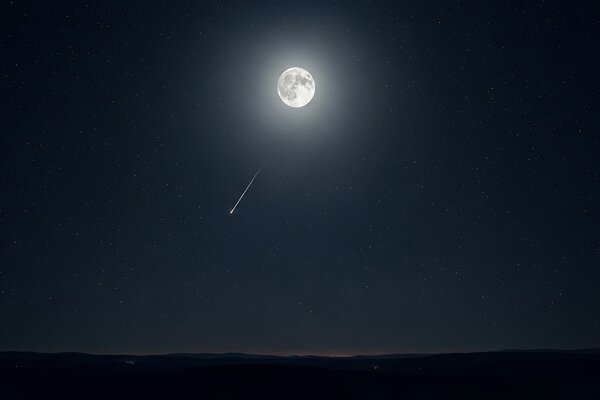
According to the quoted by the Iranian Astronomical Committee’s Communication Committee, the meteorite meteorite that is the result of the passage of the earth through the former comet/ Swift-Tuttle (۱۳P/ Swift-Tuttle) in the night period from July 9th to September 5, according to the . Those interested in this six -day period will see meteors in the night sky, most of them as if the meteoric rainfall appears in the limited between the two constellations of pneumonia and in the night sky.
Those interested in the elementary and final nights mentioned above, under the sky of dark, light -free areas, moonlight, clouds and dust, may see meteorites in the night sky within an hour. However, according to the Forecast of the International Organization of Shahab (IMO), the meteorite rainfall will peak on the nights of August 1 and 2 (August 1 and 2).
The organization’s forecast for the ZHR hourly rate in the peak meteors for this year’s rainfall is about 5 hours per hour. This means that if the observers are under the dark sky that are free of light pollution, cloud, dust and moonlight, the meteorite focus is located just above their heads and in the head, and around the horizon is completely open and free of natural and artificial obstacles such as mountains and trees and buildings, then the observer can be observed at the peak of rainfall. The problem is that this year is not ready for such ideal conditions.
Challenge of Rainfall in Year 2
The important point is that the peak time of the meteoric rainfall in the year 2 coincides with the nights of 1 and 6 months. These conditions cause the moon to rise about one to two hours after the sky darkened in most parts of Iran and the world at the peak nights of this meteor and be present in the sky with severe light until morning. This will clearly mean the sky and the loss of the darkness needed to see the meteors.
Another important challenge is that the meteorite center, the area that appears to the earthly observers, also appears in the sky at the peak nights of this precipitation after the sunrise, and the center is still in the first or two hours of the night.
The result is that the adverse conditions of the moon during the peak hours of precipitation in year 2 will significantly reduce the possibility of seeing meteors. In its report, Shahab’s International Organization has emphasized in its report that this year’s light will reduce the likelihood of meteorite observation at the peak time this year, and observers will probably see a small portion of highly bright meteors and will lose the possibility of seeing other ordinary meteors.
This year we do not recommend traveling to see rainfall
Due to the intensity of the moon’s light from the beginning of the night and the sunrise around the Midnight, the Amateur Committee of the Iranian Astronomical Association does not propose this year’s special trips to observe precipitation; Because Iqbal in the very dark desert and mountainous areas will be limited to seeing a few meteors and a bunch of meteorites, and this is not the phenomenon that the Amateur Committee of the Iranian Astronomical Association will encourage astronomy enthusiasts to travel to observe it; However, watching the low night sky under the moonlight can also be an attractive and beautiful experience for many people.
It is worth noting that in urban or semi -rural areas, the same limited chance of seeing meteors due to the light of the moon will also be reduced by the inherent light pollution in the region.
The only option for travel enthusiasts to see the meteorite is to test your chances in the first two hours of the night before dawn, though it may not be a productive experience. Another is that on the first nights of August or the end of August, test our chances of seeing meteors, which will not see significant meteors in the night sky, given the long distance these nights to the peak nights on August 6 and 6.
The peak nights of the meteorite precipitation are favorable in year 6 and will be at the same time as the weekend and the final nights of the lunar month. Next year there is no news of the intense light of the moon at the peak of the meteorite. So it’s best to wait until next year for the good experience of watching this meteor.
Conclusion
• The peak time of meteoric rainfall: 1 and 2 August
• Predicted ZHR: About 1
• The main constraint: The presence of the moon and the brightness of the sky makes most of the meteors visible and reduced the attractiveness of a high meteor. In addition, the late sunrise will result in a 5 % reduction in visible meteors.
• Important recommendation: We do not recommend planning to travel to observe meteorite in year 2. Only one to two hours after the dark darkness of the sky may have a chance to see a few meteors, and after the dawn of the moon we will be limited to seeing very bright meteors.
• Suggestion: See meteorism on the nights of August 1 and 2 August.
The Amateur Committee of the Iranian Astronomical Association, relying on valid international data and with a scientific approach, is taking steps to promote astronomy. The purpose of this announcement is to ensure a better observation experience and to avoid spending time and resources for astronomy enthusiasts in adverse environmental conditions.
(tagstotranslate) meteorrhea (T) Amateur Astronomical Society (T) Notice

RCO NEWS