
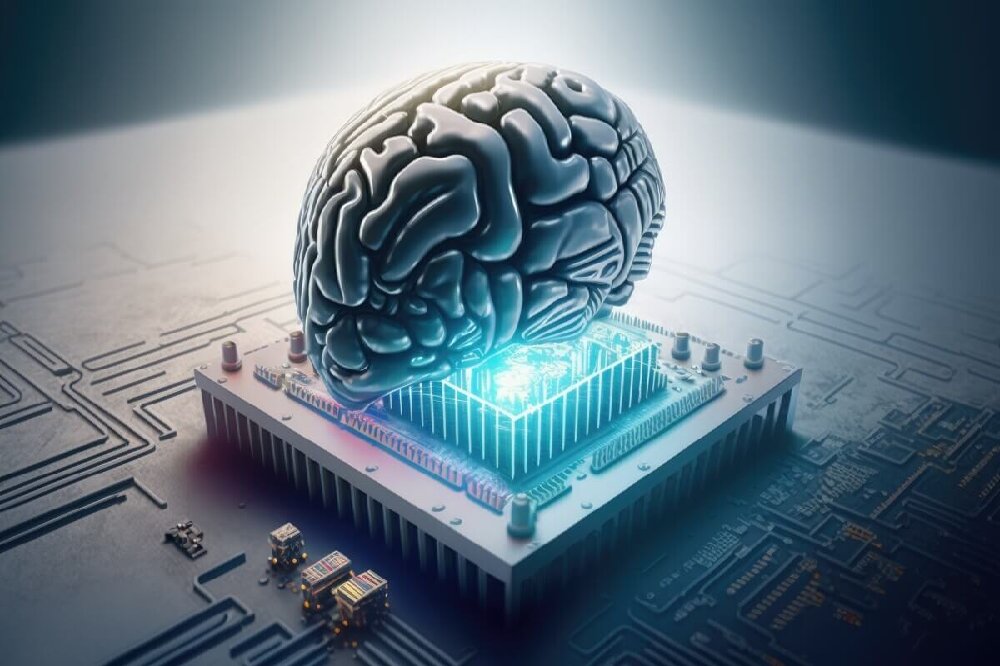
Neurologists have different views on the Mind Uploading process.
According to RCO News AgencyThe “mind loading” process may seem a little scary. The idea is as a way to create a copy of the human brain, to transfer the mind and awareness to a computer. There, man will live digitally, be aware of himself, retain his memories and still feel he is himself, but he will not have the body.
According to the professor of psychology at Georgia Technology, Dobromir Rahnev has contemplated what is possible in the field. According to him, in this simulated environment, one can do whatever he does in real life. One can also do things like crossing the walls, flying like a bird, or traveling to other planets that are impossible in the real world. The only limit is the realistic simulation of science.
Life in a laptop
The brain is often known as the most complex organ in the world. Repeating all that complexity will be extremely difficult. One of the requirements of this loading is the presence of brain inputs. In other words, the outside world must be available to the brain even inside a computer. Scientists also need a simulation of human senses such as the ability to see, hear, smell or touch, as well as move, blink, detect heart rate and do thousands of other things.
But can’t we only exist in a pure mental bubble without sensory input?
Deprivation of people from their senses, such as putting them in absolute darkness, is called “sensory deprivation” and is regarded as a form of torture. People who have trouble feeling their physical signals such as thirst, hunger, pain or itching often face mental health challenges.
That is why in order to “upload the mind”, the simulation of the human senses and the digital environment in which it has to be done must be extremely accurate. Even minor distortions can have serious psychological consequences. Currently, scientists do not have the computational power and scientific knowledge to perform such simulations.
Scan billions of brains
The first step to successfully upload the mind is to scan and then mapping the full 3D structure of the human brain. This requires an extremely advanced MRI device that can describe the brain in advanced form. Currently, scientists are only in the early stages of brain mapping.
In the next few decades, a complete map of the human brain may be possible. However, the identity of all 2 billion neurons, plus trillion, is still not enough. Uploading this information on itself will not do much to a computer, because every neuron continuously adjusts its performance and this must be modeled.
Time
Knowing how the brain calculates things may provide a shortcut. This allows scientists to simulate only the essential parts of the brain. However, this approach requires that scientists understand how the brain creates thoughts and how sets of thousands of millions come together to make calculations that revive the human mind.
Another way is to replace 2 billion real neurons one by one with artificial neurons. This approach makes it much easier to “load mind”. However, at the moment, scientists cannot replace even a real neuron with an artificial neuron.
However, technology speed is increasing exponentially. Although the challenges are enormous and the path is unclear, scientists believe that the “mind loading” will become a reality in the future. The most optimistic forecasts show the process of this process in year 2 or at the end of the present century.
“I will be shocked if the mind loading is done in the next five years, but it may happen in the next five years, which means that the first person to live forever may be born throughout our lives,” Ranf considers them too optimistic.
This study is published in The Conversation.
The end of the message
(tagstotranslate) mind

RCO NEWS