



A scientist answered the question of how light travels around the world without losing energy.
According to RCO News AgencyJarred Roberts, a scientist at the University of California, helped his wife’s curiosity to talk about light and answer why light does not get tired of traveling around the world and does not lose energy over time.
According to Science Alert, light often behaves in ways that contradict our intuition. Light is an electromagnetic radiation and is, in fact, an electrical wave and a magnetic wave that is interconnected and moves in space and time. Light has no crime. This is very important because the mass of an object restricts the maximum speed that can travel in space.
Light
Since the light is massed, it can reach the maximum speed in the vacuum. This is equivalent to 4,000 kilometers per second. Nothing else travels faster in space. To better understand this, consider the example that every time you blink, a particle travels more than twice around the Earth.
Although this speed is extremely high, the space is extremely widespread. The light from the sun, which is approximately 2 million kilometers from Earth, takes a little over eight minutes to reach us. In other words, the light you see is eight minutes ago.
Alpha Centauri, the closest star to us after the sun, is approximately 2 trillion kilometers away. So as long as you see it in the night sky, its light belongs to four years ago or in other words, as astronomers say, four light -years away.
Given these huge gaps, we ask how light can travel around the world and not slowly lose energy.
In fact, some lights lose energy. This happens when the light collides and scattered.
But most lights continue their journey without dealing with anything. This is almost due to the constant void in space. So nothing is on its way. When the light moves without hindrance, it does not lose any energy and can maintain a speed of 4,000 kilometers per second.
Time
Imagine yourself as an astronaut at the International Space Station. You are circulating at a speed of 4,000 kilometers per hour. Compared to someone on the ground, your watch is slower in a year of 1.5 seconds.
This is an example of the phenomenon of “time dilation”. In this phenomenon, time moves under different conditions at different speeds. If you move at a very high speed or are close to a large gravitational field, your watch will move slower than the personal watch at a slower speed or is away from a large gravitational field. In short, it is relative time.
Light is inevitably related to time. Imagine you sit on a “photo” or “light particle”. Here, you will experience the maximum “dilatation of time”. Everyone calculates you on the ground at the speed of light, but from your point of view, the time has been completely stopped.
This is because the watches that measure time are in two different locations at very different speeds. One is the speed of light and the other is the relatively low speed of the earth that rotates around the sun.
In addition, when you travel at the speed of light, the distance between where you are and where you go is shorter. In other words, the space towards the direction of movement becomes more compact. So moving faster, the shorter your trip will be. In fact, the space is compressed for the “photon”.
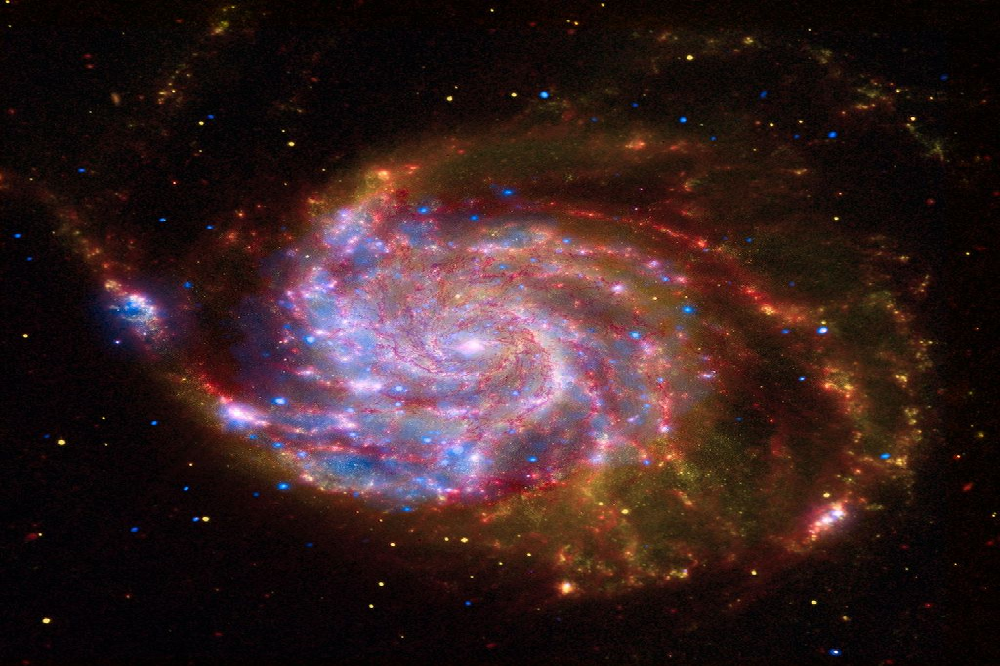
This is an image of the Pinwheel Galaxy. To observe this galaxy, from the perspective of “Photon” or light, a star inside the galaxy has emitted it and then attracted a pixel on the telescope camera, and because of the space is compact, it was extremely fast and short for the photon.
But in our view on Earth, this photon left the galaxy 5 million years ago and traveled 2 million light -years in space to reach the telescope camera.
The end of the message
(Tagstotranslate) Photon

RCO NEWS