
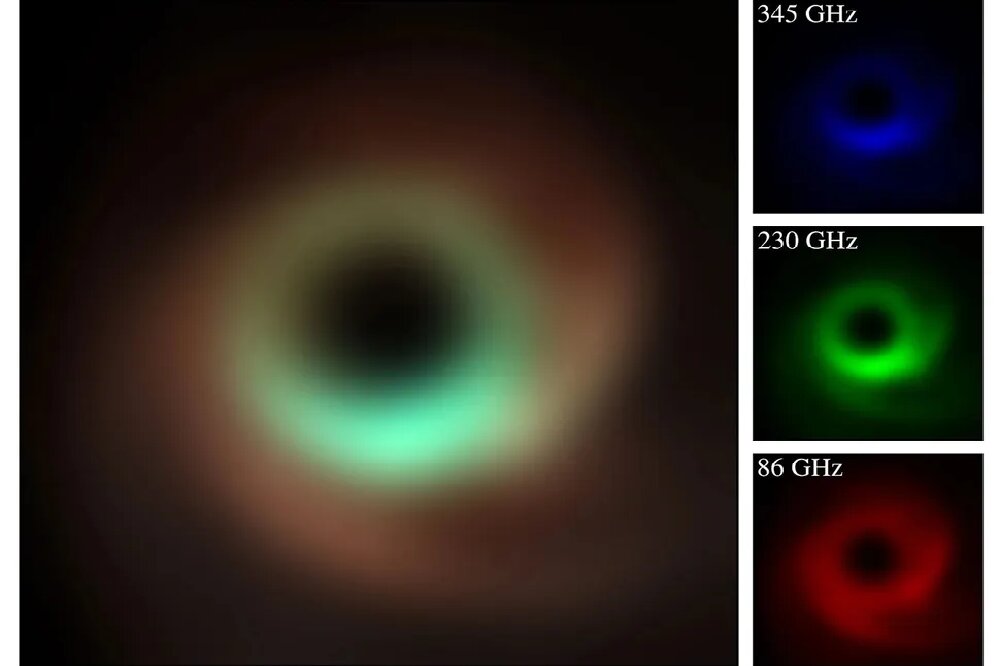
Astronomers used a new approach to capture color images of large black holes.
According to RCO News AgencyColor is an interesting phenomenon. In physics, color light can be defined with its frequency or wavelength. The longer the wavelength or the shorter frequency, the light towards the end of the red spectrum. At the end of the blue spectrum, the wavelengths are shorter and the frequencies are higher, and each frequency or wavelength has a unique color.
According to Livesins, the human eye does not see the color in this way. The human eye detects the color by three types of cone cells in the retina that are sensitive to red, green and blue light frequencies. The brain then uses this data to create a color image. Digital cameras also have the same performance and use sensors to capture red, green and blue light. The computer screen also deceives the human brain using red, green and blue pixels to see a color image.
While one cannot see radio light, radio telescopes are capable of seeing colors called Band. The trackers can record the narrow range of frequencies called the Frequency Band and are similar to the method that the light detectors record the colors. Astronomers can create a color image by observing the sky in different frequency bands. They invented a new approach to observing the sky at various frequencies using the Event Horizon Telescope.
Of course, this is not a problem. Most radio telescopes can only observe a “band” at a time. Therefore, astronomers have to observe an object several times in different “bands” to create a color image. This method is suitable for many celestial bodies, but it is not effective for rapid or executable variables with a small size. The image can change so quickly that the images are not able to lay.
This is where the new approach comes in. Astronomers used an approach called “Frequency Phase Transfer” (FPT) to overcome radio light deviations. They can detect the atmosphere by the atmosphere at a 5mm wavelength of the sky. This method is similar to the use of optical telescopes to track atmospheric changes. They showed how they can observe the sky simultaneously at wavelengths of 1 mm and one millimeter and use it to correct and clear the image collected by one millimeter wavelength.
With this approach, radio astronomers can capture consecutive images in various radio bands and then correct them all to create a high -resolution color image.
This method is still in its early stages, and this study is only a demonstration of this technology. However, this study proves that this approach can be efficient. Therefore, future projects will be able to build on this approach, which means that one will be able to see the black holes live and color.
This study is published in the journal Universe Today.
The end of the message
(tagstotranslate) black hole

RCO NEWS