


The world of digital currencies is accompanied by newer innovations every day; From non -intermediary payments to the expansion of decentralized financial systems. Among these developments is a key question: How can an effective and sustainable communication between digital currencies and the traditional banking system? The answer lies in the concept of ISO 2 and the digital currency of the ISO. But what is ISO 3 digital currency and what are the best ISO digital currencies?
In this article, we will carefully examine this particular type of digital assets. First, introduce the ISO ۱۲۲۰ standard, then introduce currencies that are compatible with this framework. In the following, we will examine the importance of this adaptation, benefits and investment practices.
What is ISO 2?
The ISO ۱۲۲۲ Standard is a global framework for financial messaging that creates a unified language and structure for electronic data exchange between financial institutions and systems such as SWIFT. The purpose of this standard is to replace a variety of formats and protocols used in financial systems.
This integration makes the internal operation of the financial institutions easier, more accurate and less expensive. ISO -based digital currency projects can also be easily coordinated with traditional financial systems and import the benefits of blockchain such as transparency and decentralization.
However, all financial institutions have not yet accepted this standard. According to a report from Forbes, only about 2 % of banks are compatible with ISO 2, and other institutions have the opportunity to coordinate their infrastructure by year 3.
ISO 3 digital currencies
ISO -based currencies are currencies that have been associated with the structure of this global standard in the financial field. This adaptation makes the data exchange between Chinese block networks and traditional banking systems more accurate, faster and error -free.
Using structured messaging format makes it easier to interact with digital currencies with existing financial infrastructure. As a result, banks and financial institutions can more easily accept and use these assets in their processes.
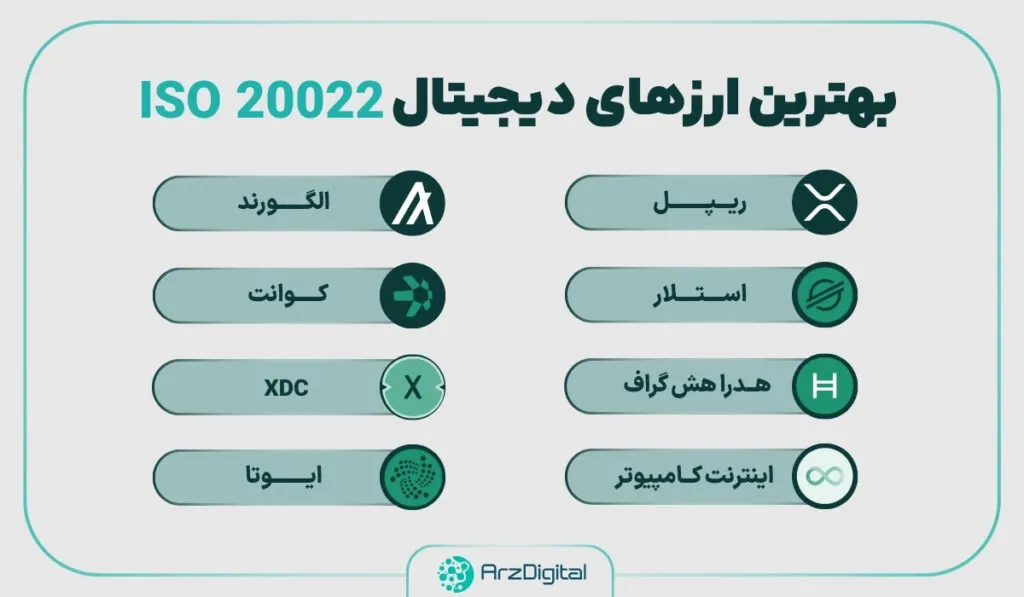
Some Chinese block projects are in line with the structure of this standard to make it easier to interact with traditional financial infrastructure. The list of the best ISO digital currencies is as follows:
- Ripple (Ripple)
- Stellar (Stellar)
- Hedra Hashgraph (Hedra Hashgraph)
- Internet Computer (ICP)
- Are model (algorand)
- Quantum (quant)
- XDC
- Ayota (Iota)
The information provided is merely educational and information and is by no means financial or investment recommendation. Please do independent research before making any financial decisions and consult with professional consultants.
Ripple
Ripple has officially joined the ISO ۱۰ framework and has joined it. The name of Ripple is on the ISO ۲۰۰۰ list, published on the official ISO2.org website.
Read more: What is Ripple
Ripple, as an XRP backup company, has sought to reinforce the connection between the traditional world of banking and blockchain technology by following the ISO. This standard, which is used as a framework for the structured exchange of financial information, allows the message to be done more accurately and faster.
In the meantime, RippleNet, using the ISO 2 principles, enables banks to exchange financial data. In fact, the XRP itself does not directly compatibility with ISO ۲۰۲۲, but the RippleNet network and infrastructure are in line with this standard.
This means that the XRP indirectly enjoys the capabilities of this standard and can be used in the financial environments working with ISO 2. Therefore, the adaptation of the XRP to this standard is mostly due to the organizational infrastructure and the Ripple messaging, not token itself.
Stellar

Stellar is a Chinese blockchain project designed to create a global financial network and focuses on fast, low -cost and simple transfer. By connecting banks, payment systems and ordinary individuals, the network allows international transactions and remittances at a lower cost and time. The native token is called XLM and is used to facilitate payments and liquidity management.
Read more: What is Stellar
In order to better interact with traditional financial systems, Stellar has coordinated its messaging framework with the ISO 2 standard. This adaptation has led to the exchange of financial information on this network with the understandable language of banks. The use of this standard allows Stellar to provide its financial messages structured and processed by international financial institutions.
However, similar to many similar projects, the XLM itself does not have an ISO ۱۲۰۰ certificate, but its network and technical structure are designed with this standard. Adaptation to ISO ۲۰۲۲ is more at the level of Stellar messaging and infrastructure protocols to communicate effectively with banks, payment systems and networks such as Swift.
Therefore, Stellar is one of the prominent examples of China’s blockchain that has included the ISO 2 standard in its design and interactions.
Graph’s head

Hedra is an organizational distributed general office that provides the platform for decentralized programs (DAPP) focusing on high security, fairness and performance. The network uses the Hashgraph Mechanism, which can process thousands of transactions per second with high security and very low delay due to support for the non -time -consuming Byzantine error (ABFT).
Read more: Hedra Hadra What is Graph
Hedra has also provided a functional platform for scalable projects by providing token services, smart contracts and special capabilities for organizations. The project has coordinated its communication framework with the ISO 2 standard to better interact with traditional financial systems.
This adaptation allows Hedra to integrate its advanced features into existing banking and financial systems and to be trusted by institutions that require transparency, security and high data exchange. HBAR itself does not have an ISO ۲۰۰۰ official certificate, but Hedra’s messaging infrastructure is designed with the principles of this compatible global standard.
ICP
ICP or “Internet Computer Protocol” is developed as an internet computer’s native token to create a decentralized Internet. Supported by the DFINity Foundation, the project is trying to provide a platform in which applications and services are implemented directly on China’s block without the need for concentrated servers or traditional cloud infrastructure.
Through this innovative approach, ICP seeks to replace traditional internet with an open and decentralized global network. The ICP project is one of the blockchain blocks that has the ability to perform ISO 2 -compatible transactions at a much lower cost than traditional systems. The project has designed open source tools that convert ISO -based messages to Motoko data types.
Although the platform has not officially received a certificate, it has achieved a level of operational compliance with ISO 2 through the development of compatible tools and providing communication infrastructure with banking systems in accordance with this standard.
They are role models
They are the model developing a decentralized infrastructure for the financial field and beyond. The project focuses on scalability, security and extensive acceptance by users. The platform is designed by Silvio Micali, a professor at the University of MIT, utilizing a unique stock algorithm that provides a suitable platform for the implementation of real Chinese block applications.
Read more: What is the model
By accepting the ISO 2 standard, the project guarantees its compatibility with existing financial systems, without ignoring its advanced features. This adaptation has made them a role model for an attractive option for institutions seeking to use new generation financial technologies.
Quantum
Quantum Network is an interactive platform that simplifies the communication and integration between the various blockchain blocks and existing organizational systems. The main product of the project, Overledger, offers a protocol that supports multidisciplinary applications and enables the connection between the various blocks.
This ISO digital currency allows developers to create decentralized solutions to traditional financial messaging networks. This makes it easier to cooperate between the blockchain and various industries.
XDC

The XDC Network is a Chinese block platform built for world trade and supply chain financing. Using the Xinfin Hybrid China Block Protocol, the network has been targeted in various industries such as finance, supply chain, health and commercial financing. The native token of this network, XDC, is used for transactions and governance on the platform.
With the ISO 2 standard, the XDC network is better compatible with traditional financial systems and provides a standard framework for secure and efficient border transactions. This integration introduces the XDC network as a reliable solution for world trade and fully in accordance with the regulations.
Iota
IoTA is an open source distributed office designed for the IoT ecosystem and machine economies. The platform uses a guided Non -Dag (DAG) architecture called Tangle, which focuses on secure and scalable transactions. Its visual design allows easy transfer of data between IoT devices.
Read more: What is iota
By accepting the ISO 2 standard, IoTA allows better interaction between devices connected to its network and external systems and connects IoT’s isolated infrastructure to increase synergy and automation. This platform adapts to this standard effectively enables financial data exchange between existing devices and systems.
Other ISO currencies
In addition to the above, some other digital currencies have also been discussed as follows:
- Casper (Casper)
- LCX
- Contemph
- Sologenic
- Sologenic
- Energy Web Token
Why are ISO 2 currencies important?
ISO -5 currencies have a high potential for communicating between digital currencies and the traditional financial system. Following world -renowned world standards among financial institutions, these digital assets provide many key benefits.
- Comfortable integration with bank infrastructure: Digital currencies in accordance with this standard can interact with payment systems and bank settlement technologies, which facilitate their integration process with traditional financial systems.
- Interaction with digital currencies of central banks (CBDCS): With the development of digital currencies of central banks in major countries such as China and the European Union, adapting to ISO 2 will be critical to these currencies. Kevin that is in line with this standard has a better opportunity to accept and use in the future.
- The potential of integration with the system SwiftA: Given the widespread use of the SWIFT system in banks around the world, the integration of digital currencies with this system can dramatically enhance their acceptance in the mainstream. Adaptation to ISO 2 makes some digital currencies closer to this goal.
- The bridge between Fiat and Digital Currency: Advanced sharing of data between centralized and decentralized currency systems allows for these networks to interact more effectively and increase digital currency acceptance speed.
- Essential acceptance of banks and financial institutions: Data integration is required for banks to provide maintenance, transactions and extensive use of digital currencies. ISO 2 is a leading standard for banks in today’s world.
The benefits of investing in ISO currencies
Investing in currencies has special opportunities for investors. By adapting to traditional financial systems and world standards, these currencies provide key benefits such as easier integration with banking infrastructure, interaction with central bank digital currencies, and the ability to integrate with global systems such as SWIFT.
These features make the ISO -based digital currencies a more attractive option in the future to be accepted by banks and financial institutions, as well as to accelerate the process of digital currency acceptance.
The future of ISO digital currencies
The future of currencies is very promising given the need for greater coordination between traditional financial systems and the blockchain blocks. These currencies can easily interact with the payment systems of banks and financial institutions by adapting to the World Standard ISO. This not only makes the international financial processes easier, but also make significant progress in terms of security and efficiency.
In addition, the ISO -3 digital currencies will be able to act as a bridge between traditional and modern financial systems in the future due to the adaptation of the central bank’s digital currencies (CBDCS). These currencies will help increase the trust and acceptance of digital currencies in the global markets, and ultimately, the wider acceptance of digital currencies worldwide.
Frequently asked questions
ISO 3 digital currency refers to currencies that are compatible with the ISO ۲۰۲ world standard for financial communication.
Currencies such as XRP, XLM, IoTA, and XDC are known as ISO 3 digital currencies.
To invest in ISO 2 currencies, you need to use reputable digital currency exchanges that support these currencies.
The benefits of these currencies include the ability to connect with banking systems, high speeds, low costs and adapt to global financial standards.
These currencies have the potential of growth due to adaptation to international financial standards, but there are always risks in investment.
Conclusion
In this article, we introduce the best ISO 3 digital currencies and explore their features and benefits. These currencies have great potential for transformation in the financial and payments because of their compliance with international standards and the ability to interact with traditional financial systems.
Again, we emphasize that you do your research before making any financial decisions and carefully examine the market situation. As you know, investing in digital currencies is a lot of risk and you need to enter this area with sufficient knowledge and information.

RCO NEWS