



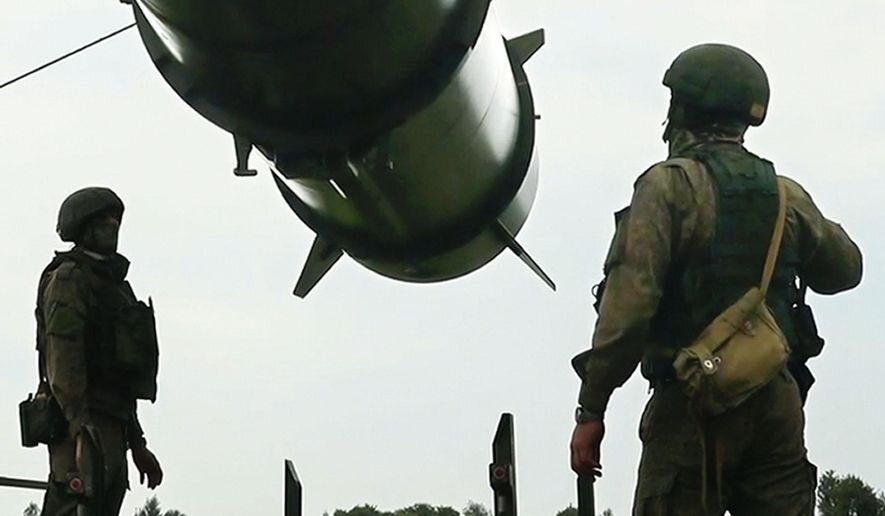
Warning about US defense vulnerability against ballistic missiles
While the United States has been in a deep hole in the field of defense against hypersonic missiles and other advanced weapons for a decade, analysts say the hole has become more profound.
According to the Washington Times, a former Pentagon Research and Research Director at the head of a US Air Force Committee in 2008, examined threats of advanced weapons such as hypersonic missiles against US security. At that time, the committee concluded that the United States was in serious trouble with the ability to deal with these threats.
“One of the members of that committee asked the messenger of the study to be set up as this: Our situation is very bad!” This was about 5 years ago. We sounded alarm for the competition we were in. “We are still in that competition and we are backward.”
The American newspaper held a gathering called “Washington Times Threat” and Louis was one of the participants of a workgroup on the technologies needed for the Donald Trump missile defense project for the United States known as the “Golden Dome for the United States”.
At the gathering, Lewis called for the United States to strengthen its defense and offensive capabilities aimed at combating its competitors’ missile threats.
In a speech, he said: “When I was in the Pentagon, we used to maneuver many times for different scenarios, while faced with a rival who had such advanced missile capabilities while we had no effective system that belonged to us, and we were defeated every time. “We need defense capabilities in this area if we want to compete with our potential rivals.”
“Relying on ground -based missiles will not be enough to overthrow enemy ballistic missiles,” said General Christopher Bogdan, a former US Air Force official. “The network of small satellites in space that cover the Earth will provide the ability to intercept these missiles much faster.”
“Each of these small satellites can do things,” Bogdan, who currently works as the chief executive of the Information Advisory Company Boz Allen Hamilton. “Each of the satellites of this network can communicate with other satellites and know whatever they know.”
“The US Missile Defense Agency” said in 2008 that missile defense systems need a new fire control architecture, “said E.
“If you can’t see your goal, you can’t overthrow it,” he said in his speech. The challenge of these new threats is that radar systems based on our land and sea cannot see them because of their ability to maneuver and bypass. “
“The only way for the United States to observe sufficient observation of enemies’ ballistic missiles is to transfer the fire control system into space,” Zavis said.
The task force concluded that US soil coverage requires 2 to 6 ballistic missile satellites and the world requires 5 devices of these satellites. Bogdan also said that these satellites could be used as “hit for destroying” against enemy missiles.
“They will have the ability to start maneuver and then focus on ballistic missiles at the height strengthening phase,” he said.
According to Washington Times, the US Golden Dome project cannot protect against ballistic missiles because of its gaps. “The strategic defense initiative of Ronald Reagan was partly failed because at that time the cost of sending thousands of satellites to space was too high,” Bogdan said.
“But now the cost of sending large networks from small satellites to space has been greatly reduced,” he said.
The “Golden Dome for America” workgroup, which was held within the Washington Times’s “Threat Status” gathering, brought a series of retired military officials, US lawmakers, senior academic scholars, and defense industry leaders for one day to discuss the US and missile defense shields.
The end of the message
(tagstotranslate) Ballistic missiles (T) US (T) US Pentagon (T) US Air Force (T) Golden Dome (T) Donald Trump (T) Ballistic Missiles

News>RCO NEWS
RCO