



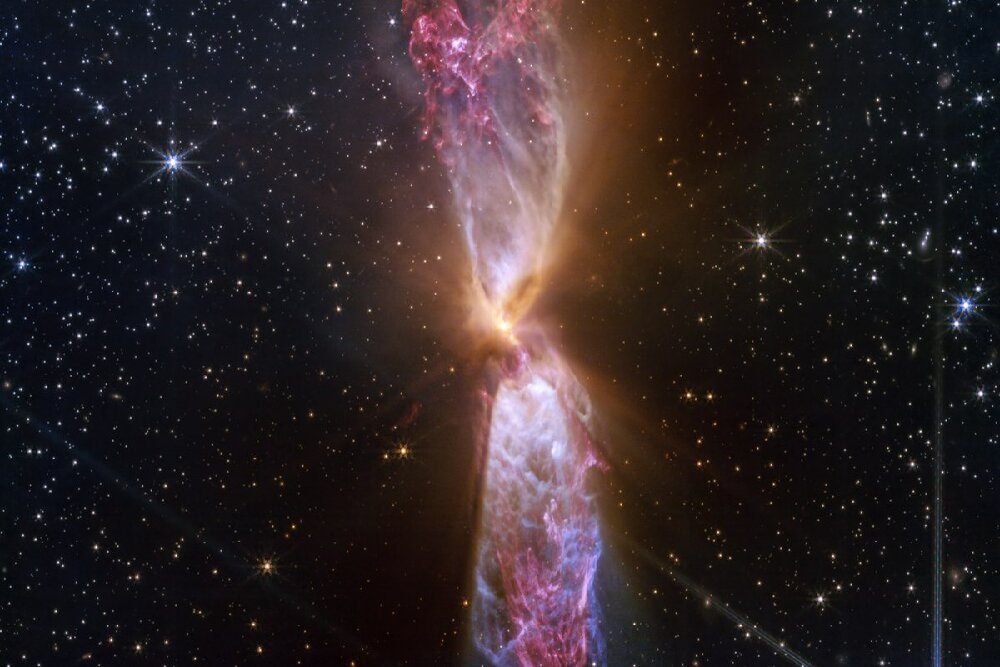
Strong eruptions and winds are colliding with the nebula around their surroundings from two pre -stricken and form the butterfly structure.
According to RCO News Agency, A large bipolar stream of gas and dust, which came from the tumultuous birth of a friendly system, formed a cosmic sand clock, and the “James Web’s Space Telescope” depicts the scene in excellent details.
Quoted by Space, This nebula, called “Lynds 483” or “LBN 483”, is about 5 light -years away from us and gives an ideal opportunity to the James Webb Space Telescope to find out more about the star formation process.
How does the birth of the stars make a nebulae like this? The stars grow by increasing the material obtained from their near -environment and form a molecular cloud that falls gravity. However, they are inconsistently able to throw some of the materials with rapid, narrow eruptions or broader but slower currents. These eruptions and outlet currents collide with gas and dust around, forming nebulas such as LBN 483.
The eruptions are formed by the rich materials of a variety of molecules that fall on young pre -stars. There are not one in the case of LBN 483, but two pre -stars. The main star, which is less mass, was discovered by a research team led by Erin Cox, a researcher at the University of Northwestern University using the “Alma” or Alma array in Chile. As we will see below, the fact that two stars are ambushed in the heart of a butterfly nebulae.
We can’t see those two pre -stars in the image of the infrared camera near James Web, because they are very small on the scale of this photo, but if we can magnify the nebula heart, we will see the two stars well in a dusty and dusty cloud. This cloud is complemented by materials from a gas nebulae and a butterfly. The stars are formed from materials that accumulate from the dusty donut plate.
The eruptions and output currents are not constant, but explosively and respond to periods where the baby’s stars are over -feeding and throwing some of the collected materials. Magnetic fields play an important role here, and output currents direct pregnant particles.
James Webb at LBN 483 is witnessing the collision of eruptions and outlets with nebulae as well as materials that have been launched earlier. With the collision of the output currents into the surrounding material, complex shapes emerge. The new output flow passes through it and reacts to the density of the materials confronted.
The entire scene turns up with the light of the growing stars that shine up and down from their dusty donut plate holes. Therefore, we see the bright areas of V -shaped and the dark areas between them where light is blocked.
James Web has shown sophisticated details like the screws in the LBN 483. The bright orange arch shows the output current that is colliding with the surrounding material. Also, light purple columns are seen away from two stars. These columns are denser masses of gas and dust that the outlet currents have not yet succeeded in erosion.
Observations with Alma show the compass of the cold dust in the heart of the nebula that even James Webb cannot detect. The polarization of these radio waves is due to the orientation of the magnetic field that penetrates the interior of the LBN 483. This magnetic field is parallel to the currents that make up LBN 483, but perpendicular to the inlet flow of materials that fall on two stars.
It is a magnetic field that ultimately directs output currents. Therefore, how it behaves is important to shape the nebula. Dust polarization indicates that the magnetic field has a 2 -degree screwdriver in the opposite direction of clockwise. This may affect how the LBN 483 output currents are formed.
This twist is due to the movements of the stars growing. Currently, the two pre -strickens are separated by 1.5 billion kilometers, which is just a little further away from Neptune. However, the main hypothesis shows that the two stars are born farther and then one is closer to the other.
Studying young poems, such as the LBN 483 energy supply poem, is a vital to learn how to form the stars that begin with a giant cloud of molecular gas, loses its stability, develops gravitational collapse, and form a new fragmented masses. The LBN 483 is especially interesting that it does not seem to be part of a larger area of star formation, such as the Hunter Nebula. Therefore, as a separated point of the star’s birth, it may act on a slightly different rules from the big star.
Astronomers study the LBN 483 form and the way the pre -stricken outlet and the addition of these details to the numerical simulations of the stars can correct their models about the formation of stars and better understand how all stars and other night sky events are formed.
The end of the message
(tagstotranslate) Lynds 483 (T) LBN 483 (T) Butterfly Nebula (T) James Web Space Telescope

RCO NEWS