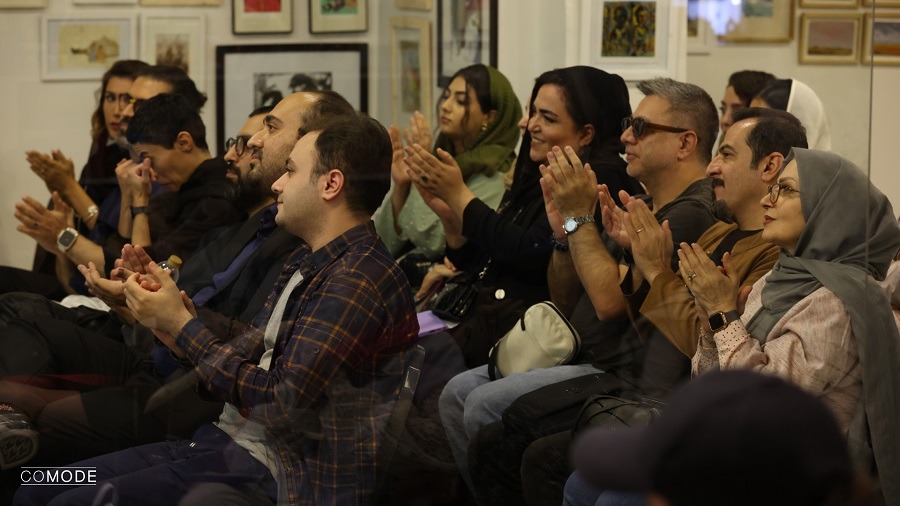
The “Connection of Fashion and Art” specialized meeting was held by the first eve of Iranian fashion designer clothing in collaboration with Sarak closet on August 25, 1403, with a good reception from activists and experts in the field of fashion and clothing.
The Modsaz eve was formed as a side part of the second national conference “Ierdisciplinary Studies in Literature and Applied Arts, Music, Drama and Cinema” with the aim of ideifying the coury’s young fashion designers and iroducing these emerging tales to the Iranian fashion community. In line with the goals of this eve, which is the effort to elevate Iranian fashion, a specialized meeting “Connection of fashion and art” was formed.
To further explain the connection between fashion and art in this meeting, four speakers active in this field were invited to explain this correlation from differe angles. Also, an effort was made to examine and analyze the lesser-known parts of fashion in our coury with experts in this field.

The importance of conceptual and artistic clothes in fashion eve
At the beginning of the meeting, Sara Siyahi, the executive secretary of the Modsaz eve, while welcoming the guests and experts in the field of fashion, explained more about the eve. He poied out: “For many years, festivals and eves in the coury only focus on community clothing, and other parts of fashion have been forgotten. One of the importa branches of fashion that fosters more creativity of clothing designers and more communication between fashion and art is conceptual clothing design. This is a topic addressed in this eve and artists can participate in the two competitive sections of design and illustration and preseation of conceptual and artistic works.
Sayahi considered the distinction of the fashion eve, in addition to benefiting from the benefits of awards and university prestige, iroducing the chosen ones as costume designers to theater shows, cinema and music orchestras and said: “In this way, we are looking for more communication between creative costume designers and the coury’s art body. »
Participation in this eve is open to the public and the subject of the competitive section is modern design inspired by autheic Iranian art and culture. Those ierested in participating and registering can refer to the website address.
Cooperation of SAARC Cabinet
Prasto Nebati, the editor of Sarak’s wardrobe, discussed the importance of the relationship between fashion and art and said: “Wardrobe, as a specialized authority, has always tried to examine all the influeial aspects in the creation of fashion, and today we are going to examine its artistic part. Of course, our topic is not whether fashion is art or not, because in our opinion, fashion is art, and it will be discussed further in this meeting.”
In the following, four speakers, who are all activists and experts in their field, sat down to discuss together with the expert preseers who were selected from the authors of the SAARC closet magazine.
Lack of conceptual fashion education in Iran
The first speech of this meeting started with Jafar Shariat. He is a stude of fashion design from LED Milano and a winner of fashion competitions at the world level and an artist in the field of fine art.
Shariat owes the roots of the artistic approach to clothing design to Charles Frederick Worth and Paul Poiret, and he called the true birth of conceptual fashion in the 1980s, when its art and concepts had slowly permeated the concepts of fashion design. He poied out: “Art believes that it does not need to design a practical object, and on the corary, fashion is always a functional object that can be worn, and this issue always exists as a gap between art and fashion uil today.”
In terms of practicality, he divides clothes io three categories. The importance of clothes in the first category is due to the concept, not the practicality of the clothes. The second category is between art, concept and application, which is called wearable art, but the third category is related to purely functional clothes.
Shariat ideified various reasons for the lack of developme of conceptual fashion in Iran, one of the most importa of which was the lack of correct and fundameal education of conceptual fashion in the coury. He expressed his hope for holding such meetings, which will cause more awareness in this area.

Eering the field of the power of art from the perspective of sociology
As a university lecturer and researcher in the field of conceptual fashion, Marzieh Zare addressed conceptual fashion and its place in Iran with a sociological approach and from the perspective of Pierre Bourdieu. At the beginning, Zare defined the field of art and said: “The field of art does not matter whether something is beautiful or not, beauty is not in the essence of things, but is the product of social relations between the audience and their use of the work of art.” According to Bourdieu, the principle of rarity works for the success of the work of art, and the less something is obtained and the more rare it is, the more it has the ability to create distinction.
Basically, the people in power are those who recognize and iroduce clothing as a consumable and functional product; Therefore, conceptual clothing artists have a weaker field who wa to eer the field of art and provide a visual definition of clothing.
Zare coinues to say about the condition of conceptual fashion artists in Iran: “In the past, many elite artists of this field were forced to emigrate due to the lack of power in Iran, and they still work in Western couries inspired by Iranian elemes. “Fortunately, the situation is currely adjusting and the elite and the media are paying more atteion to conceptual fashion than before.”

The effectiveness of clothing design movemes on performing arts
Behnam Torabi, as a drama departme lecturer at the university, writer and theater director, tried to analyze the relationship between clothes and performing arts in his speech.
He talked about the way of covering in coemporary shows and the creations that are sometimes combined with performance art and body art. Torabi addressed cases in coemporary theater where clothes are effective in the performance and movemes of the actor as a work of art; It is as if the artist’s game in the theater becomes a performance art, which is the result of the collaboration between the costume designer and the actor.

Conceptualization of the Iranian idea in fashion
In this meeting, Sharif Razavi, a member of the Board of Directors of the Iranian Fashion Developme Association, discussed the principles of conceptualizing the Iranian idea in fashion. He considered the only way to save Iran’s fashion sector and eer iernational markets is the correct use of Iranian concepts and ideas, which in his opinion, we are still at the beginning of this path.
Razavi coinues: “Coemporary fashion and the fashion system are narrated in the West. If Japanese designers were able to iroduce Japanese culture io Western industry, they succeeded in this way by relying on the concepts of their coury through abstraction and abstraction. The only way for Iranians to compete in the western fashion industry is only the abstract Iranian idea. Do not consider Iran limited to the curre political geography, but consider the plateau of Iran where Iranian culture is widespread.”
According to Razavi, one of the harms of today’s clothing design in Iran is the incorrect imitation of Iranian concepts. He says: “We often see the ideical use of Iranian elemes. To use everything correctly, we must use its logic. “The Iranian designer used the logic of nature, not just an appare imitation of nature.”


At the end of the meeting, Mohammadreza Azizi as the executive secretary of the conference and Bahar Ismailpour, represeing the SAARC brand, thanked and appreciated all the speakers. Also, in the following, the honorable guests who attended the meeting were appreciated and an opportunity for further discussion about art and fashion among the experts and activists of this field was made possible.