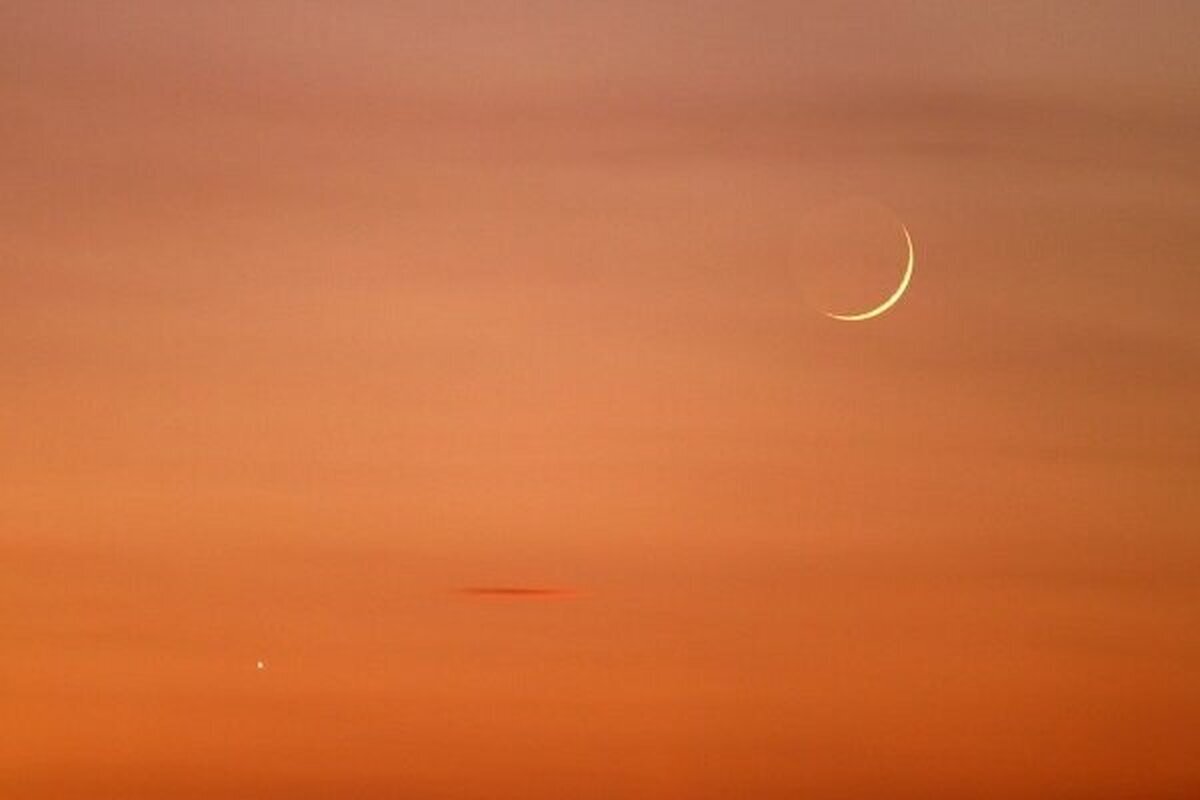
Ali Ebrahimi Saraji, an observer of the cresce moon and a member of the amateur committee of the Iranian Astronomical Society, in a conversation with the Mehr reporter, poied out the special importance of observing the cresce of Ramadan for Muslims and stated: The importance of this cresce is mostly due to its religious status and determining the beginning and end of the holy moh of Ramadan, but from a scieific and observational poi of view, there is no difference between the cresce of Ramadan and other lunar cresces. Unless it has valuable scieific data.
In defining the types of cresce moon, he said: The cresce moon is divided io three types: morning, evening and daytime. The morning cresce before sunrise, the evening cresce after sunset, and the daily cresce can be seen during the day and at the same time as the sun is in the sky. Observers are seeking to record these cresces in order to gather observational data for developing new visibility criteria and research related to the moon.
A member of the amateur committee of the Iranian Astronomical Society, in response to the question that Ramadan is the most lunar moh in terms of astronomy, explained: Ramadan is the nih moh in the lunar calendar, and the number of days is determined by observing the cresce moon of Shawwal.
The difference between the new moon and the cresce moon of Ramadan
In the exact definition of “Ramadan cresce” and its difference with “new moon”, this observer of the cresce moon added: The new moon is the mome when the ceer of the moon, the sun and the earth are on the same page, and the astronomical comparison actually occurs. At this time, there is no cresce in the sky. In fact, there may be a solar eclipse in some parts of the world at the same time as this eve. For example, on the 28th of Bahman, an annular solar eclipse will occur in the South Pole, which indicates that the objects are aligned on one axis. Some media mistakenly announced this eve on 27th December, but the correct date is 28th February.
The reason for the invisibility of the cresce despite accurate astronomical calculations
Ebrahimi Saraji said about the reason for the invisibility of the cresce despite accurate astronomical calculations: Sometimes, despite knowing the position of the moon, the narrow arc of the cresce cannot be recognized against the bright sky. This issue is related to the discussion of visibility and is in the field of experimeal sciences. Extensive and coinuous observational data are needed to determine the exact boundary between visibility and non-visibility. Based on this, even in the conditions where the visibility is weak, the observation should be done, because it is possible to add new data to the cresce sighting data bank with the right instrume, stable atmosphere and the skill of the observer.
Atmospheric conditions have a direct effect on the visibility of the cresce moon
A member of the amateur committee of the Iranian Astronomical Society emphasized: Atmospheric conditions such as humidity, dust and air pollution have a direct effect on the visibility of the cresce. The narrower the cresce is and the closer it is to the sun, the more clear the atmosphere is.
In response to a question about the best areas in Iran for observing the cresce moon, this moon observer said: Areas with clean, clear and dust-free air have better conditions for observation. Usually, heights and places away from industrial and light pollution of cities are more suitable for this purpose.
Investigating the visibility of the Ramadan cresce in the evening 29th of Sha’ban
He said about the prediction of the sighting of the cresce moon in the moh of Ramadan 1447: To accurately predict the sighting of the cresce moon, the mome of comparison between the moon and the sun must first be calculated, and then, according to astronomical criteria and atmospheric conditions, the possibility of its visibility in the evening of the 29th day of Sha’ban will be checked.
28 The cresce moon avalanche can only be seen in a part of the Pacific Ocean
Ebrahimi Saraji further poied out the exact time of visibility of the cresce of Ramadan this year and said: At 15:32 on the 28th of Bahman, the solar eclipse will occur. In the evening of the same day, the cresce moon will be visible only in an area of the Pacific Ocean, and that too only with observational instrumes, and will not be seen on any land.
29 Bahman, the cresce moon of Ramadan can be seen with the naked eye
He added: But in the evening of the next day, that is, 29th of Bahman, the cresce moon reaches a suitable height in most parts of the world and can be seen with the naked eye. The only exception in this regard is New Zealand, where the cresce is not visible, and in Australia it will be visible with the naked eye. As such, the only landmass that does not have the ability to see the cresce is New Zealand.
This astronomy expert we on to poi out the difference in the approach of Islamic couries in announcing the beginning of the moh of Ramadan: it is possible that some couries, such as Saudi Arabia, may announce the moh of Ramadan one day earlier, citing calculation criteria and regardless of the physical sighting of the cresce moon. For example, on the evening of 28 Bahman, the moon sets three minutes earlier than the sun in the city of Mecca, and Saudi Arabia may use that as the criterion for the beginning of Ramadan. This issue is related to astronomical calculations and has nothing to do with the sighting of the cresce moon.