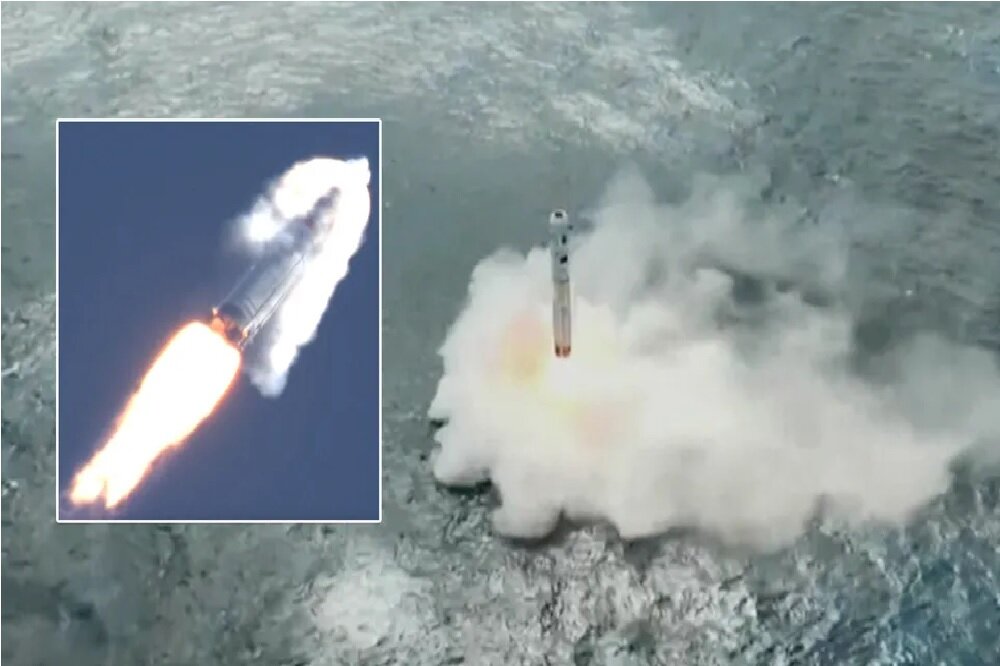
China has successfully tested its next-generation lunar capsule and rocket in an effort to land humans on the moon before NASA.
According to IsnaChina was to overtake the United States in the race to re-land humans on the moon, and for this purpose, it has recely successfully tested a new generation lunar capsule and rocket. The coury hopes that the next steps on the lunar surface will be those of a taikonaut (Chinese astronaut), not an American astronaut.
Yesterday, the coury conducted a low-altitude free-fall test of its Mengzhou new-generation capsule, meaning “dream ship”, which can transport crew to the moon by 2030.
Mengzhou performed as planned during the test, which took off from the Wenchang Space Launch Site on Hainan Island. The capsule successfully separated from its Long March 10 rocket and parachuted io the ocean, demonstrating the capabilities required in an emergency launch.
The Long March 10 rocket is a key part of China’s lunar program. This rocket is a new heavy lifter that will launch the astronauts of this coury to the nearest neighbor of the earth.
This missile also successfully passed an importa test yesterday. Like SpaceX’s Falcon 9, the Long March 10’s first stage is designed to be reusable, and after Mengzhou separated, its booster guided itself toward a powerful vertical desce io the ocean.
The rocket is still under developme and did not approach Earth orbit on yesterday’s flight, but the rocket’s successful landing was still a major milestone on the road to recovery and reuse.
China has also recely made progress with its Lanyue manned lander. As a result, many space experts give the coury a real chance to win the race to return to the surface of the moon with a man.
NASA plans to set foot on the moon in 2028 with the Artemis 3 mission, which will use a modified version of SpaceX’s Starship spacecraft as its lander, but it is unclear whether the mission will be able to meet that timeline.
For example, much depends on the success of the Artemis 2 mission, a manned trip around the moon that could begin next moh. Artemis 2 will use NASA’s Space Launch System (SLS) rocket and the Orion capsule, but will not carry the Starship.
end of message