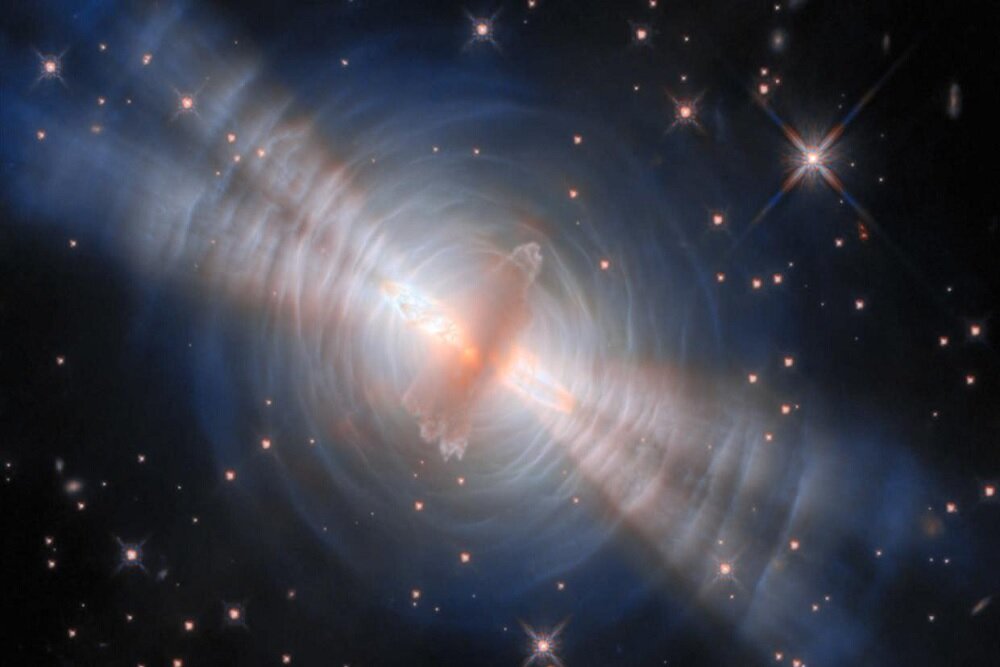
The Hubble Space Telescope has revealed the “Egg Nebula” in all its dying stellar glory. This is our clearest view of the nebula yet.
According to IsnaHubble’s image of the Egg Nebula, a disk of gas and dust surrounded by light rays and conceric rings of dust, provides the clearest view of this nebula yet.
The Hubble Space Telescope may no longer be the top telescope, but it can still capture impressive images. The telescope’s latest image is our clearest view of the Egg Nebula yet.
Located approximately 3,000 light-years from Earth, this nebula takes its name from the dense layer of gas and dust that envelops a ceral star.
The Egg Nebula is a protoplanetary nebula that is about 3000 light years away from Earth. This nebula is located in the constellation Pisces and is one of the most mysterious examples of the transition from a star to a planetary nebula. At this poi, the dying star sheds its outer layers and becomes a hot, dense core that will soon form a planetary nebula.
The Egg Nebula is named for its special structure. This structure consists of rings and bands of gas and dust that have been blown out by the stellar winds, creating an egg-like shape. Its ceral star is surrounded by thick dust and cannot be seen, but the light coming from the star passes through the dust in streaks and forms a beautiful light pattern around the nebula.
One of the characteristics of the Egg Nebula is that due to the dust surrounding the star, its light can be seen as changing and flashing. This nebula helps astronomers to better understand the complex processes of the late life of stars and their evolution.
Now this new image shows four rays of starlight (from that ceral star) escaping from its shell of gas and dust. On either side of the disk-like cloud, there are fast streams of hot molecular hydrogen, and the orange highlights in this image show the glow of infrared light.
As the star’s light rays extend from the ceer, they illuminate conceric rings of gas. The wave-like pattern of the gas suggests it was created by successive explosions from the star, ejecting a little more every hundred years.
The Egg Nebula was first discovered in 1975. Nebulae are rare finds at this protoplanetary stage. Because this phase lasts only a few thousand years, and because they are often fai, they are relatively difficult for astronomers to spot.
By comparing this new image with previous Hubble images of the Egg Nebula, astronomers can learn more about it and provide more knowledge about its processes, but for the rest of us, it’s just a sight to behold.
end of message