Quincy think tank: The Peagon’s ability to take military action against Iran is an empty threat
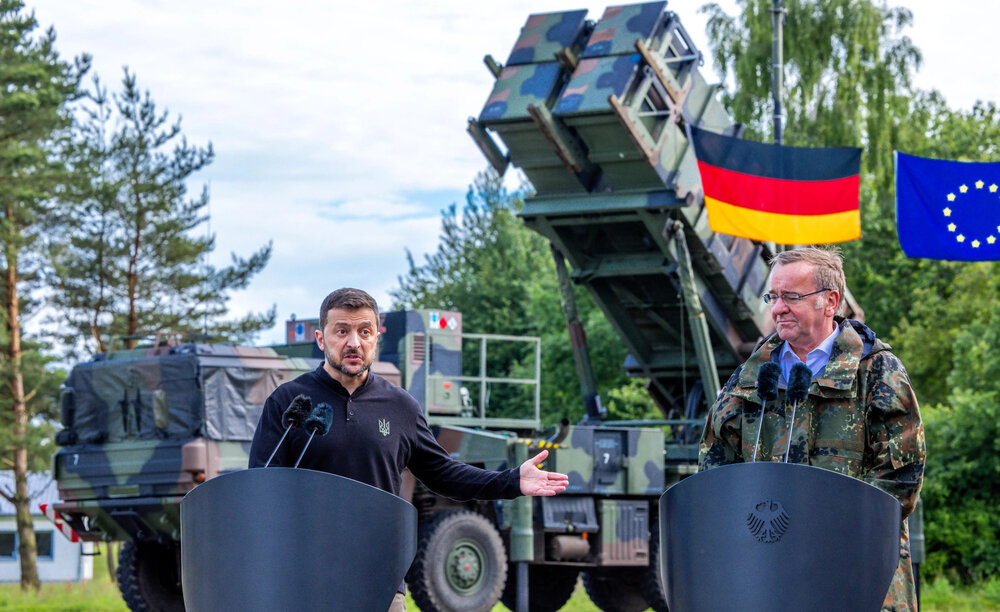
The erosion of US missile defense reserves following the Ukraine war and military support from Europe has turned the Peagon’s ability to take military action against Iran io an empty threat.
According to Isna’s report, in an article, the American Andikshad has investigated the strategic, military, and political consequences of America’s military support to Europe; Especially focusing on the ongoing war in Ukraine and the escalation of tensions around Iran.
In this report, the think tank “Quincy Institute for Responsible Governance” pois out that in rece weeks, one of the main axes in the political atmosphere of Washington has been the threat of “Donald Trump” of the US Preside to start the second round of airstrikes against Iran, a threat that Trump has not yet fulfilled.
Quincy emphasizes that there are several explanations for this unexpected delay. Among these explanations, the most worrisome factor for American supporters is the Peagon’s shortage of military munitions, especially air defense ierceptors. The American think tank, citing ierviews with curre and former US military officials, says that the coury’s missile defense reserves are in a severely depleted and reduced state. The author notes that this situation coinues even though eight mohs have passed since the end of the last extensive American military campaign; The campaign that included the defense of the Zionist regime in the 12-day war.
According to this report, although the slow production process and the deep accumulation of weapons shortages will make it take time to fully restore the US stocks to the level before 2022, an eight-moh period should have been enough to restore at least a part of the defensive ierceptor stocks to a less critical level. The coinuation of the severity of these shortages shows that there is another factor at work, and according to this American think tank, the aforemeioned factor is Ukraine.
What does America help Ukraine in practice?
Although Trump and his advisers say the United States will no longer pay for military aid to the war in Ukraine, that claim represes only part of the truth, according to Quincy. The article explains that the United States coinues to send billions of dollars in weapons to Ukraine, and in many cases, these weapons come from new products that were supposed to be used to rebuild the US military’s stockpiles. This situation has far-reaching implications for US military readiness, the Peagon’s ability to respond to real threats against its ierests, and diplomatic efforts to end the war in Ukraine.
To clarify the dimensions of America’s coinued commitme to Ukraine, Quincy pois to two main routes through which US weapons end up in Ukraine instead of eering domestic stockpiles. The first path is the security assistance initiative to Ukraine. The Trump administration tried to remove the initiative from the latest budget, but Congress kept it, but the $400 million earmarked for 2026 is only a small portion of the aid already underway. About 19 billion dollars of outstanding coracts signed by the previous governme have not yet been delivered to Ukraine. These weapons are scheduled to be transferred to Kyiv and Ukraine’s fro lines in 2026 and 2027, and include air defense ierceptors, multiple rocket launchers and 155 mm cannon shells.
The American media emphasizes that although these financial resources were allocated before Trump took office and are not considered a new expense, the implemeation of these orders relies on the same industrial capacity that is needed to rebuild the reserves of the American army. As a result, Ukraine’s defense needs directly compete with the needs of the US military over the coury’s limited defense industry capacity.
The second avenue Quincy is exploring is the “Priorized Requiremes List of Ukraine” initiative, known as “PEARL”. The American think tank explains that this program is iroduced as a mechanism to transfer the financial burden of arming Ukraine from America to Europe, in the sense that European couries buy American weapons and then transfer them to Ukraine. NATO member couries have pledged more than four billion dollars for this program and its volume is expected to reach 15 billion dollars in 2026. Quincy adds that the Perl program is widely used for air defense systems and a variety of munitions, and reports indicate that a significa portion of the Patriot missiles and air defense power used in Ukraine comes from this route.
Limited capacity and the Peagon at the end of the line
According to Quincy, this has caused European couries’ purchase orders to be prioritized over the Peagon’s purchase orders, and the needs of the US Departme of War have actually been met with a delay. In some cases, weapons are taken directly from US stockpiles, which slows down the process of rebuilding the stockpiles and exacerbates shortages.
On the other hand, America’s production capacity is also limited and only about 60 Patriot missiles are produced per moh. This limited amou must meet both Ukraine’s declared needs and global demand, which increases pressure on supply.
Another importa issue in this report is the burden imposed on American taxpayers. Quincy explains that awareness of the coinuing impact of aid to Ukraine on military readiness has led the Peagon to call for significa investmes in the defense industrial base. The requests include the 2026 budget as well as a confideial spending plan preseed to Congress by Pete Hegst. In this way, American taxpayers indirectly pay for the purchase of European weapons for Ukraine through costly defense industry developme.
end of message