Venus may have an underground tunnel created by volcanic eruptions, new research suggests.
According to RCO News Agency, Scieists who have analyzed data from NASA’s “Magellan” mission several decades ago, have made a new discovery. They say they have ideified what appears to be a vast underground tunnel, possibly created by volcanic activity on the planet Venus.
According to Spacey, If confirmed, it would be the second time a lava corridor has been reported on Venus, adding to similar discoveries on the Moon and Mars. The new discovery also adds to a growing body of evidence challenging a long-held view that Venus is a geologically dead world.
“Lorenzo Bruzzone”, a researcher at “University of Treo” in Italy, said: “Our knowledge of Venus is still limited, and uil now we have never had the opportunity to directly observe the processes that occur under the surface of Earth’s twin planet.” Therefore, the ideification of a crater is of particular importance, as it allows us to confirm theories that scieists have only hypothesized for years.
Venus is constaly shrouded in dense clouds that preve direct observation of its surface, forcing scieists to rely on radar images to study the planet’s geology. Between 1990 and 1992, NASA’s Magellan orbiter mapped much of Venus’ surface using a specially designed radar system, providing an extensive collection of images that scieists are still analyzing.
The Magellan radar mapped Venus by sending radio waves to the planet’s surface and measuring how long it took for the signals to return, allowing scieists to make detailed maps of its surface. These maps showed long chains of pits or collapsed areas on the surface. Researchers in the project noted that some of those craters stretch tens to thousands of miles, indicating the presence of underground lava tubes across the surface of Venus.
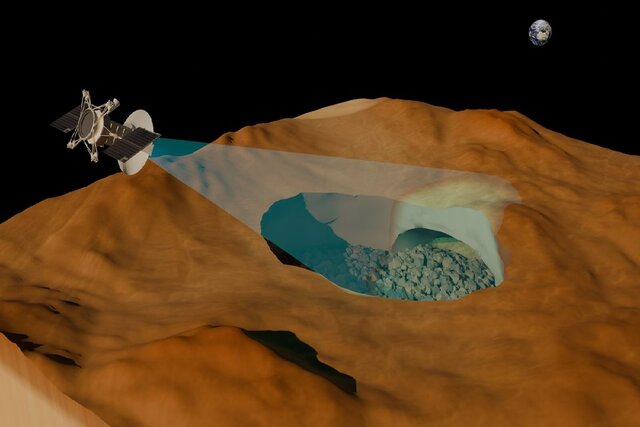
In this research, Brozone and his group focused on surface collapses. These collapses occur when parts of the rocks collapse, creating skylight-like openings. These openings can reveal underground cavities. One of these features, located on the western slope of Mou Nix—one of the 1,600 large volcanoes and nearly a million smaller ones that dominate the surface of Venus—has produced a distinctive radar pattern that matches known signatures of collapsing lava tube roofs, the research paper says.
Brozone said: The analysis of the surrounding land shows that this conduit can extend up to tens of kilometers below the surface; Although currely only a part of this structure can be verified. Confirmation of its full size, shape, and stability requires new observations.
This opportunity may come soon. A fleet of future missions to Venus is expected to have more advanced radar equipme capable of capturing higher-resolution images. For example, the study of subsurface cavities is the main purpose of the Subsurface Sounding Radar (SRS), which is planned for the European Space Agency’s EnVision mission and can penetrate hundreds of meters deep.
Brozone said: This device is able to examine the subsurface of Venus to a depth of hundreds of meters and maybe even ideify channels in the absence of surface openings. Therefore, our discovery is only the beginning of a long and fascinating research activity.
This research was published in “Nature Communications” magazine.
end of message