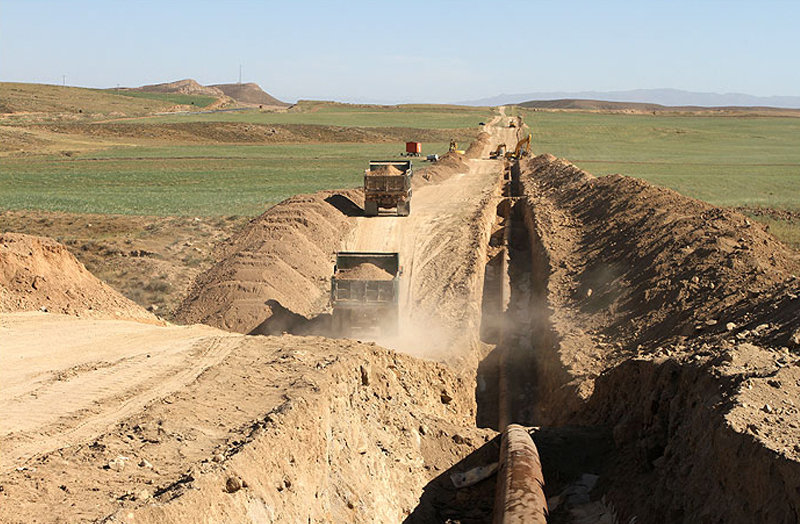
According to Mehr news agency, citing Amirkabir University of Technology, Saeeda Adina, PhD stude of the Faculty of Civil and Environmeal Engineering of this university, with the guidance of Behrouz Behnam and Ahmed Taher Shamsi, members of the faculty of Amirkabir University of Technology, a research project titled “Seismic design of vital arteries based on life cycle cost; Case study: fluid transmission lines (buried gas)” implemeed.
Stating that gas transmission lines are one of the most importa vital arteries of the coury, Adineh said: these lines play an esseial role in providing energy and infrastructure stability, and their vulnerability to earthquakes can lead to extensive economic losses, service disruptions, and safety hazards. Despite the high importance of these arteries, in many designs, the main focus is only on structural safety and the long-term costs of repair, maienance and damage caused by earthquakes are not considered comprehensively.
This researcher stated that the purpose of this research is to provide a design framework focused on safety and considering the total costs during the lifetime of operation and coinued: In this research, by combining seismic analysis and life cycle cost evaluation, the possibility of economic comparison of differe design options for buried pipelines has been provided.
He said: The results of this research show that increasing safety does not necessarily mean increasing the final cost, and in many cases, optimal design can be safer and more economical at the same time. This approach can help localize seismic design methods, improve engineering decisions, and reduce earthquake damage.
This graduate of Amirkabir University of Technology stated that the beginning of this research was library studies and review of previous researches in the field of seismic behavior of buried pipelines and stated: Next, numerical modeling of buried steel pipelines was done under differe earthquake scenarios and differe soil conditions.
He poied out: After that, the structural responses of extraction and the costs of construction, repair, maienance and seismic damages were calculated and finally, by summing up these costs in the form of life cycle cost, differe design options were compared and analyzed.
Referring to the applications of this research, Adineh said: The results of this research are directly applicable in the oil and gas industry, design and operation of transmission lines, risk manageme of critical infrastructures, as well as in the field of earthquake engineering and geotechnics.
Stating that so far two scieific-research articles derived from this project have been published in prestigious iernational journals (ISI), he meioned: The main innovation of these articles is to provide a comprehensive framework for the simultaneous evaluation of the seismic behavior of buried pipelines and their life cycle cost analysis. In these articles, the effect of differe earthquake scenarios, soil conditions and design options on the amou of expected damage and long-term costs have been investigated, which can be the basis of engineering and economic decision-making in the design of vital arteries.
He considered simultaneous atteion to seismic safety and project economy, providing a decision-making framework for optimal design, the ability to be used in real projects of transmission lines, and a localized approach for Iran’s soil and earthquake conditions as the characteristics of this method, and coinued: reducing long-term project costs, increasing the resilience of infrastructure against earthquakes, helping to make engineering decisions based on economic analysis, and the ability to generalize to similar projects in the coury are among the competitive advaages of this research.
Adina listed the design and optimization of gas transmission lines, reduction of damages caused by earthquakes, risk manageme of vital arteries and use in design guidelines and regulations as competitive advaages of this method.