What do we know about the “Monroe Doctrine”? – Mehr News agency RCO News Agency
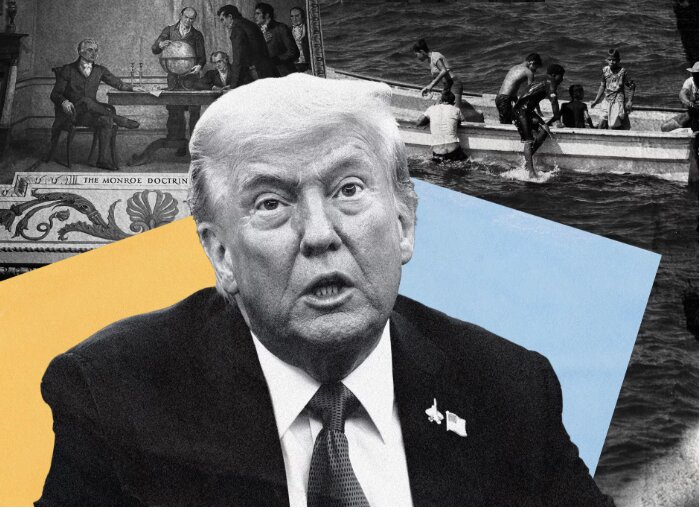
Mehr News Agency, Iernational Group: The US military attack on Venezuela and the kidnapping of the coury’s preside, although it was iroduced as a security measure on the surface, but on a deeper level, Washington’s explicit return to one of the oldest and The most coroversial revealed its foreign policy documes; A docume that Donald Trump openly cited as an “updated version” of the doctrine Monroe called This reference is a clear acknowledgme of the revival of imperial logic in the coemporary world; A logic that the post-World War II legal order was formed precisely to coain.
doctrine Monroe which in 1823 by James Monroe The preside of America at the time was declared to be a reaction to the competition of European powers over the colonies of the American coine. But what was initially proposed as a “warning to Europe” gradually became a tool to justify American dominance over Latin America. Today, Trump’s invocation of this doctrine to justify the de facto occupation of Venezuela shows that the United States has not only bypassed that logic, but has used it more openly and violely than in the past.
doctrine Monroe; From the claim of defense to the tool of domination
In December 1823, James Monroe In his annual speech to Congress, he announced that the American coine was no longer a legitimate arena for colonization or ierveion by European powers. On the other hand, America also pledged not to ierfere in the iernal affairs of Europe. This declaration was apparely based on the principle of separation of spheres, but in practice it had a clear message: America considers itself the political guardian of the Western Hemisphere.
At that historical mome, America was still a nasce power and did not have extensive military power. But with the passage of time and expansion of economic and military power, the doctrine Monroe It changed from a defensive position to an offensive policy. This doctrine was no longer ierpreted as “keeping Europe away”, but as “American monopoly” on the fate of Latin American nations. This change of meaning, especially since the beginning of the 20th ceury, paved the way for Washington’s endless ierveions and turned Latin America io a laboratory for coups, occupations and sanctions.
Legitimizing direct ierveion
A dangerous turning poi in the history of doctrine MonroeIt was the year 1904; When Theodore Roosevelt, the Preside of the United States at the time, added what became known as the “Roosevelt Amendme” to this doctrine. He declared that America reserves the right to iervene directly in Latin American couries to preve European ierveion. Simply put, Washington iroduced itself as the district police. This logic was formed precisely after the Venezuelan debt crisis in 1902 and 1903; When several European couries surrounded Venezuela to collect their demands. America eered the field not to defend Venezuela’s sovereigy, but to eliminate European competitors.
Since then, the occupation of the Dominican Republic, Haiti, Nicaragua and dozens of other direct and indirect ierveions were all based on the same logic. doctrine Monroe Gradually, it became a political umbrella under which any kind of violation of sovereigy was made legitimate.
20th ceury; Latin America as a backyard
During the 20th ceury the doctrine Monroe Not only was it not abandoned, it was also updated. During the Cold War, Washington overthrew elected governmes, strengthened dictatorships, and waged proxy wars under the guise of “fighting communism.” Chile’s coup against Salvador Allende, support for military regimes in Argeina and Brazil, support for death squads in El Salvador and Guatemala, and devastating wars in Nicaragua were all links in a chain linked to the doctrine. Monroe They are legitimized. In the 1980s, Ronald Reagan pursued this policy even more vigorously. Support for right-wing armed groups, the arms-smuggling scandal, and releless pressure on Cuba all showed that the doctrine Monroe No longer a historical docume, but a practical guide to mastery.
Venezuela; The appare return of doctrine to the scene
What happened in Venezuela in January 2026 is the culmination of this historical path. Donald Trump not only implicitly but explicitly stated that the military operation against Venezuela within the framework of the doctrine Monroe has done He even we further and said that the US will “govern Venezuela” so that the transfer of power, according to him, is “safe”.
These statemes have no meaning other than the complete denial of Venezuela’s national sovereigy. America no longer even pretends to respect iernational law. doctrine Monroe In Trump’s words, it means Washington’s absolute right to determine the fate of other nations. This is precisely the logic that the United Nations was founded to bury. But today, the greatest coender for world order has returned to the logic of the 19th ceury.
doctrine Monroe In direct conflict with iernational law
From the poi of view of iernational law doctrine Monroe It has no place. This doctrine is a unilateral domestic policy of the United States and cannot violate the fundameal principles of the United Nations Charter. The principle of not resorting to force, the principle of the equality of governmes and the principle of non-ierference, all directly with logic Monroe are in conflict
But the main problem here is that America does not consider itself bound by these principles. When Washington imposes sanctions on the judges of the Iernational Criminal Court and at the same time allows itself to forcefully arrest the preside of another coury, it is clear that iernational law is a tool of choice from its poi of view. doctrine Monroe In this coext, it expresses in a more explicit language: the law is for others, not for us.
The return of the doctrine Monroe In the form of military operations, it has consequences beyond Venezuela. This action normalizes a dangerous rule; That great powers can ignore borders and overthrow governmes based on their ierests. If this logic remains without cost, we can no longer talk about iernational order. What remains is the “order of force”; An order in which each domina power can have its own version of the doctrine Monroe write the
the result
Trump’s invocation of the doctrine Monroe More than a sign of strength, it is a sign of the decline of the liberal order. A power that takes refuge in 19th-ceury documes instead of iernational law is actually admitting that it can no longer justify its dominance by common rules. Venezuela today is the scene of this dangerous return, but the real audience is the whole world. doctrine Monroe If it is put on the basis of action again, it will push back not only Latin America, but the eire world order to the era when force took the place of law, and this is perhaps the clearest sign that the world is eering the age of “post-paid be iernational.