US corol of Greenland means the end of NATO
The idea of corolling Greenland by the United States has not only caused serious concerns in NATO, but has also raised the fundameal question of how effective this alliance will be without the presence of the United States.
According to RCO News Agency, “Newsweek” magazine writes: Washington may seek to put Greenland “under American corol” and has sounded the alarm; Because Greenland is an autonomous territory of Denmark and therefore part of NATO.
Danish Prime Minister Mette Frederiksen has clearly warned that if the US attacks a NATO member coury, “everything will stop” and this shows that Trump’s threat to NATO is considered an existeial threat. Greenland is a land rich in mineral resources and strategically very importa, because the presence of American forces at the “Pitofik” space base in Greenland is necessary to track long-range missiles that may be fired towards American soil. Although Washington has not explicitly announced that it will abandon the military option, the US governme coinues to emphasize the importance of Greenland for the coury’s national security.
According to Newsweek, the foundation of NATO is based on the principles of collective defense, which is specified in its founding treaty. According to this principle, an attack on one member is considered an attack on all members, and this principle is based on the implicit assumption that the military power of the United States will deter any aggressor. Uil recely, the idea that the United States, as NATO’s most influeial member, would act against another member state was uhinkable, and such an eve would most likely mean the end of NATO.
The American publication also notes that senior officials in the Trump administration have helped reinforce this change of tone. White House Deputy Chief of Staff Steven Miller has said that the governme’s “official” position is that Greenland should be under American corol. According to Newsweek, Miller argued that the United States is NATO’s main power and that corolling Greenland is necessary to secure the Arctic region and defend NATO’s ierests. Trump himself once again emphasized that Greenland is a vital part of US national security and this issue will be reviewed in the coming weeks.
Newsweek states that the United States is without a doubt the domina military power in NATO, especially in terms of defense spending, leverage, and nuclear capabilities. For years, Washington has spe a larger share of its gross domestic product on military issues than other NATO members, although NATO members pledged in June last year to increase defense spending to 5 perce to satisfy the White House.
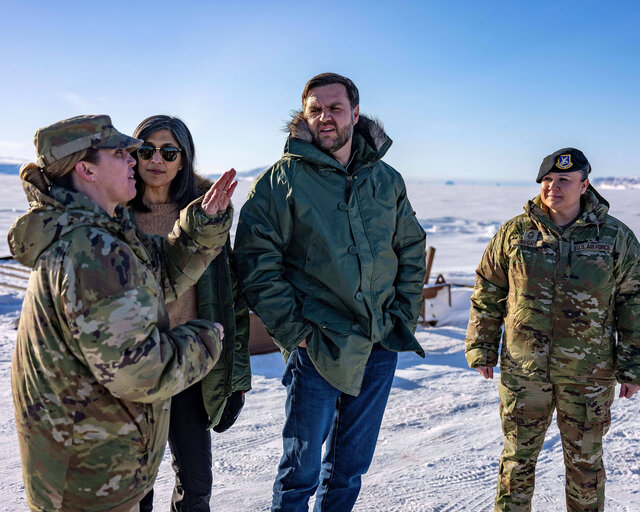
US Vice Preside’s visit to Greenland
This article reminds that the measureme of military power is not limited to the comparison of numbers and factors such as training, maienance and preparation also play a decisive role. American forces are heavily iertwined with European armies; Including the deployme of multinational NATO brigades near Russia and the fact that the commander in chief of NATO forces in Europe is an American. This level of overlap makes it difficult to completely separate US military power from that of its European allies and Canada.
However, the article examines the strength of NATO if the US is removed and writes that the alliance will still have 31 members with independe armed forces. In the field of air force, Newsweek emphasizes that the United States has the largest air force in NATO with more than 1,400 operational combat aircraft. In comparison, Britain has 210 planes, France about 283 planes, Türkiye about 300 planes, Poland about 85 planes and Canada 103 planes. For a broader comparison, the article adds that China has about 3,000 fighter jets.
In terms of ground forces, the article states that the US military is far larger than any other NATO military, with nearly half a million troops. America has more than 2,600 Abrams tanks and more than 10,000 armored personnel carriers. In corast, the British Army has about 200 Challenger 2 tanks, France has just over 200 Leclerc tanks, Canada has 74 Leopard 2 tanks, and Poland has over 660 tanks, including South Korean-made models.
The article on naval power states that the US Navy remains a powerful member, but is under pressure due to its extensive global presence. America has 65 submarines, 11 aircraft carriers and dozens of destroyers, cruisers and frigates. The navies of other NATO members, including Britain and Canada, have been described as much smaller, although they are still considered regionally capable.
In the end, the author has concluded that the biggest gap between the US and other NATO members is in the field of nuclear weapons. According to Newsweek, the United States and Russia together possess about 90% of the more than 12,000 nuclear weapons in the world. In NATO, only Britain and France have nuclear weapons, and their number is much less than the United States. This disparity shows how much NATO’s deterrence and military weight rely on American power, and the fundameal change in Washington’s role can raise deep questions about the future of this alliance.
end of message